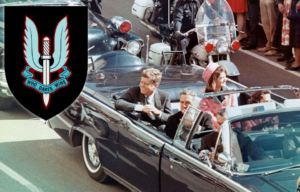
What did the Special Air Service (SAS) look like in 1963?

Founded in 1941, the Special Air Service (SAS) was an elite British regiment created to carry out irregular operations during the Second World War. Disbanded at the end of the conflict, it was reformed in 1947.
The SAS’s role during the Cold War world wasn’t initially well defined. Its troops were deployed in successful operations across Asia, most notably in Malaysia, where operatives fought a grueling jungle war against Communist rebels, while going on to win over local support in a hearts and minds campaign.
The SAS wasn’t yet well established. It hadn’t earned the high public profile it would gain in the 1980s, and some senior figures in the British Army were dubious about this band of misfits. It boasted unusual operating procedures and troops who judged officers by their actions, rather than their rank and authority.
A small unit that had already been disbanded once, the cost of the SAS meant its future was far from secure.
Shockwaves from Dallas, Texas

On November 22, 1963, gunfire rang out over a crowd in Dallas, Texas, as John F. Kennedy was fatally shot while riding in his motorcade. The assassination of John F. Kennedy became one of the most shocking moments in modern American history, sending waves of disbelief across the nation and beyond.
The impact was felt worldwide. If the leader of one of the most powerful countries could be killed in such a manner, it raised serious concerns about the safety of other heads of state. Political leaders—from elected officials to monarchs—began reassessing the effectiveness of their own security arrangements.
At the time, only a limited number of countries, including the United States and the Soviet Union, provided formal bodyguard training to allied nations. Many Western-aligned leaders relied on personnel trained by the Americans, but the assassination cast doubt on those methods. In response, governments around the world began seeking alternative sources for advanced protective training.
Special Air Service (SAS) begins offering close protection

The Special Air Service established close protection training during the Cold War. Instead of using an established approach, it created one from scratch, drawing on the organization’s experience in irregular warfare. Troops had done this work from the other side, finding ways to attack well-protected targets, and they turned what they’d learned on its head. They wrote out rules and began a process of constant improvement that allowed them to evolve their techniques down the years.
The SAS’ approach to bodyguard-ing was different from that of the Americans. The US Secret Service valued large numbers of highly visible agents as a deterrent and a barrier around the target. The SAS taught an approach that used smaller groups who were less visibly placed. Its operatives knew from experience that an attacker’s biggest worry wasn’t the guards they could see. Instead, it was the ones they couldn’t.
In the aftermath of JFK’s assassination and an attempted assault on Princess Anne and her husband, Mark Williams, the British Foreign Office and MI6 quickly reached out to friendly world leaders. The United States, which had long overshadowed its trans-Atlantic cousins, had been publicly shown to be vulnerable. The United Kingdom was offering an alternative.
How does intelligence come into play?

Special Air Service (SAS) and international relations

The early 1960s and ’70s were a period of waning power for Britain. The Cold War had solidified a lesson from World War II: the nation, while influential, was now a second-tier global power, behind the United States and the Soviet Union. Pressure from within and other international leaders was forcing the country to give up its colonies, restoring freedom to nations that had spent decades or even centuries under British rule.
Bodyguard training from the Special Air Service provided an inexpensive, yet key tool for maintaining Britain’s influence. It became a favor the Foreign Office could offer leaders across the United Kingdom’s former colonies and throughout politically sensitive regions, such as the Middle East.
The success of the SAS’ operatives ensured a steady stream of business and, with it, diplomatic coups for the Foreign Office. They were tools used to improve relations with Kenya in the aftermath of its bitterly contested independence, and they also allowed the UK to garner influence with the Shah of Iran.
JFK’s assassination secured the Special Air Service’s (SAS) future

In a difficult time, the Special Air Service’s role in bodyguard training gave the military organization a vital and important place in United Kingdom’s diplomatic toolbox. It ensured favor with politicians at home and abroad, making it much more simply a team of secretive Commandos.
More from us: The True Story Behind the Cold War’s Most Iconic Photograph
That dark day in Dallas had forever shaped the future of the SAS.