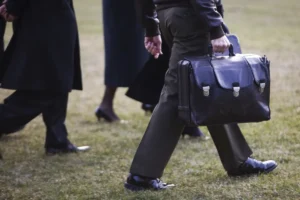
Somewhere near the President of the United States right now, a mid-grade military officer is carrying a black leather briefcase. This officer isn’t a cabinet member or a general, but they are perhaps the most shadowed person on Earth, following the Commander-in-Chief into elevators, onto stages, and even into secure hospitals.
Formally known as the Presidential Emergency Satchel, everyone else knows it as the “Nuclear Football.” It is the ultimate symbol of American power—and the most dangerous piece of luggage in history.
1. The Cuban Missile Crisis Origin

The Football wasn’t born out of a desire for power, but out of a fear of chaos. Before 1962, the authority to launch nuclear weapons was dangerously decentralized. During the Eisenhower era, some individual tactical commanders actually had the “pre-delegated” authority to use nukes if they felt a strike was imminent.
After the Cuban Missile Crisis brought the world to the brink of extinction, President John F. Kennedy was horrified at how easily a rogue or panicked officer could start World War III. He demanded a system where only the President—and no one else—could authorize a launch. The “Football” became the physical manifestation of that singular control.
2. What is Actually Inside? (It’s Not a Red Button)

Hollywood has spent decades convinced there is a large, glowing “Launch” button inside the case. The reality is far more bureaucratic and chilling. According to sources, the Football contains four key items:
- The Black Book: A 75-page menu of strike options printed in black and red ink. It outlines “Limited” vs. “Major” nuclear responses.
- The Bunker List: A guide to secure, hardened locations across the U.S. where the President can be relocated.
- The Communications Folder: Instructions for the Emergency Broadcast System (EBS) so the President can address the surviving population.
- The Authentication Card: A small sheet of paper containing the “Gold Codes.”
3. “The Biscuit”: The 76.2mm of Nuclear Security

While the aide carries the Football, the President carries the “Biscuit.” This is a credit-card-sized piece of plastic containing the active codes for the day.
When the President calls the National Military Command Center to order a strike, he doesn’t just say “Fire.” The Pentagon will issue a “Challenge Code” (e.g., “Delta-Echo”). The President must then look at his Biscuit and provide the corresponding “Matching Code.” This proves the person on the phone is actually the Commander-in-Chief.
4. Close Calls: When the Codes Went Missing

Despite being the most important items on the planet, the “Biscuits” have a habit of disappearing:
- Ronald Reagan: When Reagan was shot in 1981, his clothes were cut off by ER doctors. The “Biscuit” was stuffed into a plastic bag with his bloody hospital scraps and went missing for hours before the FBI recovered it.
- Jimmy Carter: Legend has it Carter once accidentally sent his suit to the dry cleaners with the Biscuit still in the pocket.
- Bill Clinton: General Hugh Shelton, former Chairman of the Joint Chiefs of Staff, claimed that Clinton lost his codes for several months in 2000, allegedly telling aides he couldn’t find them when it was time for the routine monthly swap.
5. The Three Footballs

The U.S. never relies on just one briefcase. There are always at least three in circulation:
- The Primary: Travels with the President.
- The Backup: Travels with the Vice President (in case the President is incapacitated).
The Reserve: Stored securely at the White House for the “Designated Survivor” during events like the State of the Union.