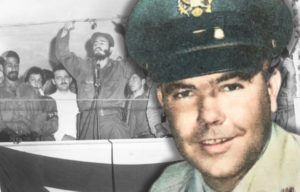
Photo Credit: 1. Hulton Archive / Getty Images 2. CIA (Colorized by Palette.fm, Contrast Increased)
In 1961, as the Bay of Pigs Invasion unraveled, a small group of pilots from the Alabama Air National Guard were secretly drawn into the CIA’s attempt to overthrow Fidel Castro. Officially, Washington disavowed any involvement, clinging to a strategy of plausible deniability meant to obscure the United States’ direct role.
The operation collapsed almost immediately. Within days, it was widely criticized as a disastrous undertaking marked by flawed planning and execution, with the CIA bearing the brunt of the blame. Matters worsened when Cuban authorities recovered the remains of Lt. Thomas “Pete” Ray, an American pilot killed during the fighting. Even in the face of this unmistakable proof, U.S. officials continued to deny his participation and refused to repatriate his body.
This sustained denial and lack of transparency further damaged public confidence. What might have been remembered as a failed intervention instead became emblematic of the perils of secret warfare, cementing the Bay of Pigs as one of the most notorious covert debacles in American history.
Bay of Pigs Invasion
Fidel Castro speaking to reporters after attending the UN General Assembly meeting in New York City, 1960. (Photo Credit: New York Times Co. / Getty Images)
In 1961, the United States covertly orchestrated an invasion along Cuba’s southern coast, relying on Cuban exiles trained and armed by American forces. The plan hinged on robust air and naval support to secure victory. Yet when roughly 1,500 exiles made landfall, U.S. support was quickly withdrawn. Concerned about international backlash, President John F. Kennedy scaled back the planned airstrikes, a move that critically weakened the mission.
To obscure direct American involvement, the military went to elaborate lengths, including repainting U.S. aircraft with Cuban markings to suggest defection or internal rebellion. Both the exile forces and the pilots flying Douglas B-26 Invaders—twin-engine bombers similar to those in Cuba’s air force—were trained by the CIA and U.S. military, reinforcing the illusion that the operation was purely Cuban-led.
By this stage, the B-26s were largely outdated, retired from frontline service, with the only functional planes held by the Alabama Air National Guard. These guardsmen were charged with training exile pilots and maintaining the aircraft, explicitly barred from engaging in combat. However, as the invasion quickly unraveled, those restrictions were ignored—with deadly consequences.
Lt. Thomas Ray of the Alabama Air National Guard was shot down while piloting a B-26 Invader during the Bay of Pigs Invasion. His plane was hit by Cuban anti-aircraft fire shortly after attacking Fidel Castro‘s field headquarters. In similar operations, napalm was dropped on the intended targets below.
Although U.S. pilots were initially prohibited from participating in the invasion, the CIA reluctantly gave their approval as the situation grew more desperate.
The Los Angeles Times reported that the agency emphasized the importance of secrecy to the airmen: “Cannot attach sufficient importance to fact that American crews must not fall into enemy hands. In the event this happens, despite all precautions, crews must state [they are] hired mercenaries, fighting communism, etc.; U.S. will deny any knowledge.”
The CIA continued to deny their involvement
Fidel Castro after the landing at the Bay of Pigs, 1961. (Photo Credit: Photo12 / Universal Images Group / Getty Images)
During the Bay of Pigs invasion, Thomas Ray and his flight engineer, Leo Baker, were shot down over Cuban territory and quickly taken into custody by Castro’s forces. Both men were executed, and Ray’s body was preserved in cold storage before being displayed publicly—undeniable evidence that the United States had been directly involved in the failed assault. Even so, U.S. officials persisted in denying any link to the operation.
Castro exploited Ray’s remains as a propaganda weapon, showcasing them to condemn Washington and accuse the CIA of masterminding the invasion. At the same time, the Agency refused to recognize Ray’s participation or make any effort to retrieve his body. For years, his family endured grief and uncertainty, while American authorities—fully aware of what had happened—chose to maintain a calculated silence.
Lt. Thomas “Pete” Ray’s body is returned to the United States
Fidel Castro’s soldiers with artillery after routing the US-backed invasion at the Bay of Pigs. (Photo Credit: Graf / Getty Images)
If the CIA had tried to bring Thomas Ray’s body home, it would have meant publicly admitting that American forces were directly involved in the Bay of Pigs Invasion. This was something the government wanted to avoid at all costs. Even Cuban officials were puzzled by how coldly the U.S. seemed to treat one of its own fallen soldiers.
After Ray went missing, his wife began pushing for answers. But those tied to the Alabama Air National Guard kept quiet, likely under pressure. Over the years, several disturbing rumors have surfaced about how the CIA handled the situation. One report, mentioned in the Los Angeles Times, claimed that agency officials even threatened to have Ray’s wife institutionalized if she didn’t stop digging into what really happened.
Ray’s daughter tried to recover his body
US President John F. Kennedy at a press conference, declaring there was never any plan to employ United States air cover for the Bay of Pigs Invasion, 1963. (Photo Credit: Bettmann / Getty Images)
In 1979, Cuba became aware that Ray’s daughter, Janet Ray Weininger, was trying to recover her father’s body. As a result, his body was returned to the US. It was also around this time that the CIA privately informed Weininger that Ray had participated in the Bay of Pigs Invasion and had actually been awarded the agency’s highest award: the Distinguished Intelligence Cross.
Despite Thomas Ray’s body having been returned and Weininger receiving her much-sought after answers, the CIA still refused to publicly confirm the airman’s involvement in the Bay of Pigs Invasion until 1998, when additional media pressure was applied. In addition to this, it was revealed the agency had also set up a fake company to pay the families of the deceased pilots a regular sum of money, and even funded their children’s post-secondary education.
As this information was finally public knowledge, Ray’s name was finally added to the Book of Honor in the foyer of the CIA’s headquarters.