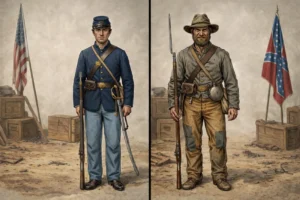
In the popular memory of the American Civil War, the battle lines are clean: a sea of Union Blue clashing against a wall of Confederate Gray. But in 1861, the reality on the ground was a chromatic nightmare.
At the start of the conflict, there was no “Confederate uniform.” Regiments showed up in whatever their local communities could provide. Some Union units wore gray, while many Confederate units—composed of former U.S. Army regulars—marched into battle wearing federal blue. This confusion didn’t just look messy; it was lethal.
1. The Chaos of First Bull Run

The First Battle of Bull Run (Manassas) was the ultimate wake-up call for uniform standardization. Because many Southern militia units (like the 2nd Mississippi) wore blue, and some Northern units (like the 2nd Wisconsin) wore gray, soldiers frequently held their fire against the enemy or accidentally decimated their own allies.
After the smoke cleared, both high commands realized that “recognition signals” were a matter of life and death. The North, having access to the established textile mills and chemical dyes of the Industrial Revolution, stuck with the traditional Federal Blue. The South, meanwhile, had to build a wardrobe from scratch.
2. Why Gray? The “Cadet” Influence

The choice of gray for the South wasn’t arbitrary. It was deeply rooted in military prestige. West Point and the Virginia Military Institute (VMI) both used “Cadet Gray” for their uniforms.
Furthermore, gray dye was easier and cheaper to produce in a pre-industrial agrarian society. While the North could import or manufacture the indigo needed for deep blues, the South relied on a simpler mixture of logwood and sumac to achieve a gray-to-steel-blue hue.
3. The “Butternut” Transition

As the Union blockade tightened around Southern ports, the supply of high-quality gray dye vanished. Confederate quartermasters were forced to innovate using local organic materials: nut hulls (butternuts), iron filings, and copperas.
The result was a yellowish-brown tint that soldiers dubbed “Butternut.” By the mid-point of the war, a Confederate “Gray” line actually looked more like a spectrum of muddy browns and tans. This became so common that “Butternut” became a slang term for a Rebel soldier, particularly those from the Western Theater.
4. Branch Colors: The Shared Heritage

Despite the difference in coat colors, both sides maintained the same branch-of-service colors inherited from the old U.S. Army regulations. This “military DNA” helped officers identify units through the “fog of war” regardless of the base color of their wool:
| Branch | Trim/Facing Color |
| Infantry | Light Blue |
| Artillery | Red |
| Cavalry | Yellow |
| Medical | Green |
5. The Scarcity of Shoes

By 1864, the “Uniform of the Confederacy” was less about a specific color and more about whatever a soldier could scavenge. It was common for Confederate soldiers to strip dead Union troops of their sturdy, factory-made blue trousers to replace their own tattered rags. By the end of the war, the “Army of Northern Virginia” was a patchwork of gray, butternut, and captured blue—a visual testament to the industrial strangulation of the South.