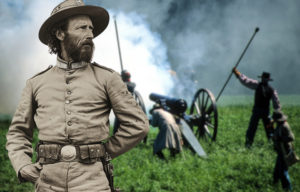
The American Civil War generated no shortage of bizarre and unforgettable tales. Soldiers spoke of bullets colliding in flight, wounds that glowed faintly before inexplicably healing, and uncanny coincidences—such as a Union general bearing the same name as the Confederate president. Among the most haunting of these stories is that of Confederate Brigadier General Martin Green, who reportedly proclaimed himself immune to harm—only to be killed almost immediately by a single, well-aimed shot.
Confederate Brig. Gen. Martin Green

Martin Green was born on June 3, 1815, in Fauquier County, Virginia. As a young man, he relocated to Missouri, where he and his brothers established a successful sawmill enterprise. Green later entered public service as a judge in Lewis County, while another brother followed a political path that ultimately led to a career as a Senator representing Missouri.
With the outbreak of the American Civil War in 1861, Green became a prominent voice for secession within the state. He helped mobilize supporters, raised a cavalry force, and took part in early fighting against Union units commanded by David Moore’s Home Guard. Although his wartime record included both notable successes—such as the Confederate victory at Lexington—and subsequent reverses, his standing among Southern forces continued to rise.
In 1862, Green was elevated to the rank of brigadier general. He went on to command troops under John S. Bowen during the Siege of Vicksburg, playing a role in one of the war’s most pivotal campaigns as Ulysses S. Grant sought to wrest control of the Mississippi River from Confederate hands.
Irony of Martin Green’s last words

On June 27, 1863, Martin Green carefully inspected the fortifications of Vicksburg, undaunted by the Union forces nearby who were determined to defeat him and his men. Though advised to seek shelter, he boldly responded, “A bullet has not yet been molded that will kill me.”
Tragically, Green’s boastful words were soon proven false when a Union sharpshooter fatally struck him in the head just moments later, taking his life instantly.
A similar incident happened with Union Gen. John Sedgwick

A comparable fate befell Union General John Sedgwick, one of the highest-ranking officers killed during the Civil War. Military service ran in his family—his grandfather had also been a general, serving alongside George Washington.—so it was perhaps inevitable that Sedgwick would follow a similar path.
Before the Civil War erupted, Sedgwick had seen action in the Seminole Wars, the Mexican-American War, the Utah War, and the American-Indian Wars. At the outbreak of hostilities, he held the rank of colonel and served as assistant inspector general for the Military Department of Washington. In August 1861, he was elevated to brigadier general, placing him in command of larger formations in the rapidly expanding Union army.
John Sedgwick at the Battle of Antietam

During the Battle of Antietam, Major General Edwin Sumner directed Sedgwick and his division into a poorly coordinated assault. The resulting chaos left Sedgwick wounded three times, forcing him into a long recovery that lasted several months.
Later, at the Battle of Spotsylvania Court House, Sedgwick was overseeing artillery placement when Confederate sharpshooters, positioned nearly 900 meters away, began firing. While his soldiers instinctively sought cover, Sedgwick grew irritated with their caution. Remaining exposed, he called out, “What? Men dodging like this for single bullets? What will you do when they open fire along the whole line?”
An ironic end

However, they stayed under cover. Even though Sedgwick had been in battle many times, he was embarrassed by how his men were reacting. Frustrated, he said, “Why are you dodging like this? They couldn’t hit an elephant at this distance.” Moments after speaking these famous last words, the Union general was shot in the head and fell dead.
Sedgwick was a highly respected general, and his death deeply affected Ulysses S. Grant. When he heard the news, Grant asked in disbelief, “Is he really dead?”