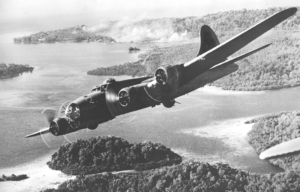

With no other options, Eaton attempted an emergency landing in what appeared to be a wheat field. The crew survived the impact, only to quickly realize they had landed in a crocodile-infested swamp. Despite the dangerous surroundings, they managed to escape and were rescued by local villagers, who treated them for malaria. Once they recovered, the crew continued their service through the remainder of World War II.
The legend of the “Swamp Ghost”

Over the years, the “Swamp Ghost” became more than just a missing bomber—it turned into a legend quietly shared throughout Papua New Guinea. Hidden deep in the swamps, the aircraft seemed preserved by its isolation, with its rusted frame standing as both a memorial and a mystery. Nature slowly took over: vines crept around the wings like reaching hands, mud held the plane firmly in place, and still water filled its empty interior, making it feel as though time had frozen at the moment it crashed.
Stories of bad luck and superstition added to its reputation, but so did the curiosity it sparked. Historians, adventurers, and aviation fans traveled into the jungle to see the wreck for themselves, all struck by the strange quiet that surrounded it. There, among the rust and silence, the “Swamp Ghost” moved beyond its role as a weapon of war and became a haunting reminder of courage, decay, and the fine line between legend and history.
Salvagers spotted the B-17E Flying Fortress in the jungle

When the Australian airmen spotted the B-17E in 1972, they were astonished by their discovery. The wreck was in remarkable condition, with thermoses filled with coffee poured by the original crew still intact!
In the 1980s, following news of the find, renowned aircraft salvager Fred Hagan and his partner, David Tallichet, embarked on a mission to locate and salvage the wreck. They were astonished to see that the “Swamp Ghost” remained in such excellent shape. Although most of the weapons and mechanics had been taken by locals, the interior was still impressive.
Hagan and Tallichet initiated the reconstruction of the heavy bomber to ensure it was strong enough for transport. However, setbacks delayed their efforts for several years. Ultimately, in 2006, the salvage mission was completed, except for one last hurdle: locals were resistant to its removal. After a ceremony to honor the spirits of the swamp, the aircraft was finally allowed to depart its resting place for the first time in 65 years.
Where is the “Swamp Ghost” now?
More from us: The Douglas SBD Dauntless Changed the Course of the Second World War In a Single Day
Once it was fully restored, the “Swamp Ghost” was put on display at a ceremony in Long Beach, California that was attended by many family members of the original crew. It has since been permanently moved to the Pearl Harbor Aviation Museum in Hawaii, where it’s undergoing restoration.