The Swamp Ghost evolved into far more than a rediscovered aircraft; it became a striking symbol of the enduring legacy of World War II. Investigators confirmed that the Boeing B-17E Flying Fortress had gone down during a 1942 mission in the Pacific, likely as the result of combat damage or a catastrophic mechanical problem. Even after the crash and decades spent in a remote swamp, much of the bomber’s structure—including large portions of the wings and fuselage—remained astonishingly preserved, creating an eerie reminder of the aircraft’s wartime past.
Within the wreck, researchers uncovered remnants tied to the bomber’s final operation, such as personal belongings, flight documents, and scattered equipment that had been unusually well conserved by the swamp’s environment. The site’s isolation and the aircraft’s haunting condition underscored the immense human toll of the war. Once considered little more than local folklore, the recovered bomber eventually came to stand as a solemn memorial to those who served and as a powerful link to the hidden wartime history of Papua New Guinea.
The crew survived a death-defying crash
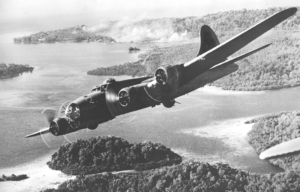
Boeing B-17E Flying Fortress. (Photo Credit: U.S. Air Force / Wikimedia Commons / Public Domain)
On February 23, 1942, just months after the Japanese attack on Pearl Harbor, Capt. Frederick C. Eaton Jr. flew a B-17E Flying Fortress over Rabaul, Papua New Guinea, which had recently been overtaken by Japanese forces. During the mission, the bomber was struck, damaging a wing and causing a critical fuel leak, making it impossible for the crew to return to their base in Port Moresby.
With no other options, Eaton attempted an emergency landing in what appeared to be a wheat field. The crew survived the impact, only to quickly realize they had landed in a crocodile-infested swamp. Despite the dangerous surroundings, they managed to escape and were rescued by local villagers, who treated them for malaria. Once they recovered, the crew continued their service through the remainder of World War II.
The legend of the “Swamp Ghost”
“Swamp Ghost” on display at the Pearl Harbor Aviation Museum. (Photo Credit: Pacific Aviation Museum / Wikimedia Commons CC BY 2.0)
Over the decades, the Swamp Ghost gradually became more than a forgotten wartime aircraft, transforming into a near-mythical presence within Papua New Guinea. Concealed deep within isolated swamp terrain, the wreck appeared almost frozen in time, its decaying structure existing as both a memorial and an enduring mystery. As the years passed, the surrounding environment slowly overtook the aircraft—vines spread across its wings, thick mud gripped the fuselage, and stagnant water filled portions of the interior, giving the impression that the crash site had been suspended between past and present.
Rumors, superstitions, and stories of bad luck gradually emerged around the wreck, strengthening its eerie reputation and attracting historians, explorers, and aviation enthusiasts eager to witness it firsthand. Amid the silence, corrosion, and overgrowth, the “Swamp Ghost” evolved into far more than a relic of World War II. It became a haunting reminder of bravery, mortality, and the fragile boundary separating documented history from enduring legend.
Salvagers spotted the B-17E Flying Fortress in the jungle
Hull of the “Swamp Ghost” on display at the Planes of Fame Air Museum. (Photo Credit: Tomás Del Coro / Wikimedia Commons CC BY 2.0)
When the Australian airmen spotted the B-17E in 1972, they were astonished by their discovery. The wreck was in remarkable condition, with thermoses filled with coffee poured by the original crew still intact!
In the 1980s, following news of the find, renowned aircraft salvager Fred Hagan and his partner, David Tallichet, embarked on a mission to locate and salvage the wreck. They were astonished to see that the “Swamp Ghost” remained in such excellent shape. Although most of the weapons and mechanics had been taken by locals, the interior was still impressive.
Hagan and Tallichet initiated the reconstruction of the heavy bomber to ensure it was strong enough for transport. However, setbacks delayed their efforts for several years. Ultimately, in 2006, the salvage mission was completed, except for one last hurdle: locals were resistant to its removal. After a ceremony to honor the spirits of the swamp, the aircraft was finally allowed to depart its resting place for the first time in 65 years.
Once it was fully restored, the “Swamp Ghost” was put on display at a ceremony in Long Beach, California that was attended by many family members of the original crew. It has since been permanently moved to the Pearl Harbor Aviation Museum in Hawaii, where it’s undergoing restoration.