In August 1946, less than a year after the surrender of Japan, the United States Navy mobilized a force that looked less like a scientific expedition and more like a tactical invasion fleet. Comprising 13 ships, 23 aircraft, and over 4,700 personnel, Task Force 68 was destined for the most hostile environment on Earth.
Formally titled The United States Navy Antarctic Developments Program, the mission became better known by its code name: Operation Highjump.
Led by Rear Admiral Richard E. Byrd, a legendary polar explorer and Medal of Honor recipient, the mission remains the largest Antarctic expedition in history. While its official goals were logistical, the sheer scale of the fleet—and its struggle against unpredictable sub-zero conditions—gave birth to some of the most persistent conspiracy theories in military history.
Task Force 68: Military Hardware in the Ice

The composition of Task Force 68 was staggering for a peacetime mission. It was a carrier battle group testing the limits of post-WWII technology in a landscape of shifting ice and blinding snow.
To get the heavy R4D-5 transport planes off the deck of the USS Philippine Sea, the Navy had to use JATO (Jet-Assisted Take-Off) bottles. These were small rockets attached to the sides of the aircraft to provide extra thrust—marking one of the first times such technology was used in a polar environment. This wasn’t just about mapping; it was about seeing if heavy military hardware could even function in a place where oil freezes and metal becomes brittle.
The fleet also included the USS Sennet (SS-408), a Balao-class submarine. The Navy wanted to know if a submarine’s hull could withstand the pressure of “pancake ice” or if its intake valves would freeze shut—a vital piece of intelligence for future Arctic operations.
The Cold War Context: The “Polar Concept”

In 1946, American military planners were obsessed with the “Polar Concept.” With the Soviet Union emerging as the new global rival, the Pentagon believed the next great conflict would be fought across the North Pole.
Antarctica provided the perfect, isolated proving ground. If the Navy could keep a carrier group operational amidst Antarctic gales and shifting ice packs, they could do it in the Arctic. Operation Highjump was, in many ways, a massive dress rehearsal for a potential Third World War fought at the edges of the globe.
Debunking the “Chilling” Conspiracies

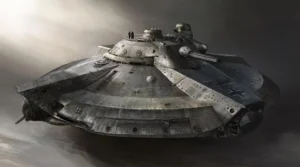
The conspiracy theories surrounding Highjump often center on “Neuschwabenland” (New Swabia), an area explored by Nazi Germany in 1938. Rumors of a “Base 211” and Nazi UFOs forcing out Byrd’s fleet have persisted for decades in the darker corners of the internet.
The Reality Check:
- The Weather, Not Warfare: Highjump ended earlier than planned because the Antarctic summer was closing. As the sea ice began to thicken, the risk of an aircraft carrier being “iced in” (stuck for the winter) was a catastrophe the Navy couldn’t afford.
- The Casualties: Three men died during the crash of the George 1 PBM Mariner. These were documented accidents caused by “whiteout” conditions—where the sky and ground become indistinguishable—not secret combat.
- The Admiral’s Quote: Conspiracists often point to an interview Byrd gave where he warned that the U.S. should adopt measures against “hostile aircraft” coming from the polar regions. In context, he was referring to the Soviet Union, not secret Nazi saucers.
The Legacy of Highjump

Operation Highjump mapped roughly 1.5 million square miles of the Antarctic interior. It proved that while the Navy could operate in the cold, the logistical cost was nearly insurmountable with 1940s technology.
By 1959, the Antarctic Treaty was signed, officially designating the continent as a demilitarized zone. Operation Highjump stands as the last moment in history when Antarctica was viewed primarily as a potential battlefield. It wasn’t a secret war, but a massive, expensive, and dangerous experiment in the world’s most unforgiving environment.