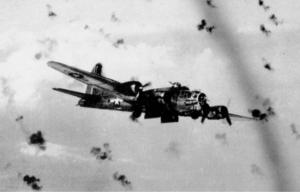
On November 29, 1943, Eugene Paul Moran manned the tail gunner’s turret of a Boeing B-17 Flying Fortress during a bombing mission over Germany when disaster struck. Enemy fire tore through the aircraft, igniting flames and sending it into a deadly spiral—an almost certain death sentence for anyone stationed in the exposed tail. Against all odds, Moran survived.
The tail gunner’s position was notoriously perilous, offering minimal armor and virtually no means of escape. Moran’s survival stands as a remarkable testament to courage, resilience, and the unpredictable hazards of aerial combat.
Enlisting in the US Army Air Forces (USAAF)

Eugene Moran, born on July 17, 1924, in Wisconsin, grew up working on his family’s farm near Soldiers Grove. When World War II began, instead of continuing his farm work, he answered the call to serve his country overseas, in response to the Japanese attack on Pearl Harbor. Motivated by these events, he enlisted in the US Army Air Forces (USAAF).
Like many of his peers, Moran enlisted at the age of 18 in October 1942. Following his training, he was assigned to the 96th Bombardment Group, 339th Bombardment Squadron, Eighth Air Force.
Eugene Moran enters the fight

Now in the fight, Eugene Moran became a tail gunner aboard the B-17 Flying Fortress Rikki Tikki Tavi, after the mongoose in the Rudyard Kipling novel, The Jungle Book. He, along with the nine crewmen, were stationed at RAF Snetterton Heath, tasked with flying daytime bombing runs over Germany.
Moran and the rest of Rikki Tikki Tavi‘s crew had only completed four missions when disaster struck.
Disaster strikes the Boeing B-17 Flying Fortress Rikki Tikki Tavi

On November 29, 1943, Rikki Tikki Tavi joined other B-17s of the Eighth Air Force on a mission targeting Bremen, Germany. Following the bombing run over the city, Rikki Tikki Tavi fell behind the formation, drawing the full attention of the German defenses.
The B-17 sustained severe damage from both aerial and ground attacks. Eight crew members were killed, leaving only Eugene Moran and the navigator as the sole survivors. The navigator, stationed in the forward section, successfully parachuted to safety, while Moran remained trapped in the tail section.
Things go from bad to worse

Amid the unfolding chaos, danger escalated further. German flak struck once more, ripping through the B-17 and tearing apart much of the aircraft. Yet remarkably, the tail section—just forward of the vertical and horizontal stabilizers—remained largely intact. Moran, trapped inside, struggled to open the hatch, only to find it jammed tight.
As the rest of the bomber disintegrated in flames, Moran’s compartment descended more slowly, drifting through the smoke-choked sky. In the midst of destruction, this section became a fragile capsule of survival, offering a slim but vital chance at life.
Eugene Moran fought until the very end

For most people, survival would have been their first priority. With that out of his hands, Eugene Moran continued to fight until he reached the ground. He fired his two M2 Browning machine guns at the Luftwaffe-flown Messerschmitt Bf-109s that continued to attack him. Seeing a seemingly unknown aircraft above, the German flack batteries also continued firing at Moran.
A few moments later, the tail section of Rikki Tikki Tavi glided down to earth, stopping abruptly when it flew into a tree. Moran was alive, but badly injured. He was bloodied and had a cracked skull from when his head was thrown against his machine guns upon impact. He’d also sustained broken ribs and forearms. Moran was attended to by two Serbian prisoners of war (POW), who were doctors. They’d seen the crash and rushed to help.
Surviving his time as a prisoner of war (POW)
