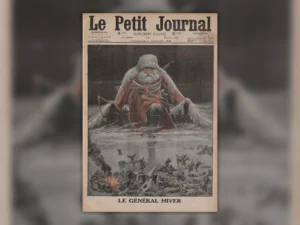
In military history, the environment is rarely neutral. While most generals fear the frost, the greatest strategic minds—from the Russian Tsars to Finnish guerillas—didn’t just endure the snow; they weaponized it.
The concept of “General Winter” isn’t just a metaphor for bad luck. It is a masterclass in force multiplication, where cold, hunger, and exhaustion are used to achieve what’s impossible with gunpowder alone.
1. The Russian Strategy: Trading Space for Time

The most famous victim of the Russian winter wasn’t a soldier, but an ego. Both Napoleon in 1812 and the Wehrmacht in 1941 made the same fatal mistake: they underestimated the logistics of a frozen landscape.
- Scorched Earth: Russian forces didn’t just retreat; they systematically destroyed shelters and food supplies.
- Logistical Collapse: At -30°C, grease in rifles freezes, horse-drawn supply wagons get bogged down in “Rasputitsa” (the mud season), and engines refuse to turn over.
- The Intentional Calculation: By the time the first snow fell, the invading armies were already starving. The winter simply finished what the scorched-earth policy started.
2. The Winter War: Skis vs. Tanks

Perhaps the most tactical use of snow occurred during the 1939-1940 Winter War. The Finnish Army, vastly outnumbered by the Soviet Union, utilized “Motti” tactics to turn the forest into a graveyard.
- Mobility as a Weapon: Finnish soldiers on skis moved through deep snow with silent speed, while Soviet tanks were confined to predictable, easy-to-ambush roads.
- Psychological Warfare: Wearing white camouflage (the “Belaya Smert” or White Death style), Finnish snipers like Simo Häyhä struck from the treeline, disappearing before the enemy could even chamber a round.
- The “Sisu” Factor: Finland’s cultural familiarity with the sub-arctic climate allowed them to maintain morale while the Red Army succumbed to mass frostbite.
Did You Know? During the Winter War, Finnish troops specifically targeted Soviet field kitchens. In the sub-zero forest, a soldier who cannot eat hot food is a soldier who will be dead within 48 hours.
3. The Science of Attrition: Why Cold Wins

Winter warfare follows a brutal mathematical pattern where non-battle injuries (NBI) often exceed combat casualties. In this environment, shelter becomes the ultimate strategic objective; a single heated basement is often more valuable than an ammunition dump.
Without cover, the human body becomes a high-maintenance engine, requiring a staggering 5,000 to 6,000 calories a day just to prevent hypothermia. When fuel—the lifeblood of mechanized movement—runs dry, an army doesn’t just stop; it freezes in place, transforming from a mobile threat into a stationary target for the elements.
4. When the Weapon Backfires

Using winter as a weapon is a gamble. If a defender’s supply lines are also cut, or if the enemy is equally prepared (such as the mountain troops of the Alpine regions), the weather becomes an indiscriminate killer.
The Battle of the Bulge (1944) is a prime example where the fog and cold initially favored the German surprise attack by grounding Allied air power, but eventually turned into a frozen stalemate that punished both sides equally.
The Enduring Legacy of the Cold

Modern militaries, including NATO’s “Cold Response” exercises, still train for these scenarios. Technology has evolved—synthetic fibers have replaced wool, and GPS has replaced scouts—but the fundamental truth remains:
Winter rewards the prepared and ruthlessly executes the complacent.