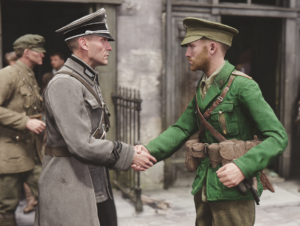
On St. Patrick’s Day, one of the strangest Irish wartime stories is worth revisiting.
St. Patrick’s Day usually brings up parades, politics, and Irish identity.

But there is a far darker wartime story hiding in the background. During World War II, figures inside the IRA tried to build a covert relationship with Germany’s military intelligence service, the Abwehr. It sounds like a conspiracy thriller, but it was real, and it ended with a failed U-boat mission called Operation Dove.
The key figure was Seán Russell, who became IRA chief of staff in 1938 after promising a renewed campaign against Britain. Russell had already opened channels to Germany by the mid-1930s, and in October 1936, he wrote to the German ambassador in Washington offering IRA support in any future conflict with Britain. For Russell, this was less about shared beliefs than cold strategy: Britain’s enemy looked like Ireland’s opportunity.

The bombing campaign that opened the door
That strategy soon turned violent. In January 1939, the IRA launched its S-Plan bombing campaign in Britain. The campaign killed ten people, including IRA agents, and it quickly became a political disaster. But it also got attention in Berlin. As bombs went off in English cities, the Abwehr moved to explore whether the IRA could be useful as a sabotage partner against Britain.
In February 1939, an Abwehr agent named Oscar Pfaus met IRA leaders in Dublin. That meeting led to a bigger step: James O’Donovan, one of Russell’s closest associates, traveled to Hamburg for talks with German intelligence. There, both sides discussed money, communications, arms, and possible attacks. O’Donovan later admitted he gave the Germans an overly optimistic picture of IRA strength, which would become a recurring theme in the whole relationship.
Operation Dove: the U-boat mission that never landed

By 1940, Russell himself was in Berlin. He was treated well, given unusual privileges, shown military facilities, and encouraged to think big. Hanley notes that Russell urged German planners to use the IRA against British forces in Northern Ireland if a wider assault on Britain took shape. In other words, this was no casual contact. It was a real attempt at wartime cooperation.
Then came the part that still makes people do a double-take. In August 1940, Russell and Frank Ryan boarded the submarine U-65 to return to Ireland on a mission code-named Operation Dove. The idea was to land in Ireland and help revive sabotage plans from inside the country. But Russell became seriously ill during the voyage and died at sea on 14 August 1940, reportedly from a burst ulcer. He was buried at sea, and the mission was abandoned before it could reach Ireland.
Why this story still shocks
What makes this episode so striking is that it was both serious and deeply flawed. German intelligence explored the IRA as a possible asset, but senior officials also doubted its real value. Postwar testimony shows that Abwehr officers thought Russell exaggerated the IRA’s strength, and even at the top level, there was skepticism about what the group could actually deliver. At the same time, the Irish state cracked down hard during the Emergency, and by 1941, the IRA had been largely interned and broken as an effective force.
That is why Operation Dove still lands with such force today. It was not a myth, not a rumor, and not a one-off conversation. It was a genuine back-channel wartime gamble — one that shows how far some IRA leaders were willing to go in the hope of striking Britain, even if the alliance they chased was shaky from the start.
If you enjoyed this story, then try: