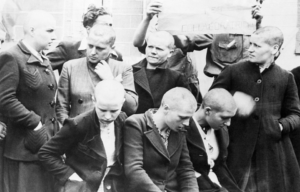
After France was liberated from German occupation in 1944, photographers and journalists rushed in to record the country’s turbulent recovery. Some of the most powerful—and unsettling—images show women being forcibly shaved in public while crowds looked on and mocked them. Their calm or detached expressions can seem confusing today, but these scenes were part of deliberate public punishments meant to shame women accused of “horizontal collaboration,” a term used for romantic or sexual relationships with German soldiers.
While collaboration came in many forms—from sharing information to helping military efforts—women who had intimate relationships with occupying troops became the most visible and symbolic targets of punishment in France’s post-liberation backlash.
German Occupation of France

France was invaded by German forces in May 1940 and defeated within a month, forcing an armistice between delegates from both countries. This marked France’s official surrender, and divided the nation into two zones: the German-occupied north and the French-controlled south, which was known as Vichy France.
Marshal Henri-Philippe Pétain was the authoritarian figurehead for Vichy France, where he acted in line with Germany, leading to tens of thousands of Jewish citizens being expelled from the region during this time. Some sources claim he’d hoped to act as a mediator between France and the Axis powers, to both keep German troops out of Vichy and to aid the French Resistance.
It wasn’t until November 1942 that German troops took Vichy, in retaliation for the involvement of Free French forces in North Africa. According to Germany, the acts committed by the French forces in the region had violated the armistice agreement that had been signed over two years prior.
Horizontal collaboration

During the German occupation of France, some women entered relationships with enemy soldiers for survival. Many were young mothers whose husbands were held in prisoner of war camps, and forming ties with German soldiers was often the only way to provide for themselves and their children.
In cities like Paris, numerous women were coerced into working in clubs, engaging with German soldiers in exchange for money. These venues became so prominent that German and French authorities collaborated to regulate existing establishments and construct new ones, sometimes forcibly bringing women from rural areas into the cities.
Not all relationships were compelled—some developed from genuine romantic connections. Photographs from the period, including those kept by German POWs, show women alongside their French partners or spouses during the Second World War.
Regardless of whether the relationships were voluntary or coerced, they were labeled “horizontal collaboration,” and women involved were subjected to harsh persecution at the war’s end.
Retribution for horizontal collaboration

France was liberated following the Allied landings in Normandy, which led to their advance into Caen and Paris. Although the Germans were ordered to destroy the capital, they ultimately surrendered.
Between this liberation and the end of the war, Allied forces focused on expelling the remaining German troops from France, while citizens took action against those accused of horizontal collaboration.
Some women who had romantic relationships with German soldiers managed to escape this retribution by traveling to Germany with their husbands or boyfriends during the liberation. Those who stayed behind, however, became targets due to their horizontal collaboration. In fact, the outrage against these women was so intense that some were wrongly accused of fraternizing with the enemy.
Les femmes tondues

Women accused of “horizontal collaboration” were publicly shaved to mark them as having had intimate relationships with German soldiers. They became known as les femmes tondues, and historians estimate their number at roughly 20,0000.
For many of these women, the punishment went far beyond losing their hair. They were often partially stripped, mocked by crowds, covered in tar, hit with stones, kicked, beaten, spat on, and in some tragic cases, even killed.
Those who carried out these acts included members of the French Resistance as well as former collaborators. In a harsh irony, some of the people leading the punishments had themselves cooperated with the occupiers. By targeting these women, they diverted attention from their own actions during the war and tried to protect themselves from retaliation.
Recognition as German citizens

It’s estimated that relationships between German soldiers and French women during World War II resulted in the birth of around 200,000 offspring. Many of these boys and girls grew up never knowing the identity of their fathers, while others who did often stayed quiet to avoid stigma and hostility. Those labeled as the offspring of occupying troops were frequently subjected to abuse and shunning, sometimes even within their own households.
In many cases, the truth only came to light decades later, when hidden mementos—letters, photographs, or personal belongings—were uncovered after their mothers’ deaths. These revelations prompted many of the so-called “war children” to seek answers about their heritage or to establish a connection to their German families. More recently, both Germany and France have formally recognized their plight. Germany extended dual citizenship as a gesture of accountability and reconciliation, while France, in a surprising turn, has also supported citizenship requests, acknowledging the hardships these children endured and offering symbolic justice.