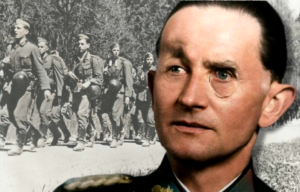
General Dietrich von Saucken is remembered for boldly bringing his cavalry sword to a meeting to a meeting with the Führer

Photo Credit: 1. Heinrich Hoffmann / ullstein bild / Getty Images (Colorized by Palette.fm) 2. Heinrich Hoffmann / ullstein bild / Getty Images (Colorized by Palette.fm, Contrast & Saturation Increased)

Children are often taught that standing up to a bully is the best form of defense. In the 20th century, few figures embodied tyranny more fully than the Führer, whose authoritarian leadership drove Germany into a devastating war that left widespread destruction, suffering, and a lasting stain on the nation’s history.

Opposing him was extremely perilous. He demanded absolute loyalty from his military commanders, many of whom complied out of fear for their positions—or their lives. Those who challenged him were exceedingly rare and typically faced harsh repercussions.

General Dietrich von Saucken stood out as a notable exception. Renowned for his battlefield competence and commanding presence, he exuded a calm yet firm authority. On multiple occasions, von Saucken openly confronted the Führer and even addressed him with blunt defiance. Remarkably, he managed to avoid arrest or execution, earning a reputation as one of the few officers willing to stand up to one of history’s most feared dictators.

Dietrich von Saucken brought his cavalry sword to a meeting

Military portrait of Dietrich von Saucken
Dietrich von Saucken, 1943. (Photo Credit: Heinrich Hoffmann / ullstein bild / Getty Images)

In the bitter winter of 1945, as the Third Reich crumbled all around him, nearly every senior German commander had come to terms with the grim reality of imminent defeat—everyone except the Führer himself. General Dietrich von Saucken had already jeopardized his position by saying as much, a candor that briefly cost him his command. But with the war falling apart and veteran leaders scarce, he was recalled to duty only weeks after his dismissal.

Von Saucken, a lifelong soldier and proud son of East Prussia, had distinguished himself in both global conflicts. So when he was called to the Führer’s subterranean headquarters in February 1945, he was handed an almost hopeless mission: defend East Prussia against the relentless advance of the Red Army. The assignment was bleak, but it spoke to the respect he commanded as a skilled and principled officer.

Upon reporting to receive his orders, von Saucken made a deliberate and daring statement—he arrived wearing his cavalry saber, a traditional emblem long forbidden in Hitler’s presence. The Führer offered no reprimand, whether out of obliviousness or unwillingness to challenge the general’s quiet but unmistakable act of defiance.

Pushing his luck with the Führer

Military portrait of Albert Forster
Albert Forster. (Photo Credit: Unknown / Not Disclosed / Wikimedia Commons / Public Domain)

Witnesses to this “historic” encounter report that not only did Dietrich von Saucken flaunt attire likely to provoke the Führer, but his manner of speaking dripped with disdain, another transgression that could’ve led to his imprisonment in a forced labor camp, or worse. Men had faced execution for lesser offenses.

Initially, he delivered a military salute to the German leader, not the customary one demanded of those around him. Remarkably, the Führer, once again, appeared oblivious.

When he insisted that East Prussia must be defended and added that von Saucken would report to local loyalist Gauleiter Albert Forster, the general abandoned all pretense of heeding these directives. The notion that he would answer to a low-ranking, local and anonymous figure incensed von Saucken, prompting him to slam his hand onto the table between him and the Führer. Only then did he finally command the German leader’s undivided attention.

“I have no intention of taking orders from a Gauleiter,” von Saucken declared.

At this point, it seemed the general had reached a state of indifference regarding the repercussions his statements might elicit. He brazenly disregarded the Führer‘s directive and addressed him as “Herr,” instead of the expected honorific “Mein,” which citizens were mandated to use when referring to him.

The entire room sat in stunned silence, waiting to see how the German leader would react. To everyone’s surprise, he simply responded, “Alright, Saucken, have command of it yourself.”

Dietrich von Saucken becomes a prisoner of the Red Army

Exterior of Oryol Prison
Dietrich von Saucken was imprisoned at Oryol Prison, before being transferred to a gulag in Tayshet. (Photo Credit: DaLordWC / Wikimedia Commons / Public Domain)

Dietrich von Saucken remained committed to his men even in the final days of the war. Rather than abandoning his post, he chose to oversee the evacuation of wounded soldiers—a decision that ultimately led to his capture by Soviet forces, followed by 10 years in a prison camp.

When he was finally released, the toll of years in captivity had left him physically weakened and reliant on a wheelchair for the rest of his life. He later settled in Bavaria, where he adopted a quieter routine and turned to painting as a source of comfort.

His story raises an enduring question: how might history have unfolded if more military leaders had refused to carry out orders they believed were wrong? Could acts of defiance like his have altered events or lessened the suffering of the time? While such questions remain open to debate, one point is certain—challenging tyranny requires immense courage, and its effects can echo long after the moment has passed.

Ian Harvey

Ian Harvey is one of the authors writing for WAR HISTORY ONLINE