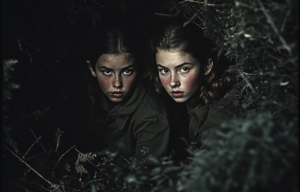
Throughout World War II, women played essential yet often underrecognized roles within resistance movements across German-occupied Europe. They carried out some of the most dangerous tasks of the conflict—smuggling messages and weapons, collecting intelligence, conducting sabotage, and, in some cases, taking part in direct combat—while constantly facing the risk of arrest, torture, or death.
By taking on these responsibilities, they became a crucial element in undermining German occupation forces and, in doing so, challenged the restrictive social expectations placed on women at the time. Their contributions demonstrated that courage and resolve are not limited by gender, leaving behind a lasting legacy of resilience, ingenuity, and steadfast resistance to oppression.
Freddie and Truus Oversteegen
Freddie and Truus Oversteegen with Dutch Prime Minister Mark Rutte during the War Mobilization Cross ceremony, 2014. (Photo Credit: Ministerie van Defensie / Wikimedia Commons CC0 1.0)
Growing up in Haarlem in the Netherlands, Truus Oversteegen and Freddie Oversteegen were raised with a strong moral conviction to stand up for those in danger. Their mother, a committed Communist with a strict sense of justice, taught them that remaining passive in the face of injustice was itself a form of complicity. Freddie’s youthful appearance—complete with braids and an almost childlike demeanor—would later become an unexpected advantage during dangerous resistance operations.
Even before the outbreak of World War II, their home already served as a refuge for those fleeing persecution. By 1939, their mother was sheltering Lithuanian refugees and a Jewish couple escaping Nazi oppression. Being exposed to these realities at a young age made the sisters acutely aware of the consequences of tyranny and helped shape their determination. These early experiences laid the groundwork for the courage and quiet resolve that would later define their actions in the Dutch resistance.
Joining the Dutch Resistance
Dutch Resistance members with captured German arms during the country’s liberation, 1944. (Photo Credit: Keystone Features / Getty Images)
In May 1940, Germany invaded the Netherlands, beginning an occupation that lasted until the end of World War II. During this period, many Jewish people were deported, and non-Jewish citizens faced harsh conditions.
The invasion inspired Truus and Freddie to resist. With their mother’s support, they started distributing anti-German flyers and newspapers for the Resistance. Their efforts caught the attention of Frans van der Wiel, a leader in the Haarlem Resistance Group. He visited their home and asked their mother if the girls could officially join the Resistance. She agreed.
They did different jobs for the Resistance
Dutch Resistance group operating near Dalfsen, Ommen and Lemelerveld. (Photo Credit: Unknown Author / Wikimedia Commons CC0 1.0)
Freddie and Truus were initially unaware of the full extent of their involvement with the Resistance. In the beginning, their assignments included sabotaging bridges and railways with dynamite, focusing specifically on the line between Ijmuiden and Haarlem. They also set fire to a German warehouse and helped smuggle Jewish children out of the country, even assisting some in escaping from concentration camps.
Their gender played a crucial role in their effectiveness, as most Resistance operations were associated with men. The Germans assumed that women were only involved in distributing newspapers and other materials. Being both female and young allowed them to operate with little suspicion.
Becoming assassins
Members of the Dutch Resistance speaking with the 101st Airborne Division during Operation Market Garden, September 1944. (Photo Credit: CIA / Wikimedia Commons / Public Domain)
Before long, the girls were tasked with carrying out assassinations of Germans and Dutch collaborators. Using their youthful appearance, they lured German officers into the woods – either while on patrol or in a local tavern – and shot them. According to Freddie, it was something they had to do. “It was a necessary evil, killing those who betrayed the good people,” she said.
In 1943, the sisters joined up with Hannie Schaft, a former university student who’d dropped out after refusing to sign a loyalty pledge to Germany. She’d started out with small acts, such as stealing identification cards for Jewish people. When she began assassinating Germans, she became known as “the girl with the red hair.”
Working with Hannie Schaft
Hannie Schaft, late 1930s-early ’40s. (Photo Credit: Unknown Photographer / Wikimedia Commons / Public Domain)
The trio formed a highly effective assassination and sabotage cell, carrying out their operations with precision. In addition to targeting key figures, they concealed firearms in the baskets of their bicycles and once even raised a Communist flag at the headquarters of the National Socialist Movement. Their success in their covert activities led to a 50,000 guilder reward for their capture by the end of the war.
On March 21, 1945, Hannie was detained at a military checkpoint in Haarlem while in possession of the banned Communist newspaper, de Waarheid. After intense interrogation, she was executed by Dutch authorities on April 17, 1945. Following the war, Hannie was given a hero’s burial with honors, attended by Queen Wilhelmina and Prince Bernhard. Today, more than 15 cities in the Netherlands commemorate her legacy with streets bearing her name.
Post-war struggles
Truus Oversteegen at Hannie Shaft’s memorial, 1985. (Photo Credit: Poppe de Boer / Wikimedia Commons CC0 1.0)
Truus and Freddie never revealed how many people they killed throughout the duration of their Resistance work. When asked, Freddie replied that they were soldiers and soldiers don’t reveal such details.
Following the war, Freddie and Truus struggled with the trauma of their friend’s death and the murders they’d committed. To cope, Truus became an artist and spoke at war memorial services. Freddie coped “by getting married and having babies,” yet nothing could help the insomnia she suffered.
The sisters were awarded the War Mobilization Cross
Truus Oversteegen with Dutch Prime Minister Mark Rutte during the War Mobilization Cross ceremony, 2014. (Photo Credit: Evert-Jan Daniels, Ministerie van Defensie / Wikimedia Commons CC0 1.0)
The sisters didn’t receive much recognition for their wartime efforts right away, largely because they were labeled as Communists. It wasn’t until 1967 that Truus was honored as Righteous Among the Nations by the State of Israel—a prestigious award given to non-Jews who risked their lives to save Jews during the Holocaust.
Years later, in April 2014, the Dutch government officially acknowledged their bravery by awarding them the War Mobilization Cross.
Both sisters have since passed away. Truus died on June 18, 2016, and Freddie followed on September 5, 2018.