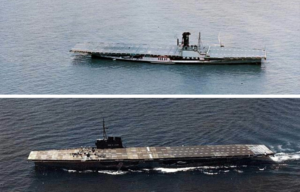
Few people know that two aircraft carriers were stationed in the Great Lakes of North America during WWII

Photo Credit: Naval History & Heritage Command / U.S. Navy / Wikimedia Commons / Public Domain (Colorized by Palette.fm)
During World War II, aircraft carriers fundamentally reshaped naval warfare by allowing air power to strike far beyond the range of land-based aircraft. Yet not every carrier built during the war entered combat. The USS Wolverine (IX-64) and USS Sable (IX-81) were unusual exceptions, serving exclusively on the Great Lakes as dedicated training carriers.

Their purpose was to prepare Navy pilots for one of the most difficult tasks in aviation: taking off from and landing on a moving carrier deck. Operating in the safer waters of the Great Lakes gave trainees a controlled environment to practice before deployment overseas. Though neither ship saw combat or came under enemy fire, their role was critical to the war effort. Together, Wolverine and Sable helped train more than 17,000 naval aviators, many of whom later flew from combat carriers in both the Atlantic and Pacific theaters.

Turning luxury vessels into aircraft carriers

Greater Buffalo sailing through Lake Michigan
Greater Buffalo, 1942. (Photo Credit: Unknown Author / U.S. Navy National Museum of Naval Aviation / Wikimedia Commons / Public Domain)

Cmdr. Richard F. Whitehead, then an aviation aide at the Great Lakes Training Center based at Glenview Naval Air Station in Chicago, was the first to suggest repurposing civilian vessels to train carrier pilots. He saw the value in conducting such training away from the dangers of active war zones and pushed the idea with determination.

Initially, military leadership was hesitant to embrace the concept. But the surprise Japanese attack on Pearl Harbor in December 1941 shifted priorities. With front-line aircraft carriers stretched thin, Adm. Ernest J. King swiftly endorsed Whitehead’s plan, acknowledging the critical need for a steady pipeline of skilled carrier aviators.

USS Sable (IX-81)

USS Sable (IX-81) sailing through Lake Michigan
USS Sable (IX-81), 1944-45. (Photo Credit: U.S. Navy National Naval Aviation Museum / Wikimedia Commons / Public Domain)

Originally launched as the Greater Buffalo in October 1924, the USS Sable began life as a side-wheel excursion steamboat. Famous for her elegant, Renaissance-inspired design, she earned the nickname “Majestic of the Great Lakes” and was capable of carrying over 1,500 passengers, 103 vehicles, and nearly 1,000 tons of cargo.

When the U.S. Navy took ownership of the Greater Buffalo, she underwent significant modifications. The ship’s cabins and superstructure were replaced with steel supports, and unlike her sister ship, the USS Wolverine, the Sable was fitted with a steel flight deck instead of a wooden one. This change was made specifically to test non-skid coatings for military use.

Renamed USS Sable, she remained unarmed and lacked both armor and essential features such as elevators and a hangar deck.

A notable aspect of her service was that many of her crew members had previously served on the USS Lexington (CV-2), which had been lost in the Battle of the Coral Sea.

USS Wolverine (IX-64)

USS Wolverine (IX-64) sailing through Lake Michigan
USS Wolverine (IX-64), August 1943. (Photo Credit: U.S. Navy / NavSource / Wikimedia Commons / Public Domain)

The USS Wolverine (IX-64) began her life far from the battlefield. Launched in November 1912 as the Seeandbee, she was a luxurious side-wheel paddle steamer built to carry travelers between Cleveland and Buffalo. Designed for comfort as well as capacity, the vessel could transport as many as 6,000 passengers along with roughly 1,500 tons of cargo across the Great Lakes.

By 1942, wartime demands had changed everything. The U.S. Navy urgently needed more carrier-qualified pilots and recognized the ship’s broad, stable hull as ideal for conversion into a freshwater training carrier. A 550-foot wooden flight deck was constructed above the existing vessel and fitted with arresting gear, so pilots could practice carrier landings. Much of the ship’s original structure remained visible beneath the modifications, giving Wolverine an appearance unlike any other carrier in the fleet.

Renamed Wolverine, the vessel served as a stripped-down but highly effective training platform. She carried no weapons, no armor, no hangar deck, and no aircraft elevators, and her flight deck sat unusually close to the water compared with front-line carriers. Despite these limitations, she proved invaluable, helping train thousands of naval aviators on the waters of the Great Lakes before they departed for combat operations overseas.

Training pilots in the Great Lakes

Crewmen standing around a General Motors FM-2 Wildcat that crashed into the flight deck of the USS Sable (IX-64)
General Motors FM-2 Wildcat crashed into the flight deck of the USS Sable (IX-64), May 1945. (Photo Credit: U.S. Navy / Naval History & Heritage Command / U.S. Navy National Naval Aviation Museum / Wikimedia Commons / Public Domain)

By 1943, both the USS Wolverine and Sable – nicknamed the “Corn Belt Fleet”  – were stationed out of Navy Pier, in Chicago. They were assigned to the 9th Naval District Carrier Qualification Training Unit (CQTU), and operated throughout Lake Michigan.

Trainees were taught how to takeoff and land on aircraft carriers, with the idea being that, if they could successfully accomplish their tasks on the shorter flight decks, then the larger ones wouldn’t be an issue. While conducting their training, the pilots were made to keep their cockpits open, in the event of a crash, and to “graduate” they had to carry out 10 (later eight) takeoffs and landings.

Training occurred seven days a week. However, it was often curtailed due to a lack of wind over the decks of the aircraft carriers. In order for aircraft to effectively take off, they need a certain amount of wind, and the lack of it over Lake Michigan meant that heavy aircraft like the Grumman F6F Hellcat, Vought F4U Corsair, Douglas SBD Dauntless and Grumman TBM Avenger were unable to operate from them.

Over the course of the Second World War, Wolverine and Sable trained 17,820 pilots, including future US President George H.W. Bush, and were the sites of 116,000 landings. Fewer than 300 aircraft were lost. On top of training aviators, Sable was also used to test the TDR-1, a wooden remote-controlled drone.

Decommissioning of the USS Wolverine (IX-64) and Sable (IX-81)

USS Wolverine (IX-64) sailing through Lake Michigan
USS Wolverine (IX-64), August 1942. (Photo Credit: U.S. Navy National Naval Aviation Museum / Wikimedia Commons / Public Domain)

After World War II ended, the USS Wolverine and Sable were taken out of commission and struck from the Naval Vessel Register. Wolverine was put up for sale to the public, either for flag operations or scrapping, and was eventually sold for scrap in December 1947.

The Great Lakes Historical Society’s effort to convert Sable into a museum was not successful. Following that, the ship was sold to the US Maritime Commission, where it was disassembled and scrapped.

Clare Fitzgerald

Clare Fitzgerald is a Writer and Editor with eight years of experience in the online content sphere. Graduating with a Bachelor of Arts from King’s University College at Western University, her portfolio includes coverage of digital media, current affairs, history and true crime.

Among her accomplishments are being the Founder of the true crime blog, Stories of the Unsolved, which garners between 400,000 and 500,000 views annually, and a contributor for John Lordan’s Seriously Mysterious podcast. Prior to its hiatus, she also served as the Head of Content for UK YouTube publication, TenEighty Magazine.

In her spare time, Clare likes to play Pokemon GO and re-watch Heartland over and over (and over) again. She’ll also rave about her three Maltese dogs whenever she gets the chance.

Writing Portfolio
Stories of the Unsolved

linkedin.com/in/clarefitz/