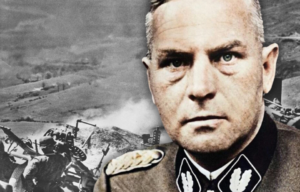
The Waffen-SS functioned as the combat branch of the SS and played a major role in Germany’s military campaigns across Europe during World War II. Initially made up largely of volunteers with limited formal military training, it evolved over time into a highly organized and well-trained fighting force.
This transformation was influenced in part by leaders such as SS-Obergruppenführer Felix Steiner, under whose direction the unit developed a reputation for effectiveness on the battlefield.
Felix Steiner’s early military career

Beginnings of the Waffen-SS

Felix Steiner joined the SS-Verfügungstruppe (V-Truppe) on March 16, 1935, as Obersturmbannführer and was appointed the commander of the 3rd Battalion/SS-Standart “Deutschland.” With ex-Army officer Paul Hausser, he set out making his troops the finest in Europe, staging his training around the tactics of the Sturmtruppen.
Steiner’s training turned military tradition on its head. He focused on athleticism, as opposed to barracks square drills, and he abolished the class system. He also changed the weaponry, swapping out the Mauser rifle for lightweight weapons, such as sub-machine guns, pistols, hand grenades and explosive charges.
The effort Steiner put into V-Truppe‘s development paid off. Impressed with the unit, the Führer signed a decree that made it a permanent force within the country’s military. The Reichsführer of the SS was also impressed and saw the group as a stabilizing force within the regime.
Unfortunately for him, Steiner wasn’t too fond of the man, speaking poorly of both him and Germany’s government.
World War II breaks out in Europe

V-Truppe‘s first foray into action came during the invasion of Poland in August 1939. Joined by the armored Kempf Division, it participated in three days of fighting in Mława, with additional artillery fire at the Różan river crossing. With the aid of the 7th Panzer Regiment, they captured the crossing, leading to the capitulation of Modlin Fortress on September 28.
The Deutschland Division continued to hone its skills before being sent to the Netherlands in May 1940. Along with General der Artillerie Albert Wodrig’s XXVI Armeekorps, Felix Steiner’s men breached the Wilhelmina Canal, capturing Walcheren on May 17.
Focus soon turned to France, where the German military had to contend with fierce British resistance. In the Nieppe Forest, with the aid of Hausser’s unit and the 3rd Panzer Division, the Deutschland Division was able to breach enemy lines and reach the Lys Canal. After establishing a bridgehead on the opposite side, Steiner made his division the sector’s leading unit.
On June 5, 1940, with the Allies retreating from Dunkirk, Steiner led his men through the Weygand Line and across the Aisne and the Marne. Despite Paris capitulating on June 14, the French continued to put up fierce resistance, leading to an engagement near Châtillon between June 16 and 18, for which Steiner was awarded the Knight’s Cross of the Iron Cross.
Felix Steiner and the Waffen-SS move to the Eastern Front

In November 1940, the Reichsführer of the SS promoted Felix Steiner to SS Brigadeführer und Generalmajor der Waffen SS and tasked him with organizing a new unit made up of the Nordland, Germania and Westland SS regiments. The majority of recruits were non-German volunteers from Denmark, Norway, Belgium and the Netherlands.
Called 5. SS-Panzerdivision Wiking (SS Division Wiking), the unit was transported to the Eastern Front, passing into Russia on June 22, 1941. Paired with Generaloberst Paul Ludwig Ewald von Kleist’s Panzergruppe 1, they moved across the River Dnieper, toward Dnepropetrovsk. However, the Soviet Red Army pushed back with a strong winter offensive toward the end of the year.
Despite Soviet efforts, the SS men held strong and were eventually joined by Sturmbannführer Johannes-Rudolf Mühlenkamp’s Panzer battalion. In July 1942, they stormed Rostov, before crossing to the Caucasus. By September, they’d made it to the land bridge with Asia and became embroiled in fighting along the Terek.
Tasked with leading a new Waffen-SS unit on the Eastern Front

The success Felix Steiner had with SS Division Wiking resulted in him being awarded the Knight’s Cross with Oak Leaves. It also afforded him charge of a new unit, the III (Germanisches) SS Panzercorps, made up of personnel from both the Wehrmacht and Luftwaffe. Despite fighting exhaustion, Steiner molded them into a cohesive unit.
Steiner’s troops were sent to fight Yugoslavian partisans during the summer of 1943. Within a few months, in late November, they were ordered back to the Eastern Front. After making the trip north to the Orianenbaum Front of Heeresgruppe Nord, they were joined by ill-equipped Luftwaffe field divisions.
While the initial plan was to train new members, the Soviets had other ideas. On January 13, 1944, they unleashed an artillery barrage against the Oranienbaum Pocket, followed by an attack by the 2nd Shock Army. At the same time, the 42nd Red Army Infantry and nine tank corps attacked German forces in Leningrad.
Realizing Leningrad had fallen, Steiner led his forces across the Narva and into the western part of the city. Establishing artillery and unit supports, they managed to survive the Battles of Narva and Tannenberg Line. However, the Soviets’ summer offensive against the Heeresgruppe Mitte ravaged the northern front and forced a retreat in late July 1944.
Attacking the 1st Belorussian Front

In January 1945, Felix Steiner was assigned to defend Pomerania with his newly formed 11th SS Panzer Army. His mission was to strike at Marshal Georgy Zhukov’s 1st Belorussian Front, which was steadily advancing toward Germany, and push toward Küstrin.
Recognizing the plan as nearly impossible, Steiner proposed a smaller-scale offensive to Generaloberst Heinz Guderian. The discussion ended with Steiner exclaiming, “Accept my plan or relieve me!” to which Guderian replied, “Have it your own way!”
The operation began on February 16 and, for two days, the 11th SS Panzer Army executed successful maneuvers. Ultimately, the Soviet forces regained momentum and drove the Germans back to their starting positions. Though the victory was fleeting, it offered the Führer a glimmer of hope. Steiner remained in command until March 1945, when General der Artillerie Walther Lucht took over the army.
On April 21, during a briefing on the deteriorating situation around Berlin, Steiner’s name came up again. This prompted the Führer to place him in charge of yet another offensive against the advancing Soviet forces.
Felix Steiner turns on the Führer

While hiding out in his bunker, the Führer planned for Felix Steiner and his men, now called the Armeegruppe Steiner, to launch another attack on Georgy Zhukov’s forces, to prevent them from surrounding General der Panzertruppe Hasso von Manteuffel’s 3rd Panzerarmee and advancing on Berlin.
Steiner heard the plan and immediately refused to participate. He’d begun to feel disillusioned with the Führer after a visit from his friend, Friedrich-Werner Graf von der Schulenburg. Against the regime, von der Schulenburg discussed killing Germany’s leader, a conversation that had initially troubled Steiner. Since then, he’d become involved in plans to arrest and slay the Führer, but they’d fallen through.
Staff informed the Führer of Steiner’s inaction. He sent Gotthard Heinrici and Generalfeldmarschall Wilhelm Keitel to force him to attack, but their attempts failed and he was relieved of his duties on April 27, 1945. Continuing his defiance, Steiner asked the man sent to relieve him if he could continue to serve, and he did so up until he surrendered to the Americans.
By this point, Germany’s leader had conceded that the country had lost the war. A few days after relieving Steiner of his duties, he took his own life.
Felix Steiner’s post-war life

Felix Steiner was arrested upon surrendering. While he faced charges at the Nuremberg Trials, but they were dropped and he was released on April 27, 1948.
Five years later, Steiner was recruited by the Central Intelligence Agency (CIA) to help start the Gesellschaft für Wehrkunde (Society for Defence Studies). It was used as a military think tank and propaganda tool for German rearmament.
More from us: Prisoners of War Who Bravely Defied Their Captors
Along with publishing books about his military experiences, Steiner also helped found the Waffen-SS Veteran’s Association, which campaigned for the legal, historical and economic rehabilitation of the organization. He remained active in it until his death on May 16, 1966.