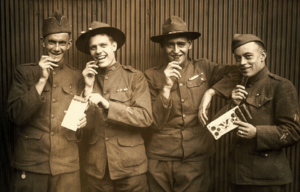
Chocolate lovers usually focus on the treat’s rich, satisfying flavor—but it hasn’t always been designed to taste good. During World War II, the Hershey Company produced a special type of chocolate bar for the U.S. military that was intentionally made to be far less appealing.
Known as the Field Ration D bar, it was packed with high-calorie, life-sustaining ingredients meant for emergency situations. The goal was simple: provide soldiers with vital energy when food was scarce—while making the bar just unpleasant enough that troops wouldn’t eat it unless they truly needed it.
Looking for rations that could survive combat conditions

In April 1937, Col. Paul Logan from the office of the U.S. Army Quartermaster General met with Hershey Chocolate Corporation president William F. R. Murrie and chief chemist Sam Hinkle. Logan was searching for a compact, life-preserving chocolate bar that could be issued to American soldiers during wartime. The Army wanted a pocket-sized ration that could withstand high temperatures while delivering a dense supply of calories and nutrients.
There was one unusual requirement: the chocolate wasn’t supposed to taste good. In fact, Logan specifically requested that it taste no better than “a boiled potato.”
Murrie and Hinkle brought the proposal to Milton S. Hershey, who quickly took interest in the project and supported the effort to develop the unusual military ration.
Field Ration D

Paul Logan had four main requirements for the Field Ration D Bar:
- It had to weigh four ounces.
- It should have a high caloric value.
- It needed the ability to withstand high temperatures.
- It couldn’t be too tasty.
The final result developed by Hershey was dubbed the “Field Ration D.” It consisted of a blend of chocolate, sugar, cocao fat, skim milk powder, artificial flavoring and oat flour. The mixture created was essentially a heavy paste that needed to be pressed, rather than poured, into molds. This made the bar was so dense that the instructions attached suggested it should be eaten over the span of about half an hour.
Keeping the Hershey chocolate factory open

Once the United States entered the Second World War, Congress planned to shut down the candy industry for the duration of the conflict, deeming the industry non-essential. In an attempt to keep his business operating, Milton Hershey argued that Hershey’s chocolate was an essential source of nutrients for American troops.
Thus, the bulk of the company’s wartime production was geared toward producing chocolate for the American forces.
American troops weren’t fond of the Field Ration D

While Hershey’s was producing a large amount of Field Ration D bars during World War II, American soldiers were certainly not their biggest fans. Troops jokingly nicknamed the bars Germany’s “secret weapon,” due to their effect on digestive systems. Troops were also known to trade the bars for better tasting food with unsuspecting civilians who weren’t well acquainted with the chocolate.
Even though the taste of the Field Ration D wasn’t popular among troops, Hershey’s won the Army-Navy “E” Production Award in 1942. This award was given to companies during the conflict for excellence in the production of top-quality equipment for the US military.
Hershey’s Tropical Bar

In 1943, the US Army, once again, approached Hershey’s about the possibility of developing a new chocolate bar for the Pacific Theater. The goal for this was to withstand high, tropical temperatures and taste a little bit better than the Field Ration D.
The Hershey’s Tropical Chocolate bars were one- or two-ounce pieces of chocolate that could hold their shape after one hour in 120-degree Fahrenheit temperatures. The bar was made from many of the same ingredients as the Field Ration D, but included vitamin B-1. This helped prevent beriberi, which resulted from a B-1 deficiency, that caused nerve, heart and muscle damage, as well as overall weakness.
It’s estimated that, by the end of 1945, over three billion Field Ration Ds had been produced and distributed to soldiers across the world. Similarly, by the end of World War II, nearly 38o million two-ounce Tropical Chocolate bars had been produced for the US military.
More from us: Bob Denard: The Mercenary ‘Pirate of the Republic’
Fast-forward to July 1971, when the Hershey’s Tropical Chocolate bar went to the moon with the Apollo 15 astronauts. While these chocolate bars might not have had the best taste, they sure were widespread.