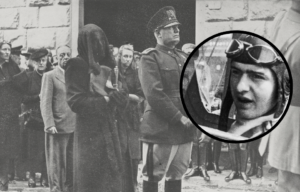
Bruno Mussolini, the second recognized son of Italian dictator Benito Mussolini and his wife, Rachele, was an accomplished and decorated aviator. His promising career was tragically cut short in 1941 when he died at just 23 years old—a loss that deeply affected his father.
Early Life

Bruno Mussolini was born on August 22, 1918, in Milan, Italy. During the time of his birth, his father Benito Mussolini was the editor of Il Popolo d’Italia (“The People of Italy”) newspaper. In 1919, Bruno caught a severe case of diphtheria. According to Rachele Mussolini, Bruno’s sickness greatly affected Benito Mussolini “far more than any political success or defeat.”
Benito and Rachele Mussolini would spend days at Bruno’s bedside watching for the faintest sign that his health was improving. When the physicians finally told Rachele and Benito that their son was out of danger, Benito’s eyes “filled with tears of joy.”
This clean bill of health didn’t last long for young Bruno, however, as he suffered a bronchial complaint just as he was getting over his diphtheria. By the time he got over his bronchial complaint, two-year-old Bruno’s weight had dropped to only 15 pounds.
He and his brother followed in his father’s footsteps

After this initial health scare, Bruno grew to be a healthy and happy child. At age 12, Bruno and his older brother Vittorio (who was 14 at the time) followed in their father’s footsteps and took up journalism as a job. Together they published La Penna del Ragazzi (“The Boys’ Pen”), a weekly magazine published in Rome.
On November 7, 1938, Bruno married Gina Ruberti in Rome. Gina Ruberti was the daughter of the head of the Ministry of Education’s Contemporary Art Bureau. On March 18, 1940, the couple welcomed a daughter who they named Marina.
Bruno Mussolini as a pilot

In June 1935, Bruno became Italy’s youngest licensed pilot at age 17. During the Second Italo-Ethiopian War (1935-1936), Bruno flew with the Regia Aeronautica (Italian Royal Air Force). At age 18, Bruno earned a silver medal of valor for his work in the Ethiopian campaign. After Ethiopia, Bruno also flew in the Spanish Civil War, working in a bombing squadron with the Rightist airforce. He made raids on Barcelona, Valencia, Alicante, and Cartagena. Bruno earned a second silver medal of valor during the Spanish Civil War.
Bruno also flew for Italy during the Second World War. According to Bruno’s younger brother Romano Mussolini, when Bruno returned home to Italy from Germany, Benito Mussolini asked Bruno to report on the true capabilities of the German airforce. Bruno told his father that “despite the Germans’ admirable and widespread efforts, they would lose the War.”
Bruno set flight records

In addition to participating in major European conflicts, Bruno also was involved in setting various flight airspeed records. In 1937, Bruno was credited with establishing speed records for land planes carrying 500, 1000, and 5000 piping loads over a closed circuit. In 1938, Bruno Mussolini and two other pilots flew nonstop from Spain to Brazil.
Bruno’s untimely death
Bruno Mussolini’s life came to an abrupt end on August 7, 1941, when he volunteered to test a prototype of the Piaggio P.108 bomber. The P.108 was a formidable four-engine aircraft capable of carrying a 7,700-pound bomb load. However, the plane saw only limited production during World War II, hindered by a prolonged development process, the strain on Italy’s industrial capacity, and ongoing shortages of resources.

At approximately 8:50 a.m. on August 7, 1941, Bruno Mussolini took off from Pisa Airport in Italy aboard a prototype Piaggio P.108 bomber. He had flown the same aircraft over Riccione just a week earlier and planned to conduct a series of additional test maneuvers.
That morning, however, the heavy aircraft struggled to gain lift and only became airborne at the very end of the runway. In the process, one of its wings struck a small house, causing the plane to flip and crash on Bruno’s side. He and three fellow airmen were killed in the accident.
Bruno was cleared of any fault

An investigation into this accident cleared Bruno of any fault. The investigation revealed the cause of the accident to be the improper functioning of the gas switch, due to the great distance between the motors and the pilot’s post. Bruno Mussolini was posthumously awarded the Gold Medal for Aeronautic Valor for his sacrifice.
Benito Mussolini’s reaction to Bruno’s death
Family close to Benito Mussolini reported that the dictator was heartbroken at the loss of his second son. Rachele Mussolini recalled that “Il Duce’s excruciating silence” hit her the hardest when the couple found out about Bruno’s accident. She added, “it was as if he had turned to stone.”
Vittorio Mussolini also recalled how Bruno’s death impacting his father, stating “there was a Mussolini before Bruno’s death, and a Mussolini after Bruno’s death. I’m not saying that prior to August 7, 1941, our father smiled often, but despair was not part of his emotional range. The tragedy turned him into a different man whose lost stare, at times, provoked tragedy.”
Benito Mussolini partially dealt with his grief over Bruno’s death by writing a book titled Parlo con Bruno, or, I Talk With Bruno. This book implied timeless intimacy between the father and son and mixed Fascist, Catholic, and family piety together.

An elaborate funeral was held at the Fascist Party headquarters in Pisa and Bruno Mussolini was interred in the Mussolini family crypt in San Cassiano cemetery in the town of Predappio. In 1985, actor Robert Downey Jr. played Bruno Mussolini in the television mini-series Mussolini: The Untold Story.