Weather played an important role in World War II

Germany was far behind the Allies

Lagging behind the Allies in gathering crucial weather intelligence, the Germans turned to risky alternatives. They deployed used specially-modified aircraft, naval ships, and even U-boats in daring missions to collect meteorological data. But these efforts often ended in failure—lone weather ships were vulnerable targets for Allied forces, and aircraft had limited range and effectiveness for such specialized tasks.
Realizing they needed a more reliable solution to close the gap, the German military devised an audacious plan: establish their own weather stations on North American soil. This led to the development of the Wetter-Funkgerät Land (WFL)—a covert, automated weather station designed for enemy territory.
Wetter-Funkgerät Land

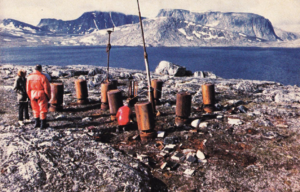
Scientists at Siemens developed an automatic weather station capable of transmitting data every three hours via radio waves on 3940 kHz. Known as the Wetter-Funkgerät Land, twenty-six were manufactured; 14 were placed in Arctic and sub-Arctic regions, including Allied-occupied Greenland, and five were stationed around the Barents Sea. Two were designated for North America.
The WFL featured an array of specialized instruments, including two masts. One of these masts held the anemometer, which measured wind speed and direction. It also included a telemetry device that automatically recorded data and transmitted it via a radio signal. Powered by rechargeable nickel-cadmium batteries, it could operate for up to six months.
Two U-boats were assigned to install the automatic weather stations in North America. U-537 was the first and only one to successfully deploy the WFL, codenamed “Kurt.” The second, U-867, was sunk in 1944 near the Norwegian coast by a Royal Air Force (RAF) bomber.
Installing the Wetter-Funkgerät Land on North American soil

Camouflaging Weather Station Kurt

Weather Station Kurt was expertly disguised to avoid arousing suspicion. The Germans labeled it with the logo and name of the fabricated “Canadian Meteor Service” and even scattered empty American cigarette packs nearby to suggest it had been set up by Allied troops. With most civilians unaware of military operations, German intelligence counted on lower-ranking Allied personnel who might stumble across the station to disregard it, wary of drawing attention.
The station had been deployed by the submarine U-537, which spent less than 30 hours off the coast of Newfoundland before turning for home. On the return voyage, the U-boat survived three separate attacks by Canadian aircraft near the Grand Banks. Despite facing these hazards, U-537 reached the port of Lorient in German-occupied France on December 8, 1943—70 days after the mission began. While no Allied ships were sunk on this patrol, the operation stood out as a rare example of German activity on North American soil.
Becoming a forgotten part of World War II-era history

Weather Station Kurt only worked for a few weeks before failing, and it remained undiscovered long after World War II was over. In 1977, geomorphologist Peter Johnson was conducting research near Martin Bay when he stumbled upon the site. He thought it was a Canadian military outpost and simply marked it as “Martin Bay 7” on the map he kept during his research.
Around that same time, a retired Siemens engineer named Franz Selinger was writing a history of the company. He went through Kurt Sommermeyer’s papers and learned of the station’s existence. He subsequently notified the Canadian Ministry of Defence.
More from us: The Devastating Invasion That Kicked Off the Second World War
In 1981, Weather Station Kurt was officially discovered, standing on the same spot where the Germans had left it over 30 years prior. It was dismantled and taken to the Canadian War Museum in Ottawa, Ontario, where it remains on display to this day.