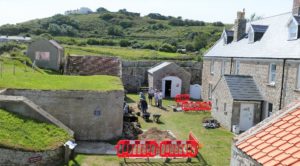
A German bunker that was uncovered on Alderney has also revealed a Roman courtyard and several other intriguing finds spanning multiple periods. Situated in the Channel Islands between England and France, the bunker was constructed directly within the footprint of an ancient Roman fort.
Alderney, inhabited for roughly 1,700 years, is home to a Roman tower believed to have protected a nearby settlement. This structure is considered one of the most intact military buildings from the Roman era.
Rising 26 feet high, the tower is thought to date from the 4th century C.E. and boasts walls approximately 10 feet thick. ArtNews recognizes it as one of Britain’s best-preserved Roman forts.
The original fort covered around 320 square feet and had rounded corners where towers once stood. While large portions of its outer walls survive, only fragments of the main tower remain. Its design is reminiscent of Roman signal stations found in Yorkshire, according to Current Archaeology.

The BBC says the site “has been occupied for about 1,700 years, containing the remains of structures from the medieval, Tudor and Napoleonic eras built on top of each other.”
The British are believed to have refurbished the Roman fort in 1793, leveling off the tower walls in the process, according to Heritage Daily. When the German’s invaded the island it appears they inserted a Type 501 bunker “neatly between the tower ruins, using the north and south internal walls effectively as shuttering to pour their concrete, according to Dr. Jason Monaghan, who is helping lead the excavation efforts.
Sadly, in completing their work on the bunker, the German’s “dug out the entire interior of the tower to do this, destroying any evidence for internal structures or floors” Monoghan told the BBC.
As German forces saught strategic defensive and offensive positions during WWII they converted the Roman Fort into “Resistance Point Piratenschloss (Pirate’s Castle). The Nunnery’s position to Longis Bay, a natural harbor, was considered a strategic stronghold for the Nazis. The location is just 60 miles off the coast of England and approximately 10 miles from France.

From 1940 until 1945, Alderney was the only British territory to be controlled by the Nazis. Along with the bunker, the Nazis used the island to house several concentration and forced labor camps including “Lager Norderney located at Saye, Lager Helgoland at Platte Saline, Lager Sylt near the old telegraph tower at La Foulère and Lager Borkum, situated near the Impot,” according to Wikipedia. Two of the camps on the island were the only Nazi concentration camps to ever be located on British soil.
The island’s original residents were fully evacuated during the war and Hitler ordered nearly 6,000 prisoners to the small island by 1942. The forced laborers who were brought to the island were forced to build anti-tank bunkers, air raid shelters, concrete barricades, and other features that could help fortify the island. Hitler ordered that the island become an “impregnable fortress.”
Much of the island’s history during the Nazi occupation was lost after the war. German officers who were left in charge of the facilities on the island burned the camps to the ground and destroyed as many records as possible. It wasn’t until May 16, 1945, that British forces liberated the island. In December 1945, residents were allowed to return to Alderney.
In 2021, the team at Dig Alderney discovered a courtyard they had been looking for over the past several years.
An update on Dig Alderney’s Facebook page says, “We’ve been looking for it for years; Trenches 2,3,5,6, and 8 came up blanks. But this year we have it in Trench 6E. Once we have reviewed the notes made on site we may also be able to confirm it also survives in 6B…”

Dig Alderney has made significant strides in their excavation work. Researchers will continue to focus on uncovering the remaining medieval and Tudor features, as well as investigating nearby Iron Age and Roman structures.
Visitors to Alderney can still view portions of the Roman Tower, which remain accessible to the public. The Nunnery Heritage Site is also emerging as a popular destination, offering educational spaces, exhibits, and other attractions.
For those interested in tracking excavation and restoration efforts on the island, the States of Alderney has compiled an official government document detailing ongoing projects and notable historical discoveries. The full document is available for viewing here through the States of Alderney.
Given the fort’s layered history spanning multiple periods, it will likely take several more years before the island’s archaeological work is fully completed.