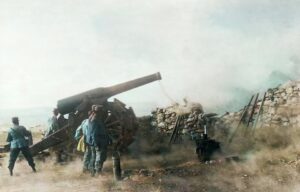
Although the Western Front dominates most narratives of World War I, the Isonzo Front carried its own brand of relentless misery. Stretched along the unforgiving mountains of what is now the Italy-Slovenia border, the front saw twelve major battles unfold in just two years. Soldiers fought not only each other but also the terrain itself—sheer cliffs, freezing rain, scorching summers, and supply lines that often failed long before the enemy’s guns did. Each engagement became a grinding contest of attrition in some of Europe’s harshest landscapes. The human cost was immense: more than a million men were killed or wounded, a stark reminder of the staggering hardship endured in one of the war’s most punishing and frequently overlooked campaigns.
What were the Battles of the Isonzo?
The Battles of the Isonzo were a series of 12 fierce clashes between the Austro-Hungarian and Italian armies, fought near what is now the border of Slovenia. Before Italy officially entered the war, Austro-Hungarian forces had already built strong defenses in the region’s rugged, mountainous terrain, anticipating future battles.

Italy’s push against Austria-Hungary was motivated by the 1915 Treaty of London, which promised Italy territorial gains at Austria-Hungary’s expense. Under the leadership of Chief of Staff Luigi Cadorna, the Italian strategy focused on capturing the city of Ljubljana.
The first attack began on June 23, 1915. Despite having a 2:1 numerical advantage, the Italian Army struggled to break through because the Austro-Hungarian troops were well-entrenched and put up a determined fight.
The Isonzo River was a huge hurdle

It quickly became clear that success depended on driving the enemy from their fortified mountain positions. However, achieving this required crossing the Isonzo River—a challenge that Italian forces repeatedly failed to surmount.
Mounting casualties
The capture of Gorizia from August 6-17, 1916, was a major victory for Cadorna’s troops, providing a rare moment of success in an otherwise grueling war. After a year of hard fighting, the Italians adjusted their strategies, switching to shorter, more concentrated attacks to reduce casualties and improve their chances of success.

Despite these improvements, the last three battles in the fall of 1916 were still heavily impacted by the tough mountain defenses held by the Austro-Hungarian army. As the fighting continued, enormous amounts of resources were poured into what many began to see as a losing battle.
The casualties of the Battles of the Isonzo were staggering. Nearly 645,000 Italian troops died, making up almost half of Italy’s total military losses in the First World War. Austro-Hungarian forces suffered 450,000 casualties, bringing the total to about 1.2 million by the time the final battle took place.
According to reports, the last major clash, known as the Battle of Caporetto, led to around 305,000 Italian casualties and 70,000 Austro-Hungarian losses.
The first five Battles of the Isonzo
First Battle – June 23-July 7, 1915: Cadorna, a firm believer in the benefits of the campaign in Austria-Hungary, launched the first attack. The battle lasted 14 days, and, as aforementioned, the Italians were fought back by the Austro-Hungarians. The Italians were ultimately defeated.
Second Battle – July 18-August 3, 1915: The Italian Army captured Cappuccio Wood, as well as Mount Batognica. The battle only concluded when both sides ran out of ammunition. Later on, the Austro-Hungarian forces were able to reoccupy Cappuccio Wood.
Third Battle – October 18-November 3, 1915: The primary Italian objectives were to take two bridgeheads (Tolmin and Bovec) and, if possible, the town of Gorizia. They advanced to the Piave River, but ultimately stalled and failed to gain ground due to heavy Austro-Hungarian defenses.

Fourth Battle — November 10-December 2, 1915: The Italian Second Army attempted to occupy Gorizia. They successfully captured the nearby area of Oslavia and San Floriano del Collio, but failed to take their initial target. At the same time, the Italian Third Army launched a series of attacks, but these failed to bring about any significant gains.
Fifth Battle – March 9-17, 1916: The Second and Third Italian Armies once again attempted to take Gorizia, in order to reach the Tolmin Bridgehead. Though the battle was less bloody than those previous, Gorizia still remained free of Italian control.
The sixth to eleventh battles
Sixth Battle – August 6-17, 1916: The Italians were finally able to capture Gorizia, through the use of hand-to-hand combat, along with the Oslavia-Podgora Ridge and San Michele. The offensive is considered the most successful Italian attack along the Isonzo Front and was responsible for improving troop morale.
Seventh Battle – September 14-17, 1916: The Italian Army switched from broad attacks to focused ones. Over three days, the Italian forces saw minor victories in areas surrounding the Soča River Valley, in present-day Slovenia.

Eighth Battle – October 10-12, 1916: With a similar goal to the previous, this offensive saw both sides struggle to achieve victory, as heavy Italian casualties forced the battle to be called off. They suffered between 50,000 and 60,000 casualties, while the Austro-Hungarian forces saw 38,000.
Ninth Battle – November 1-4, 1916: Now positioned in the Soča River Valley, the Italian Army tried to advance further inland, but were, again, met with heavy Austro-Hungarian resistance.
Tenth Battle – May 12-June 8, 1917: By this point, Cadorna was beginning to worry about the German Army aiding the Austro-Hungarian forces. The Italians deployed 38 divisions against 14 from Austria-Hungary and began what would be a multi-week infantry advance along a 40 km front. The nearly month-long battle resulted in the Italians struggling to gain any major advances.
Eleventh Battle – August 19-September 12, 1917: By consolidating their position near Monfalcone, Italy and the Banjšice Plateau, this offensive is considered one of the few tactical victories for the Italians, who broke through the Austro-Hungarian line in two areas.
The twelfth and final Battle of the Isonzo
The Twelfth Battle of the Isonzo stands out as one of World War I’s most consequential and destructive engagements. Early on October 24, 1917, German and Austro-Hungarian forces unleashed a swift, well-coordinated attack that broke through Italy’s northern lines. The unexpected offensive quickly collapsed Italian resistance, and by afternoon the Central Powers had crossed the Isonzo River and captured Caporetto. Exhausted and caught off guard, Italian troops retreated in confusion, abandoning equipment and supplies as they withdrew toward the Piave River, where they managed to reorganize in mid-November.

The collapse at Caporetto delivered a crushing shock to Italian confidence and remains one of the country’s most painful military defeats. The broader Isonzo campaign left both armies ravaged; massive losses were incurred with almost no meaningful shift in territory, creating a legacy of bitterness and sorrow. In Italy, the scale of the setback fueled public anger and ignited widespread anti-war protests, ultimately leading to General Luigi Cadorna’s dismissal. His replacement, General Armando Diaz, implemented a steadier, defense-focused approach that helped stabilize the lines and restore Italy’s credibility among the Allied powers.
This bleak period also etched itself into literary history. Ernest Hemingway, who served as an ambulance driver supporting Italian forces, later drew deeply from his experiences on the Isonzo Front when crafting A Farewell to Arms. The novel’s stark reflections on the senselessness of war and its emotional devastation owe much to the turmoil and hardship Hemingway witnessed firsthand on the Italian front.