The conclusion of World War I was considerably more complicated than it is often presented in simplified historical accounts. For the Allied powers, victory over Germany was only one objective. They also sought to hold Germany accountable for its role in the outbreak of the conflict and to ensure that the consequences of war would be clearly understood.
Beyond securing peace, leaders in Britain, the United States, and other Allied nations hoped to create a lasting deterrent against future large-scale wars in Europe. Their aim was to establish the principle that aggressive actions leading to a continental conflict would bring severe penalties, discouraging any nation from pursuing a similar course in the future.
World War I continued after the Armistice was signed

While much about the Armistice and the subsequent Treaty of Versailles can be directly blamed for the Führer‘s rise to power less than two decades later, many factors contributed to World War I‘s slow end. Such conflict rarely just stops. More often than not, it grinds to a gradual cessation over a few days, at least.
The ceasefire was supposed to begin at 11/11/11: at 11:00 AM on the 11th day of the 11th month in 1918. The German Empire was in disastrous shape by then, but many in the Imperial Army and Navy didn’t want to accede; they wanted to keep fighting Britain on the open seas.
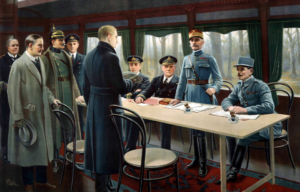
This led to the Kiel Mutiny, during which naval personnel openly defied their superiors who wished to keep fighting. They knew it was a lost cause. This prompted further rebellion among servicemen. To quell the growing disquiet, Kaiser Wilhelm II abdicated, shifting power to the Weimar Republic. Delegates were ordered to sign the surrender papers as quickly as possible, so word could spread that Germany’s war was over.
Germany was finished, but some Allied countries wanted it more severely punished, believing that only a “crushing” defeat could prevent another conflict elsewhere in Europe. While some were still arguing about the terms, the papers were signed at 5:10 AM on November 18, 1918.
What did Germany’s surrender entail?

A great deal of the Armistice was based on US President Woodrow Wilson‘s Fourteen Points, which outlined terms he believed were reasonable. It included items that remain in existence to this day, such as self-determination and open democracy.
Germany was told to remove troops from occupied regions, and the Ottoman and Austro-Hungarian Empires were dissolved. New countries in the Middle East were to govern themselves, but few were actually able to do so without outside help from the United States and Europe.
Under the Treaty of Versailles, Germany was compelled to disarm; submarines were turned over to the Allied nations. It was also told to make substantial war reparations, among other requirements, which was a major reason for the country’s economic near-collapse in the 1920s.
What happened following the signing of the Armistice?

In cities such as Paris, the end of World War I was greeted with jubilant celebrations as crowds filled the streets, replacing years of wartime strain and uncertainty with relief and optimism.
Conditions at the front were not always as straightforward. Although many German soldiers welcomed the armistice and stopped fighting once it came into effect, not every unit received the news immediately. Some formations continued combat operations simply because they were unaware that the ceasefire had begun. Consequently, a number of soldiers were killed after the official 11:00 a.m. deadline, not knowing that the war had already ended.
More from us: 24 Rare Photos That Give Us Another View of World War I