Patton’s wealth

Patton was not only a talented battlefield commander, he was also exceptionally rich. He was born into a remarkable family with a deep military history. His ancestry contained Welsh aristocrats, ties to the British monarchy, and indirect relations to George Washington. So from birth Patton only knew a life of privilege. His fortune increased greatly when he married Beatrice Banning Ayer, the daughter of Frederick Ayer, a Boston industrialist whose own family held enormous wealth.
However, his wealth did not stop him from racking up an impressive list of achievements. Patton was fascinated with military history from a young age, and despite his struggles with spelling and reading, became an expert on warfare and wrote extensive works on the topic. He participated in the 1912 Summer Olympics in Stockholm finishing in fifth place overall. Patton also became proficient at fencing and used this knowledge to design a new sword for the US cavalry.
When the US entered WWI, Patton joined John J. Pershing and the American Expeditionary Force on their way to Europe. It was during this time that Patton discovered his passion for tanks, and recognized their potential in warfare.
Increase armored strength
Between the two world wars, Patton pushed fanatically for increased investment in armored warfare, but budget restraints and a general lack of interest from other parties meant little was done in this aspect. However once WWII broke out in Europe, the US was motivated to quickly build up its military, which was not prepared for a large-scale war.
It was around this time that Patton became acquainted with Adna R. Chaffee Jr., a man who is considered to be the father of US armored forces. Chaffee made Patton the commander of the 2nd Armored Brigade, which was part of the 2nd Armored Division.
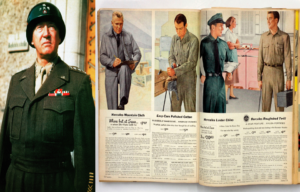
Patton assisted in the mobilization of this force, which would see him use the Sears Roebuck catalog in a desperate big to equip his men.
Sears Roebuck

Sears, Roebuck, and Co. was an American retail giant founded in 1892 that, in technical terms, still exists today. For much of its history, the company—better known simply as Sears—ranked among the largest retailers in the United States.
The business began by selling watches and jewelry, but it quickly evolved into a company that offered almost anything a household could need, from clothing to entire prefabricated homes. Its massive mail-order catalog became a familiar fixture in homes across the country, serving as a kind of shopping wish list for millions of Americans.
Marketed as the “Book of Bargains,” the Sears catalog featured an enormous range of goods, including tools, musical instruments, toys, medical supplies, clothing, baby carriages, bedding, firearms, and furniture. As automobiles became more common and customers gained easier access to physical retailers, Sears responded by opening stores across the United States. The company even managed to remain profitable during the harshest years of the Great Depression.
Sears continued to thrive throughout much of the 20th century, but its dominance eventually faced growing pressure from emerging retail competitors such as Target and Walmart.
Funding his troops
As mentioned previously, although the US was not yet involved in the war, when WWII started they were caught with their pants down, militarily speaking. A major mobilization took place, of which Patton was involved. But he physically was unable to equip his troops fast enough, forcing him to resort to a civilian retail catalog.
Patton used his own funds to purchase tools, parts, and supplies from the Sears catalog to rapidly equip the 2nd Armored Division during this turbulent time.
Air University, the U.S. Air and Space Force’s center for professional military education, writes, “Personal hygiene relied on G. I. issue steel helmets for washing hands, shaving, and bathing until at Patton’s direction Army quartermasters contracted with a San Bernadino Sears and Roebuck store to supply enough washbasins for the expanding number of troops.” Within a period of just 30 days, Patton was able to provide proper running water, latrines, and showers for all of his troops.
His decision to use his own money to equip his men was an indicator of what was to come with Patton; a leader that spent little time discussing a problem and instead focused on solving it.