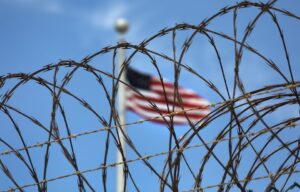
Do you know the differences between a military prison and a federally-run correctional facility?

Photo Credits: John Moore / Getty Images. (resized).

In 2019, correctional institutions across the United States—including federal, state, and military systems—held approximately 1.38 million people in custody. Over the past century, the purpose and approach of incarceration have changed significantly. Today, many federal prisons place a stronger emphasis on rehabilitation, providing inmates with educational opportunities, vocational training, and reentry programs designed to help them successfully return to civilian life after release.

While federal and military prisons can appear similar from the outside, they serve very different purposes. Federal prisons are mainly used to house civilians convicted of federal crimes and are generally focused on rehabilitation and eventual reintegration into society. Much of this system is managed by the Federal Bureau of Prisons. Military prisons, on the other hand, detain service members found guilty under the Uniform Code of Military Justice, along with prisoners of war and certain detainees held for national security reasons. These facilities are governed by strict military discipline and chain-of-command structures, resulting in an environment that is notably different from civilian correctional institutions.

What is a military prison?

Aerial view of Naval Consolidated Brig, Miramar
Naval Consolidated Brig, Miramar. (Photo Credit: Mahlon K. Miller / Wikimedia Commons / Public Domain)

Military prisons are usually used to hold prisoners of war (POWs), unlawful combatants, individuals who threaten national security, and military personnel convicted of serious crimes. These facilities are different from regular prisons and generally fall into two categories: penal, which focus on punishment or rehabilitation, and security-focused, which hold people considered a threat.

The U.S. military’s prison system is organized into three tiers, with a total of 59 facilities. Level One is the lowest and mainly includes inmates before or after their trials who have sentences of one year or less. Level Two holds the majority of prisoners, with sentences of up to seven years. Level Three uses the high-security prison at Fort Leavenworth, Kansas to house the most dangerous offenders.

Military prisons have changed a lot since they first opened

Front of Yellow building with windows and a sign reading 'USDB' above the door.
Leavenworth, Kansas, United States Disciplinary Barracks Main entrance. Opened in 1875. (Photo Credits: Gorsedwa / Wikimedia Commons CC BY-SA 3.0 / GNU Free Documentation License)

Since the first U.S. military prison was established in 1874, both the role of these institutions and the types of inmates held in them have changed considerably. In earlier years, imprisonment was most often the result of military offenses such as desertion or disobeying orders. After the United States ended the draft in the 1970s, the nature of these offenses shifted, with assault, drug use, and drug trafficking becoming increasingly common among incarcerated service members. By 2002, the typical military prisoner was generally a White man with a high school diploma, most often serving a sentence for a crime involving harm to another person.

The success of military correctional systems is often credited to their highly structured approach. Many facilities offer programs that include job training, counseling, and other rehabilitative services intended to encourage reform and prepare inmates for reintegration. Some also use boot camp-style programs centered on discipline, daily routine, and physical training. Parts of these methods have even shaped rehabilitation practices later adopted in civilian federal prisons.

Even so, life inside a military prison is very different from life in a civilian correctional facility. Daily routines are tightly controlled, expectations are strict, and discipline plays a much greater role in every aspect of prison life. This demanding environment reflects the military justice system’s broader purpose: maintaining order, enforcing standards of conduct, and balancing punishment with efforts to correct behavior.

The facilities differ between military and civilian prisons

Prisoner supplies laid out on a bunkbed in Guantanamo Bay detention camp
Belongings of a typical inmate imprisoned at Guantanamo Bay detention camp, Cuba. (Photo Credit: Joe Raedle / Getty Images)

Military prisons operate under the exacting standards of the broader Armed Forces, where discipline is absolute and order is enforced with exacting precision. Inmates must maintain spotless quarters, reflecting the rigorous expectations of basic training, and even minor violations can lead to immediate corrective measures. Supported by steady military funding, these facilities are typically modern, well-equipped, and meticulously cared for.

By contrast, civilian prisons—including federal facilities—face a distinct set of challenges. Limited budgets and staffing shortages often constrain oversight, leading to inconsistencies in enforcement. While regulations call for cleanliness and order, their implementation can vary significantly from one institution to another. As a result, the high level of structure and discipline found in military prisons is seldom matched within the civilian correctional system.

Military prisons follow a strict daily schedule

Six prisoners standing together outside
Inmates at the Peter J. Pitchess Detention Center performing landscape duties during a work detail. (Photo Credit: Axel Koester / CORBIS / Getty Images)

Military prisons begin their day at 6:00 AM with roll call. In typical military fashion, inmates follow a strict schedule that consists of meals, maintenance and workshops. Weekends feature more time for relaxation and recreation.

Military prisons have better food

Woman in grey shirt and black hat pulls paper off of large silver tray of food that sits on a shelf of trays with baked goods. Paper attacked to shelves of trays reads 'COOKIES FOR DETAINEE ONLY.'
Food that has been prepared in a kitchen for the detainees at the U.S. military prison for ‘enemy combatants’ on June 26, 2013 in Guantanamo Bay, Cuba. (Photo Credits: Joe Raedle / Getty Images)

Food is a big part of prison life, and military prisons are known for having much better meals than civilian facilities. Guards in military prisons have strict rules in place that prohibit inmates from taking food outside of the dining hall, while civilian inmates have little to no oversight regarding this, allowing for trading to occur. Federal institutions also have access to a commissary that allows prisoners to purchase food and other goods.

Civilian prison guards are more likely to be corrupt

Soldier standing in the middle of a hallway at the Guantanamo Bay detention camp
Soldier stationed at the Guantanamo Bay detention camp, Cuba. (Photo Credit: John Moore / Getty Images)

Military prisons are generally staffed by military police or personnel from local security forces units. These guards, as members of the armed forces themselves, are held to the same standards of conduct and discipline as the inmates they oversee. Because they’re trained to serve across all military branches, they tend to approach their duties with professionalism and often show respect toward those in custody.

In contrast, civilian prisons can present a more unpredictable dynamic. Some guards take a laid-back approach—doing their rounds and then keeping to themselves—while others lean heavily on their authority, using fear or intimidation to maintain control. This often creates friction and fosters distrust among inmates. In more troubling cases, some civilian guards exploit their power, leading to mistreatment. Such abuse is less common in military facilities, where a shared code of conduct and mutual accountability help keep such behavior in check.

Military prisoners aren’t allowed to salute their fellow officers

Impact program members marching along the grounds of the Elayn Hunt Correctional Facility
Members of the Impact program march around the grounds of the Elayn Hunt Correctional Facility in Louisiana as part of boot camp. (Photo Credit: Damian Strohmeyer / The Denver Post / Getty Images)

While most aspects of life in a military prison are surprisingly similar to life in the service, one important tradition is actually prohibited: the salute. Military inmates aren’t allowed to salute officers; doing so is actually a punishable offense. Prisoners aren’t allowed to salute officers because it’s seen as inappropriate for a superior to return the gesture.

Ranks are removed for inmates 

Back of man's head and shoulders, dressed in a camo uniform and hat. Behind him is a guard tower and gates with barbed wire at the top. Dark blue sky on the other side of the fence.
U.S. Army soldier stands outside the entrance of the “Gitmo” detention center at the U.S. Naval Station at Guantanamo Bay, Cuba. (Photo Credits: John Moore / Getty Images)

Ranks are also removed upon imprisonment. In 2012, Lt. Col. Ken Pinkela was found guilty of felony assault, willful disobedience, abusive contact and conduct unbecoming of an officer. He was taken to the US Disciplinary Barracks at Fort Leavenworth to serve out his sentence.

As one of the highest-ranking inmates, Pinkela struggled to come to terms with his loss of rank, which he’d worked for 20 years to achieve. “In Leavenworth, your former rank carries no weight,” he told The Marshall Project. “On the day I went in, the silver oak leaves emblazoned on my uniform that signaled what I was were taken away from me, and I became an inmate – a prisoner to a country that I swore to protect and serve.”

Use of solitary confinement

Three US military officials standing inside a solitary confinement cell at Guantanamo Bay detention camp
Solitary confinement cell at Guantanamo Bay detention camp, Cuba. (Photo Credit: Cody Black / U.S. Army / Wikimedia Commons / Public Domain)

One of the more harrowing parts of imprisonment is solitary confinement – or “the hole.” The punishment is used in both military and civilian prisons if an inmate disobeys an order or commits an offense. According to Quartz, solitary confinement in the US is “inflicted upon at least 80,000 inmates, including juveniles, often for months or years.”

No human interaction

Woman in military uniform with patch on arm reading 'MP' and wearing blue gloves touches a mirror on a white wall above a sink inside of a cell. Some pictures can be seen on a wall behind her.
Cell search at the United States Disciplinary Barracks, Leavenworth, Kansas. (Photo Credits: Sgt. Vincent Daly, Fort Leavenworth Public Affairs / NCO Journal / US Military / Wikimedia Commons / Public Domain)

Military prisoners can be placed in solitary for up to six months, where they sit in an eight-by-seven-foot room with a toilet, sink, bed and light. They receive no human interaction, with food shoved through a small slot in the door. Sometimes, all it takes to be thrown into solitary is having old toothpaste.

Former US Army soldier Chelsea Manning, who was imprisoned at Fort Leavenworth, was threatened with indefinite solitary confinement for possessing expired toothpaste, dropping food on the floor, and allegedly having copies of Vanity Fair and Cosmopolitan.

Rehabilitation of prisoners

Prisoners sewing together military uniforms at tables
Prisoners sewing together military uniforms. (Photo Credit: Federal Bureau of Prisons / Wikimedia Commons / Public Domain)

One of the main objectives of prison is to rehabilitate criminals and prepare them for reentry into society. Rehabilitation programs are especially important for military prisoners who will be given a dishonorable discharge upon their release, as they’ll need a new skill or trade upon reentering the civilian world. Military prisons offer training for inmates in carpentry, auto repair, cooking, hospitality and more.

More from us: Here’s Why Saddam Hussein’s Plan to Engage the Coalition in WWI-Style Trench Warfare Failed

Civilian prisons also provide inmates with opportunities for learning and growth. Resources to obtain high school diplomas, learn skilled trades and special programs for substance abuse are provided. Inmates can also take college courses, at their own expense. Unfortunately, these opportunities are not as readily available to civilian prisoners as they are to military inmates.

Elisabeth Edwards

Elisabeth Edwards is a public historian and history content writer. After completing her Master’s in Public History at Western University in Ontario, Canada Elisabeth has shared her passion for history as a researcher, interpreter, and volunteer at local heritage organizations.

She also helps make history fun and accessible with her podcast The Digital Dust Podcast, which covers topics on everything from art history to grad school.

In her spare time, you can find her camping, hiking, and exploring new places. Elisabeth is especially thrilled to share a love of history with readers who enjoy learning something new every day!

The Digital Dust Podcast

linkedin.com/in/elisabethcedwards