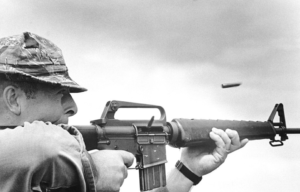
US troops in Vietnam disliked the M16 rifle so much that they purchased AK-47s from the black market

Photo Credit: Bettmann / Getty Images

When it first entered service during the Vietnam War, the M16 was celebrated as a breakthrough for U.S. forces—lightweight, accurate, and seemingly well-suited for jungle combat. In practice, however, the rifle often underperformed. Soldiers frequently encountered malfunctions such as jams and feeding problems, sometimes in the midst of firefights.

These ongoing issues eroded confidence among troops, leaving many to question whether the M16 could be trusted in critical moments. Meanwhile, the AK-47, a simple and robust Soviet-designed rifle, earned quiet admiration for its ability to operate reliably under almost any conditions. Its dependability not only emphasized the durability of opposing forces but also highlighted the frustrating shortcomings of the M16 in its early deployment.

Adoption of the M16 rifle in Vietnam

In 1966, Gen. William Westmoreland, Commander of the US Forces in Vietnam, introduced the M16 rifle as the new standard-issue infantry rifle, replacing its predecessor, the M14. Developed by engineer Eugene Stoner in the late 1950s, it was favored for its accuracy, light weight and the amount of fire it provided.

US soldier holding an M16 rifle
US Army soldier with the 1st Cavalry Division holding an M16 rifle during a patrol, January 1971. (Photo Credit: Christopher Jensen / Getty Images)

American troops in Vietnam were given a modified version of the M16, variant XM16E1. The weapon’s adoption was largely in response to the high number of casualties resulting from the enemy’s use of AK-47s. However, controversy surrounding the efficacy of the M16 prevented it from being issued to troops stationed in Europe and the US.

The M16 rifle jammed… A lot

Early versions of the M16 were plagued by significant reliability problems. A frequent issue, called a “failure to extract,” happened when a spent cartridge became lodged in the chamber, resulting in a jam. In some situations, this caused the rifle to function more like a single-shot musket than a fully automatic weapon, leaving soldiers vulnerable during combat.

Reporter firing an M16 rifle.
United Press International reporter Betsy Halstead learns how to fire an M-16 automatic rifle while at the Khe Sahn special forces camp during the Vietnam War. (Photo Credits: Bettmann / Getty Images).

The most reliable way for soldiers to clear a jammed cartridge was to manually push it out, using a steel rod inserted through the barrel to dislodge the stuck casing.

The M16 was still seen as more effective than the M14

It was later found that the jamming problem was caused by switching to ball powder, which was meant to boost the muzzle velocity to 3,250 feet per second.

Spent shell casings in the sand
Spent shell casings from M16 rifles at the Fort Dix firing range, New Jersey, 1967. (Photo Credit: Leif Skoogfors / Getty Images)

Even with these problems, the M16 was still seen as better than the M14. In fact, the US Army even called it the best rifle for combat in Vietnam. To fix the issues, they improved training, adjusted the gunpowder formula, and made sure cleaning kits were widely available—but not before a Congressional report brought attention to the problems.

A harrowing report is released

In 1967, nearly 80 percent of the 1,585 soldiers surveyed reported having stoppage issues with the M16 rifle during combat. Many of these soldiers wrote letters to their families, voicing concerns about the weapon’s reliability. In response, their families sent these letters to members of Congress, bringing the issue to the attention of the House Armed Services Committee.

US soldier holding an M16 rifle
Rifleman with the 1st Cavalry Division holding an M16 rifle, October 1967. (Photo Credit: Bettmann / Getty Images)

This approach worked, leading to the formation of a Congressional Subcommittee to investigate the M16. After a detailed review, the committee’s report confirmed the soldiers’ complaints. It found that the Army had failed to provide proper training on the new rifle, did not ensure the ammunition was compatible, and neglected to supply enough cleaning kits to prevent jamming.

Despite these findings, the military continued issuing the M16 to soldiers. As reliability problems persisted, many service members in Vietnam lost trust in the weapon and began looking for alternatives.

Picking up the AK-47

During the Vietnam War, many American troops came to respect the AK-47, the standard rifle used by the Viet Cong and North Vietnamese forces. In the 1950s, China produced its own version, known as the Type 56 or AK-56. This model was slightly shorter and lighter than the original Soviet rifle and could be fired in either semi-automatic or fully automatic modes.

The AK-47 earned its reputation for being extremely durable and easy to handle. It continued to function in harsh environments and needed very little upkeep. Because of its straightforward, rugged construction, even inexperienced fighters could use it effectively—a major advantage in the intense heat and humidity of Southeast Asia’s jungles.

US Marine holding an AK-47
US Marine who survived an ambush with a bullet-nicked ear and a captured Viet Cong AK-47, December 4, 1967. (Photo Credit: Ed Palm Photo / Getty Images)

American soldiers often grew frustrated with the M16, especially because it had a well-known habit of jamming during combat. In contrast, the AK-47 earned a reputation for reliability, and many troops began to favor it. Soldiers obtained the rifles in various ways—some captured them from enemy forces, while others acquired them through informal trades or secret purchases. Despite widespread reports of malfunctions in the field, military officials maintained that the M16’s issues were caused by improper use or lack of maintenance, rather than flaws in the weapon’s original design.

Samantha Franco

Samantha Franco is a content writer with a BA and MA in history, focusing on Victorian, medical, and epidemiological history. She has written content for multiple sites covering an array of historical topics.