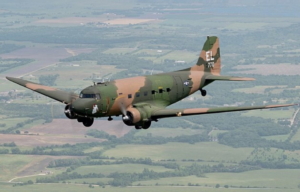
During the Vietnam War, U.S. service members gave the 1960s folk tune “Puff, the Magic Dragon” an entirely new association. They adopted the title as a nickname for the Douglas AC-47 “Spooky,” the first fixed-wing gunship deployed in the conflict.
What began as a simple cargo plane was transformed into a devastating airborne weapons system. Armed with three 7.62mm Gatling guns mounted along its fuselage—each capable of unleashing thousands of rounds per minute—the AC-47 quickly became known as one of the war’s most intimidating aircraft.
After dark, its firepower produced a breathtaking and eerie display: streams of red tracer fire sweeping through the night sky, giving the impression of a dragon spewing flames. That dramatic, almost storybook image cemented the aircraft’s now-famous moniker, “Puff, the Magic Dragon.”
Its effectiveness in defending remote positions and delivering accurate close-air support reshaped the way airpower was used in Vietnam. The AC-47’s success laid the groundwork for the development of later gunships such as the AC-119 and the renowned AC-130. Even today, the influence of “Puff” can be seen in modern gunship doctrine and design.
Deployment of Douglas C-47 Skytrains to Vietnam

The predecessor to the AC-47 Spooky was the two-engined Douglas C-47 Skytrain, which was flown extensively by the Allies during the Second World War. The C-47 was brought to Vietnam in November 1961, but was mainly flown as a transport and cargo gunship by the Americans.
Many C-47s were outfitted as “flare ships” and designated FC-47s (“F” for flare, in this case). They’d drop parachute flares over enemy positions during night attacks, and, by November 1963, had deployed more than 7,000.
Development of the Douglas AC-47 Spooky

By 1963, the Viet Cong’s nighttime guerrilla tactics highlighted the need for the U.S. military to improve its air strategy for operations under low-light conditions. After careful consideration, the U.S. Air Force moved forward with the creation of the modern fixed-wing gunship.
This innovative concept involved adapting a fixed-wing aircraft to carry heavy armaments mounted on the sides for side-firing capability. While the idea of side-firing gunships had been explored before World War II, it wasn’t until 1963 that the concept became a reality.
The C-47 Skytrain was chosen as the test aircraft for the first fixed-wing gunship, as it fulfilled all the all the necessary criteria. The success of the design relied on the aircraft’s ability to focus concentrated fire on enemy targets while maintaining enough power and space to carry significant weaponry. As a cargo plane, the C-47 could transport large amounts of munitions, and its propeller-driven design allowed for the maneuverability needed for precise fire support in combat situations.
‘Spooky’ experiments

By mid-December 1964, modifications to the C-47 Skytrain were completed. Initially, this new type of aircraft was designated the FC-47, for “fighter/cargo.” However, fighter pilots were upset with the “fighter” categorization; they refused to believe that a slow cargo aircraft could be a fighter. To appease them, the new aircraft was designated AC-47, meaning “attack/cargo.”
Testing of the AC-47 began in Vietnam in late 1964. On December 14, it flew its first daytime combat mission, firing on enemy boats, trails and staging areas. The aircraft’s first night mission occurred on December 23, 1964. During the attack, the AC-47 fired over 4,500 rounds of ammunition and dropped a total of 17 flares. Its efforts successfully halted the Viet Cong assault.
The AC-47 continued to be successfully tested throughout early 1965. In fact, these trials were so successful that an AC-47 was sent to the United States to provide crew training. That July, the US Air Force ordered officers with Training, Advising and Counseling (TAC) to establish an AC-47 squadron. In August, the 4th Air Commando Squadron was created. It operated five aircraft upon its inception, with 26 equipped by the end of the year.
Weaponizing the Douglas AC-47 Spooky

The C-47 Skytrain’s appearance didn’t change when it was modified into an attack aircraft. Inside, three M134 Miniguns were installed to fire through two rear window openings and the side cargo door, all positioned on the aircraft’s left side, where the pilot sits.
Mounting the weapons on the left side was crucial for providing close-air support to ground troops. The Miniguns had a blazing-fast rate-of-fire of 6,000 RPM, enough to cover an entire football field in just one minute. A MK.20 Mod.4 gunsight was also added to the left cockpit window.
Both the pilot and the gunners could operate the Miniguns, but the pilot usually fired them since the controls were built into the yoke. The gunners’ main role on the AC-47 was to monitor the guns and perform any necessary maintenance.
From ‘Spooky’ to ‘Puff’

Replaced by newer, more modern gunships

By 1969, the Ac-47 Spooky was beginning to show extreme wear and tear. It wasn’t practical to keep rebuilding and maintaining the gunships, especially as the more sophisticated AC-130 and Fairchild AC-119s were beginning to arrive in Vietnam.
Slowly, Puff, the Magic Dragon was transitioned out of mainstream use, and the last American AC-47 combat mission happened on December 1, 1969. Of the 53 delivered to Vietnam, about 41 of them saw combat during the Vietnam War.
The AC-47 was eventually replaced first with the Lockheed AC-130A Spectre, followed by the AC-119G Shadow, AC-119K Stinger and, finally, the AC-130E Pave Spectre. While these gunships were more modern, they wouldn’t have been as effective if it hadn’t been for the success of Puff, the Magic Dragon.
Other nations have equipped the Douglas AC-47 Spooky

While the US Air Force retired the AC-47 Spooky from active duty, other air forces worldwide have – and still – equip the aircraft. In December 1984 and January ’85, the United States supplied two to El Salvador and trained crews on how to operate them. As well, Thailand, Cambodia, South Africa and Uruguay were among the countries to once fly the gunship.
More from us: C-5 Galaxy vs C-17 Globemaster III: What’s the Difference Between These Cargo Aircraft?
Currently, the Columbian Air Force is the only one to still fly the AC-47, a variant known as the Basler BT-67. The 214th Tactical Air Support Squadron has about six in its inventory.