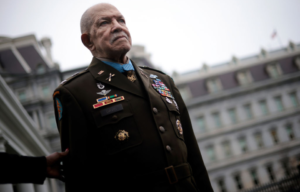
Paris Davis’ entry into the US Army

Paris Davis was born on May 6, 1939, in Ohio, and raised in a blue-collar family where his father worked in a foundry. From an early age, he showed a strong interest in both sports and the military. Those twin ambitions came together at Southern University in Louisiana, where he studied political science on an ROTC scholarship and excelled on the football field, earning recognition as an All-American halfback.
In 1962, Davis entered the U.S. Army, quickly distinguishing himself through intelligence, discipline, and physical prowess. His performance propelled him upward, ultimately making him one of the first African American officers to earn a place in the Army’s Special Forces—a notable achievement at a time when racial barriers were still deeply entrenched.
As a captain with the 5th Special Forces Group, Davis was fully aware that his position came with heightened expectations. His commander cautioned him that, because of his race, he would be judged more harshly than his peers. Davis met that reality head-on, enforcing a firm standard of professionalism and mutual respect. From the outset, he made it clear that discipline was non-negotiable, and any form of disrespect—including failing to call him “sir”—would not be accepted.
Deployment to Vietnam

In early 1965, Paris Davis and his Special Forces team deployed to Vietnam, parachuting into a secluded farming region in Bình Định province—a key corridor for Viet Cong and North Vietnamese Army movements. Their mission centered on training local volunteers to resist enemy forces.
Davis’s courage was soon put to the test in May of that year when he rescued an aviation fuel truck driver. An aviation fuel truck in Bồng Sơn overturned and pinned its driver inside. Disregarding both the driver’s pleas and the imminent danger, Davis sprinted to the wreckage and hauled the man to safety. Moments later, the truck erupted in flames.
His heroic rescue did not go unnoticed; Davis was awarded the Soldier’s Medal in 1968 for his selfless actions that day.
Paris Davis didn’t want to leave any man behind

Paris Davis didn’t wait long to further distinguish himself in Vietnam, risking his life for his men during an enemy attack in June 1965. The day began early for him, the 12 servicemen with the 883rd Regional Forces Company and the accompanying 90 South Vietnamese volunteers. They’d been tasked with conducting a surprise raid on an NVA camp deep in the jungle.
Davis and Master Sgt. Billy Waugh stormed into the enemy commander’s hut and killed him at close range. At the same time, the other members of the group threw grenades and shot their rifles. The majority of the NVA troops were caught unawares and killed in their cots. Some, however, heard the commotion and escaped into the jungle.
Considering the raid a success, Davis and his men started making their way back to camp. That’s when they heard the sound of bugles, signaling an impending ambush by the NVA – and a rather large one, at that. The team was pushed into a rice paddy with no cover as sniper fire rained down on them. Three bullets struck Waugh, while another hit the medic in the head. A mortar blast also knocked out the group’s weapons specialist.
Frequently exposing himself to enemy fire, Davis rallied his unit and directed their own small arms fire throughout what became a 19-hour standoff. He himself suffered severe injuries to his leg and hand, with a grenade blast practically tearing off his trigger finger. Despite his injuries, he continued to evacuate his wounded comrades, even as air support arrived and dropped bombs over the area. Among those he rescued was Waugh.
A colonel watching the engagement from above ordered Davis to seek shelter, but he refused, as it meant leaving behind his men. He frequently shot his M16 rifle with his pinkie finger while sprinting to the injured and dragging them to safety. When relief arrived, he refused medical aid for himself until everyone had been evacuated. It’s widely believed his efforts ensured each member of his team made it out alive.
Recommended for the Medal of Honor

Although Paris Davis had already been recognized for his actions in Vietnam with the Purple Heart and the Silver Star, his commander, Maj. Billy J. Cole, believed those honors fell far short of capturing the scale of his heroism—particularly Davis’s repeated refusal to leave wounded men behind under intense enemy fire. Convinced that his actions warranted the nation’s highest award, Cole promptly submitted a Medal of Honor recommendation. When no response came, he followed up, only to learn the paperwork had inexplicably vanished. Undeterred, he resubmitted the nomination, but that submission disappeared as well.
As months turned into years, suspicion grew among Davis’s fellow soldiers. Many came to believe that Davis was skipped over for the recognition because of his race.
Davis himself did not allow the setback to define him. He continued his military career with distinction, eventually rising to command the 10th Special Forces Group before retiring in 1985 with the rank of colonel. His commitment to service carried over into civilian life, where he founded The Metro Herald, a Virginia-based newspaper focused on elevating Black perspectives and documenting key moments in the struggle for civil rights.
Wider acknowledgment of his legacy came slowly. In 2019, Davis was inducted into the Ranger Hall of Fame, one of several long-overdue tributes recognizing a lifetime marked by courage, principled leadership, and an enduring pursuit of fairness and justice.
Paris Davis is presented with the Medal of Honor

Nearly two years later, it was announced that then-Acting Defense Secretary Christopher Miller had ordered a fast-tracked review of the long-overlooked Medal of Honor nomination for the Green Beret. Although a March 2021 deadline was set, little progress was publicly reported. That changed in November 2022, when a Pentagon official confirmed to Military.com that the nomination had been endorsed by Gen. Mark Milley, chairman of the Joint Chiefs of Staff.
From there, the nomination advanced to Defense Secretary Lloyd Austin, who approved it and forwarded it to President Joe Biden for final consideration.
On March 3, 2023—almost six decades after Davis’s acts of valor in Vietnam—he was formally awarded the Medal of Honor during a White House ceremony. In his remarks, President Biden praised Davis as a “true hero,” describing him as the embodiment of the medal’s values: “brave and big-hearted, determined and devoted, selfless and steadfast — America.”