In August 1972, a group of U.S.-deployed magnetic sea mines off the coast of northern Vietnam reportedly detonated at the same time, despite no enemy ships entering the area. American records noted multiple explosions, and some accounts estimate that as many as 4,000 mines may have gone off. The unexpected trigger behind this chain reaction was later attributed to solar activity.
Historically powerful solar storms

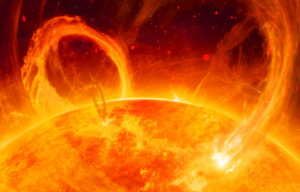
In August 1972, one of the most powerful solar storms ever recorded occurred. That month, the Sun had displayed increased solar activity before unleashing a series of extremely powerful solar flares – intense eruptions of radiation caused by the interactions of powerful magnetic fields within the star.
The burst of energy from a solar flare can be followed by a coronal mass ejection (CME), a magnetic cloud of radioactive particles that’s expelled from the Sun into the cold expanse of interplanetary space at unfathomably high speeds. While the Sun is almost 93 million miles away from the Earth, normal CMEs can make the journey in just one or two days.
August 4, 1972

The most powerful flare in the August 1972 solar storms occurred on the 4th, sending a highly energized and radiation-rich cloud into space. It reached Earth in just 14.6 hours, setting a record for the fastest observed coronal mass ejection (CME) travel time that still stands today. The impact on Earth’s magnetosphere produced unusually intense auroras, visible far beyond their typical range—reportedly as far south as Spain.
When the CME arrived, monitoring systems and sensors were inundated with charged particles, causing readings to spike dramatically, while magnetometers were pushed beyond their normal limits. Such extreme solar events pose risks not only on Earth but also in orbit, where satellites and spacecraft can suffer significant degradation; one satellite is estimated to have accumulated roughly two years’ worth of operational wear during this storm alone.
The timing also raised concern within the space program, as the event fell between the Apollo 16 and Apollo 17 missions, with the latter scheduled for launch months later. Had a mission been underway during the storm, astronauts could have faced dangerous radiation exposure even inside the command module, and a lunar surface excursion at the peak of the event could have delivered potentially lethal doses.
Sea mines detonated off the coast of Vietnam

American magnetic sea mines deployed off northern Vietnam were engineered to detonate in response to the magnetic signature of passing ships. Each mine contained sensors that continuously monitored local magnetic fields, triggering an explosion whenever a vessel came within range. These mines were part of Operation Pocket Money, a mission intended to block maritime trade along the Vietnamese coast.
New appreciation for the August 1972 solar storms

In 1972, the strange happenings caused by the enormous coronal mass ejection were seen as unremarkable and mostly fell under the radar of researchers at the time. It wasn’t until Delores Knipp, an esteemed research professor at the University of Colorado Boulder, began looking into the event that the true scale of the Sun’s activities back then was realized.
Knipp’s research began after a chance conversation with a colleague, who, at the time, was working at what would later become NOAA’s Space Weather Prediction Center. The latter had witnessed US Navy officials enter a meeting with his boss, and while he’d been unable to hear the details, he knew it was about a then-recent solar storm and its impacts on the military.
The 1972 solar storms are a warning about the power of the Sun

After learning about this, Knipp dived into military archives. She found a document that had been declassified in the 1990s that contained information about the spontaneous detonation of sea mines in Asia. With some more digging, she realized estimates made at the time significantly low-balled the power of the solar storm. She believes it was actually much closer in severity to the 1859 Carrington Event, the largest geomagnetic storm ever recorded.
Despite this, many failed to recognize its significance. “I think people forgot about it,” Knipp said in 2018. “They didn’t know about the sea mine problem and the effect on the power grids got published in engineering journals, not science journals.”
More from us: US Navy SEAL Solomon Atkinson Embodied the Spirit of Dedicated Military Service
Knipp regards the August 1972 solar storms as a warning about how vulnerable we are to the mind-boggling power of the Sun.