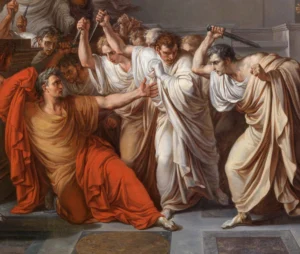
Before the daggers came out on March 15, 44 BC, Julius Caesar pulled off one of the most audacious battlefield gambits the ancient world had ever seen, and he did it outnumbered, surrounded, and with no way out.
Everyone knows how Caesar died. Fewer people know what he actually built before it all fell apart.

The Ides of March—March 15, 44 BC—is one of history’s most recognizable moments. The Senate floor. The conspirators. Twenty-three stab wounds. But strip away the drama of his death, and you’re left with a man who was, first and foremost, a battlefield genius. And nowhere is that clearer than at the siege of Alesia in 52 BC—a military operation so bold it still gets studied in war colleges today.
The Enemy Caesar Couldn’t Ignore

By 52 BC, discontent had reached a breaking point. A young Gallic nobleman named Vercingetorix pulled off something the Romans hadn’t seen: he adopted a strategy of attrition—avoiding pitched battle with the legions while denying them supplies, ordering villages burned, crops destroyed, and herds driven away. It was the first time anyone had united the Gauls under a single coordinated strategy, and it was working.
Caesar took a loss at Gergovia. His army was stretched. Then Vercingetorix made a fateful miscalculation—he retreated to a heavily fortified hilltop town called Alesia, believing he could trap Caesar between his own 80,000 defenders and a massive relief force coming from outside.
The Most Audacious Construction Project in Military History
Caesar opted simply to besiege the settlement, and what followed were some truly incredible siege works.
Outnumbered and deep in enemy territory, he ordered his army to construct not one but two continuous walls—one facing inward to trap Vercingetorix, one facing outward to block any relief force. The internal line prevented the Gauls from escaping, while the outer line prevented them from being relieved from outside. In total, these works stretched over 37 kilometers, and it’s thought they took about four weeks to complete.
He was building a prison around 80,000 soldiers while simultaneously fortifying against an army that hadn’t arrived yet. It was either genius or madness, and in Caesar’s case, it was both.
Caught Between Two Armies

When the relief force finally arrived at Alesia, it numbered some 250,000 foot soldiers according to Caesar, creating an extraordinary concentration of forces. Caesar’s legions were caught between two armies, fighting on two fronts at the same time, from inside a narrow corridor of their own construction.
The only weak spot in Caesar’s double line was a small gap in the northwest, and the Gauls desperately needed to break through it. At one point, the Roman lines buckled. Caesar personally rode to the threatened sector in his distinctive red cloak so his troops could see him—a high-risk move, but one that steadied the line.
The Fall of Vercingetorix

The Gauls couldn’t break through. Vercingetorix, wearing his finest armor, unconditionally surrendered to Caesar and was immediately taken away in chains. He would spend six years in a Roman prison before being executed in 46 BC.
For Caesar, Alesia was an enormous personal success—the Senate declared thanksgiving for the victory. It cemented his reputation, fueled his political rise, and set in motion the chain of events that would eventually lead Rome’s senators to decide he had become too dangerous to live.
Eight years after Alesia, on the Ides of March, they made sure of it.
If you like reading about Julius Caesar, then don’t miss:
- When Pirates Kidnapped Julius Caesar, He Laughed at Their Ransom Demands & Told Them To Ask for More