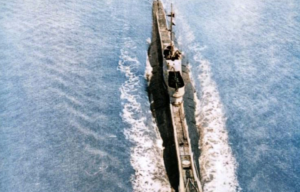
Photo Credit: Arkivi / Getty Images (Colorized by Palette.fm)
In 1931, the British submarine HMS Poseidon (P99) sank after colliding with a Chinese merchant vessel off the coast of China. The disaster initially attracted considerable attention in Britain, especially because several crew members managed a dramatic escape from the submerged submarine. Over time, however, the incident gradually faded from public memory.
Decades later, the story resurfaced when it was reported that Chinese authorities had secretly raised the wreck from the seabed without formally notifying the British government or relevant international bodies. The recovery is believed to have taken place in the 1970s but was not publicly acknowledged for years. When the details eventually became known, they renewed interest in the long-overlooked submarine and sparked discussion about the legal and diplomatic questions surrounding sunken military vessels, including issues of ownership and sovereignty.
HMS Poseidon (P99) collides with the SS Yuta
HMS Poseidon (P99) at sea. (Photo Credit: Arkivi / Getty Images)
In the early hours of June 9, 1931, the Royal Navy Parthian-class submarine HMS Poseidon (P99) was conducting routine surface exercises near Weihai, China, close to a British naval outpost. In calm seas and clear conditions, tragedy struck when the submarine collided with the Chinese merchant vessel SS Yuta, tearing a large breach along its starboard side.
Water flooded the vessel quickly, and it sank to a depth of more than 100 feet. Of the 52 sailors aboard, only 31 managed to escape, while 21 lost their lives, making it one of the deadliest submarine accidents in Royal Navy history. In response, the Royal Navy launched an immediate rescue operation, deploying the aircraft carrier HMS Hermes, the heavy cruiser HMS Berwick, and Poseidon’s sister submarine HMS Perseus to assist survivors and manage the aftermath of the disaster.
Leading to important policy changes
Testing of a Davis Submerged Escape Apparatus, 1942. (Photo Credit: Lt. C.J. Ware, Royal Navy Official Photographer / Wikimedia Commons / Public Domain
Eight crew members from HMS Poseidon managed to escape using the Davis Submerged Escape Apparatus, an early form of scuba gear. Unfortunately, not all of them survived—two never reached the surface, and another passed away later.
This incident prompted the Royal Navy to rethink its submarine escape procedures. Since some of Poseidon’s crew successfully escaped, the Admiralty decided to change its approach. Instead of instructing crews to remain inside and wait for rescue, they now encouraged immediate escape attempts after a collision. This change was announced in the House of Commons in March 1934.
Additionally, the military began equipping submarines with escape chambers and increased its research into decompression sickness treatment.
China launches a secret salvage mission
HMS Poseidon (P99) and Proteus (N229), Parthian-class submarines, in drydock. (Photo Credit: Royal Navy Official Photographer / Imperial War Museums / Wikimedia Commons / Public Domain)
For decades after the collision, HMS Poseidon lay untouched on the ocean floor, largely forgotten and seldom mentioned. That changed in 1972, when, amid the upheaval of China’s Cultural Revolution, the nation quietly undertook a secret mission to raise the wreck. Newly established underwater recovery teams carried out the effort in complete secrecy, with the full story only surfacing many years later.
The operation was a formidable challenge, demanding precise coordination to navigate significant technical and logistical obstacles. While China’s true motives remain unclear, some theories suggest the salvage served as a training ground to strengthen recovery capabilities, while others argue it may have been intended to eliminate a possible hazard to navigation.
Keeping the salvage of HMS Poseidon (P99) under wraps
Steven Schwankert attending the screening of The Six at the Vancouver International Film Festival, 2021. (Photo Credit: Phillip Chin / WireImage / Getty Images)
The salvage operation was kept under wraps for decades, and it wasn’t until 2002 that the first hints came out, thanks to an article in the Chinese magazine Modern Ships. This piqued the interest of researchers, leading to further investigations.
The West learned of the mission through Steven Schwankert, an American journalist and diving enthusiast. Schwankert stumbled upon the story during his research and was intrigued by the lack of information out there. His work led him to Hong Kong, where he uncovered the details of the 1972 salvage. He also came across testimony from a man who claimed to have witnessed the vessel being pulled from the ocean.
These revelations sparked renewed interest in Poseidon and her crew, and the British government sought an explanation from China, leading to several diplomatic discussions.