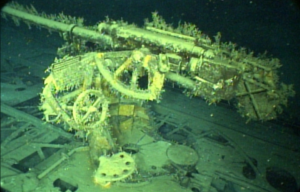
Photo Credit: US Government / NOAA's Maritime Heritage Program / Collection of LCDR Jeremy Weirich, NOAA Corps / NOAA Photo Library / Wikimedia Commons / Public Domain
During World War II, German U-boats ranged deep into the Gulf of Mexico, sinking a number of Allied vessels in a short but highly destructive campaign. Of the 23 submarines known to have operated in the region, only one—U-166—was confirmed lost to American action. Despite its brief combat career, the circumstances surrounding its destruction sparked decades of controversy within the U.S. Navy.
Commissioned in March 1942 during the Second World War, U-166 was a Type IXC submarine. It initially served in a training role with the Kriegsmarine’s 4th U-boat Flotilla before being transferred to the 10th Flotilla for combat operations. After early patrols near the British Isles, the submarine moved to bases in France and later crossed the Atlantic to begin operations in the Gulf of Mexico.
During its patrols, U-166 sank four vessels: the Dominican schooner Carmen, the SS Oneida, the fishing vessel Gertrude FV, and most notably the passenger liner SS Robert E. Lee. The attack on Robert E. Lee near the mouth of the Mississippi River on July 30, 1942, proved decisive. The liner’s escort, the patrol craft PC-566, commanded by Lt. Cmdr. Herbert G. Claudius, responded with a depth-charge attack. Claudius reported that he had destroyed the submarine.
Navy officials, however, questioned his account. Instead of receiving recognition, Claudius was reassigned to an anti-submarine training position, and the sinking of U-166 remained officially unconfirmed for decades—fueling long-standing debate over what truly happened beneath the Gulf’s waters.
On the day Robert E. Lee was torpedoed, a U.S. Coast Guard Grumman J4F-1 Widgeon patrol aircraft spotted a German U-boat off the Louisiana coast. The crew attacked, dropping depth charges and reporting a direct hit. Navy officials, however, dismissed the claim. With no wreckage recovered at the time, U-166 and its 52 crewmen were officially listed as missing in action.
The submarine’s fate remained unknown for nearly sixty years. In 2001, researchers mapping the seafloor near the wreck of Robert E. Lee made a dramatic discovery. Just two miles away, at a depth of roughly 6,650 feet, they located U-166. Partially buried in silt, the submarine’s conning tower and deck gun were clearly visible, conclusively identifying the wreck.
Because the remains of the crew were still inside, the site was designated a protected war grave.
A detailed survey conducted in 2014 provided new insight into how U-166 was destroyed. Damage to the forward section indicated that a depth charge had detonated on the deck, likely triggering the submarine’s own torpedoes in a catastrophic explosion. The findings confirmed that the Coast Guard aircraft’s attack—initially doubted and dismissed—was in fact responsible for sinking U-166 and killing everyone aboard.
Photo Credit: US Government / NOAA’s Maritime Heritage Program / Collection of LCDR Jeremy Weirich, NOAA Corps / NOAA Photo Library / Wikimedia Commons / Public Domain.
As a result of this new information, it was determined that PC-566 had actually been responsible for the U-boat’s loss. Claudius was posthumously awarded the Legion of Merit with Combat “V,” with then-Secretary of the Navy Ray Mabus saying, “Seventy years later, we now know that [Claudius’s] report after the action was absolutely correct. [Claudius’s ship] did sink that U-boat, and it’s never too late to set the record straight.”