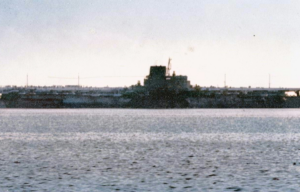
Photo Credit: Hiroshi Arakawa, Ishikawajima Shipyard / Kure Maritime History Science Museum / Wikimedia Commons / Public Domain (Colorized by Palette.fm)
During World War II, the Imperial Japanese Navy embarked on an ambitious program to construct some of the most formidable warships ever designed. The Japanese aircraft carrier Shinano was originally laid down as the third Yamato-class battleship—a class that produced the largest battleships ever built. After Japan’s crushing defeat at the Battle of Midway, however, naval priorities shifted toward carrier warfare, and Shinano was converted into an aircraft carrier while still under construction.
Although enormous in size and heavily armed, Shinano’s operational career proved extremely brief. Soon after entering service, she was torpedoed and sunk by the USS Archerfish (SS-311). The loss made her the largest warship ever destroyed by a submarine, securing Shinano a dramatic and lasting place in naval history.
Construction of the IJN Shinano
Hiryū, one of the Japanese aircraft carriers sunk during the Battle of Midway, hours before she went under. (Photo Credit: Naval History & Heritage Command / Wikimedia Commons / Public Domain)
Construction of the Japanese aircraft carrier Shinano began on May 4, 1940, at the Yokosuka Naval Arsenal. She was initially intended to be the third vessel of the massive Yamato-class battleship line. After Japan suffered heavy losses—particularly at the Battle of Midway—naval planners revised the design while construction was still underway, converting the vessel into a 65,800-ton support aircraft carrier. Rather than serving primarily in direct combat, Shinano was meant to act as a logistical hub, transporting aircraft, fuel, and ammunition to operational carrier groups.
The entire project was shrouded in extraordinary secrecy. The shipyard was heavily guarded, surrounded by tall fences, and strict penalties—including the possibility of execution—were imposed for security violations. These precautions prevented public access and documentation during construction. As a result, no photographs of Shinano being built are known to exist. Only two verified images of the ship survive today: one taken by a reconnaissance flight of a B-29 Superfortress and another captured by a civilian observer during the carrier’s brief sea trials.
Armor and armament
IJN Shinano underway during sea trials, November 1944. (Photo Credit: Yamato Museum / Wikimedia Commons / Public Domain)
The IJN Shinano was initially based on the design of the Yamato and Musashi, with plans calling for slightly thinner armor and upgraded anti-aircraft capabilities. However, once she was converted from a battleship into an aircraft carrier, her design shifted significantly. Much of her original armor and her massive main guns were sacrificed to accommodate her new role.
As a carrier, Shinano featured a large, flat flight deck with a smooth, modern profile. She was massive—872 feet long, 119 feet wide at the beam, and had a draft of nearly 34 feet. Her power came from 12 Kampon water-tube boilers connected to four steam turbines, producing a total of 150,000 shaft horsepower. This gave her an impressive top speed of 27 to 28 knots under ideal conditions.
Shinano was built to carry a significant number of aircraft and defend herself with an array of weaponry. Her defenses included eight twin-mounted five-inch dual-purpose guns, 35 triple one-inch anti-aircraft guns, and twelve 28-barrel 4.7-inch anti-aircraft rocket launchers. Her waterline armor ranged from 160 to 400 mm thick, and her flight deck was protected by 75 mm of armor—making her one of the most heavily armored carriers of her time.
Initially planned for commissioning in early 1945, the IJN Shinano‘s construction timeline was accelerated following the Battle of the Philippine Sea. This battle inflicted heavy losses on the Japanese Navy, including the destruction of two fleet carriers, one light carrier, and two oilers, while several smaller vessels sustained damage.
The hastened construction of Shinano led to compromised workmanship on later components. Nevertheless, she was launched on October 8, 1944, and officially commissioned on November 19 of the same year.
After her commissioning, Shinano was scheduled to travel from the shipyard to Kure Naval Base, where she was to be outfitted with armaments and aircraft under the command of Capt. Toshio Abe. Although Abe requested a delay due to incomplete bailing pumps and fire mains, his superiors denied his appeal and insisted on immediate departure. As a result, he was forced to set sail at night, despite his preference for a daytime departure.
Shinanodeparted at 6:00 PM on November 28, 1944, escorted by Isokaze, Yukikaze, and Hamakaze. During the voyage, the group detected radar signals indicating the presence of an American submarine nearby, prompting evasive maneuvers. Unknowingly, these actions placed Shinano directly in the path of the USS Archerfish (SS-311).
Sinking of the IJN Shinano
USS Archerfish (SS-311), the submarine responsible for sinking the IJN Shinano. (Photo Credit: Unknown Author / US Navy / Wikimedia Commons / Public Domain)
Joseph Enright, the captain of the USS Archerfish, spotted the Japanese aircraft carrier IJN Shinano two hours before the carrier realized a submarine was nearby. Commander Abe, in charge of the Japanese forces, mistakenly thought they were dealing with a group of American submarines and ordered his ships to change course to escape. Even though Shinano was the faster ship, it had to slow down to avoid possible damage.
At 2:56 AM on November 29, Abe first steered his ship toward the submarine but then turned southwest, unintentionally exposing Shinano’s entire side to Archerfish. At 3:15 AM, Enright ordered the launch of six torpedoes. Two of them struck the carrier before the submarine quickly dove to a depth of 400 feet to avoid any counterattack.
In total, Shinano was hit by four torpedoes, leading to her sinking. Enright and his crew didn’t learn the true identity of the carrier until after World War II. They also didn’t know that it took more than seven hours for Shinano to go under after being hit.
Hindsight is 20/20
Sketch of Japanese aircraft carrier IJN Shinano. (Photo Credit: De Agostini / Getty Images)
At first, those on board the IJN Shinano failed to fully comprehend the extent of the torpedo damage, resulting in only limited attempts to save the ship. Commander Abe, in particular, insisted on maintaining maximum speed, unintentionally worsening the flooding and hastening the vessel’s sinking.
By the time the crew recognized the full severity of the situation, it was already beyond salvage. Shinano had become too heavy to tow, too flooded to pump out, and too damaged for most of her crew to escape. Of the approximately 2,400 men aboard, 1,435 perished with the ship, including Abe and both of his navigators.
Survivors were relocated to Mitsukejima until January of the following year to prevent the sinking from becoming widely known. Postwar analysis by the U.S. Navy revealed critical design weaknesses in the Yamato-class ships, particularly at joints prone to leakage, and determined that the torpedoes fired by USS Archerfish struck these vulnerable points, directly contributing to the carrier’s loss.
Initially, U.S. Naval Intelligence questioned Enright’s claim of sinking a Japanese carrier, assuming all had already been accounted for. After the war, however, his achievement was verified, and he was awarded the Navy Cross in recognition of his success.