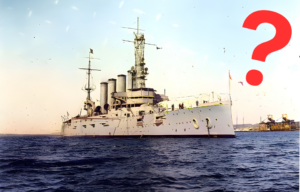
Service as the USS California

Renamed the USS San Diego (ACR-6)

The USS San Diego faced significant mechanical issues early on, including a boiler explosion that led to her being placed on reduced commission in the year following her launch. Despite this setback, she returned to her role as the flagship for the Commander-in-Chief, Pacific Fleet, until February 1917, when she was put into reserve after the United States had not yet entered World War I .
When the U.S. declared war on Germany in April 1917, the San Diego was fully recommissioned as the flagship of the Commander, Patrol Force, Pacific Fleet. Just a few months later, on July 18, the ship was reassigned to the Atlantic Fleet, where she was tasked with escorting convoys through perilous North Atlantic waters, heavily patrolled by German U-boats.
One year later, on July 19, 1918, the ship would face a catastrophic event that highlighted the very real dangers of the sea.
Shaken by an explosion at-sea

On July 18, 1918, the USS San Diego departed from the Portsmouth Naval Shipyard in Maine, bound for New York under the command of Harley H. Christy. Throughout the journey, the crew remained on high alert. Lookouts scanned the horizon, fire control teams stayed ready, and gun crews maintained their watch as the ship followed a zigzag course for protection.
The next morning, a sudden and powerful explosion struck the ship’s port side. The crew quickly worked to contain the flooding, but they ran into a major issue—the blast had warped the bulkhead, preventing them from fully sealing the watertight door between the engine room and the No. 8 fire room.
Sinking of the USS San Diego (ACR-6)

As water rushed into the ship, Captain Christy ordered full speed ahead, thinking they were under attack by a German U-boat. But the USS San Diego couldn’t accelerate—it was barely able to move. Both of its engines had failed, and the engine rooms were flooding fast.
The ship started to tilt to one side, and within 10 minutes, it was clear it wouldn’t stay afloat. Christy gave the order to lower the lifeboats and abandon ship. Just 28 minutes after the explosion, the San Diego sank beneath the waves, making it the only major U.S. warship lost during World War I.
Out of more than 1,000 sailors on board, six were killed in the disaster.
Survivors were left with no answers

After the sinking, Capt. Christy remained convinced they’d been struck by a torpedo, but there was no evidence that a U-boat had been in the area at the time, and none of the lookouts saw the wake created when a torpedo is fired.
Others speculated it could have been a sea mine, but it’s unlikely one would explode at the stern, instead of the bow of the ship. An official inquiry concluded the sinking was caused by such an explosive, as six contact mines had been located in the vicinity, but the true reason wasn’t that simple.
In 2018, 100 years after the USS San Diego sank, USNI News announced that the cause of the explosion was still inconclusive. Luckily, the American Geophysical Union (AGU) was about ready to hold its annual conference, where a bombshell revelation a century in the making would be dropped.
What really happened to the USS San Diego (ACR-6)?

After two years of research using archival documents, 3D scans and high-tech models, a team of researchers from the Naval History and Heritage Command (NHHC) announced their findings. At the 2018 AGU conference, underwater archaeologist Alexis Catsmabis declared, “We believe that U-156 sunk San Diego.”
Catsmabis explained that the flooding patterns didn’t look like an explosion was set inside the vessel, and the hole ripped into the USS San Diego‘s hull “didn’t look like a torpedo strike,” either. It was concluded that the armored cruiser was struck by a U-boat mine placed by SM U-156.
“Torpedos of the time carried more explosives than mines – and would have shown more immediate damage,” shared marine scientist Arthur Trembanis. The explosion itself wasn’t that powerful, but San Diego was filled to the brim with coal, making her top-heavy enough to easily capsize as she took on water.
“With this project, we had an opportunity to set the story straight,” Catsmabis said in a press release, “and by doing so, honor [the memory of the six crewmen who died] and also validate the fact that the men onboard did everything right in the lead up to the attack as well as in the response.”
More from us: Operation Catechism: Demise of the German Battleship Tirpitz
Today, the wreck of San Diego lies upside down off the coast of New York’s Fire Island, some 110 feet below the water’s surface. Since the highest parts are just 66 feet down, the wreck has become a popular scuba diving attraction. It’s also been nicknamed the “Lobster Hotel” for the large community of lobsters that call the armored cruiser home.