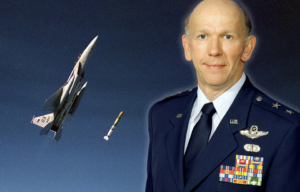
Wilbert “Doug” Pearson has the rare honor of being the only U.S. Air Force officer to ever score an air-to-space kill

Photo Credit: 1. Paul E. Reynolds / Wikimedia Commons / Public Domain 2. United States Government / Wikimedia Commons / Public Domain

On September 13, 1985, the U.S. Air Force achieved a historic breakthrough when a missile fired from a jet aircraft successfully struck and destroyed a satellite in orbit—the first time such an operation had ever been carried out. The test marked a major advance in Cold War aerospace and weapons technology, demonstrating that the United States possessed the capability to engage targets far beyond the boundaries of Earth’s atmosphere.

The operation also secured a singular place in military history for pilot Wilbert “Doug” Pearson. He became—and remains—the only Air Force officer known to have destroyed an object orbiting Earth with a rare air-to-space hit.

The Space Race created fears of nuclear-armed satellites

Illustration of a fighter aircraft firing an anti-satellite (ASAT) weapon
Fighter aircraft firing an anti-satellite (ASAT) weapon at high altitude. (Photo Credit: National War College / Wikimedia Commons / Public Domain)

During the Space Race, the Soviet Union developed a robust program for launching small reconnaissance satellites into orbit, which were used to monitor U.S. military activity. Although the United States maintained an overall technological advantage in many areas of defense, these satellites were viewed with concern because they reduced the ability to conceal military movements and could potentially undermine strategic surprise.

Fears also emerged that the Soviet Union might eventually deploy nuclear weapons in orbit. These concerns began soon after the launch of Sputnik 1 in October 1957. In response, the United States began exploring its own programs aimed at countering or destroying enemy satellites, although it would take many years and multiple experimental efforts before a practical capability was achieved.

The need for an anti-satellite (ASAT) weapons program

ASM-135 ASAT on display
ASM-135 ASAT with a kinetic warhead. (Photo Credit: National War College / Wikimedia Commons / Public Domain)

The U.S. Anti-Satellite (ASAT) Mission Development and Test Program took shape during the Cold War as concerns grew that the Soviet Union might eventually deploy satellites capable of carrying nuclear weapons. Meanwhile, Soviet efforts to maintain an edge in space technology intensified the competition for military dominance beyond Earth’s atmosphere.

With the program closely connected to the broader Space Race, rapid response and precision were considered critical. Wilbert Pearson, the pilot who would later carry out the historic mission, described the objective by saying, “We needed a system that could respond quickly, hit with precision, and handle different types of targets. That requirement is what drove us toward an air-launched solution.”

Following the first test flights in 1982, development advanced rapidly. The program reached its landmark achievement in 1985, when a missile fired from an aircraft successfully struck and destroyed a satellite in orbit, marking one of the most important accomplishments in the history of military technology and space operations.

Details of Wilbert Pearson’s historic flight

Illustration of an anti-satellite (ASAT) weapon approaching the P78-1 (Solwind) satellite
Anti-satellite (ASAT) weapon approaching the P78-1 (Solwind) satellite. (Photo Credit: USAF / Wikimedia Commons / Public Domain)

Wilbert Pearson accomplished the historic flight, earning him the title of “ace.” Piloting the McDonnell Douglas F-15A Celestial Eagle, he embarked on the mission to test the ASM-135 ASAT. Starting from Edwards Air Force Base, California, Pearson set course towards the satellite designated for elimination: P78-1, AKA Solwind.

The P78-1 (Solwind) satellite was launched on February 24, 1979. After several years in orbit, its batteries were running low. By the time of Pearson’s historic flight, the satellite was scheduled to be terminated and chosen as the target for the ASAT test.

Before the test, two preliminary trials were done to verify the reality of an air-to-space strike. The first assessed whether the missile could detach from the jet and reach the necessary altitude, while the second targeted a star to test its aiming accuracy.

The benefits of the McDonnell Douglas F-15A Eagle

McDonnell Douglas F-15 Eagle carrying an ASM-135 ASAT
McDonnell Douglas F-15 Eagle carrying an ASM-135 ASAT. (Photo Credit: USAF / Wikimedia Commons / Public Domain)

Choosing the right aircraft was critical for this time-sensitive mission. It ultimately came down to the F-15 Eagle. “The F-15 was a real racehorse,” explained Pearson. “We could fly supersonic and we could maneuver it to be in the right kind of a climb, and we could integrate all the required systems into the airplane to communicate with the missile. It could physically hold the ASAT weapon. It was a very large missile so it needed a big enough airplane.”

He further explained how “an F-16 didn’t have the ground clearance; you couldn’t put the missile on the centerline of the airplane and take off with it without hitting the ground. We could take operational F-15A airplanes and with fairly minimal modifications turn those into ASAT-killer airplanes.”

Wilbert Pearson makes the hit

ASM-135 ASAT launching from the underbelly of a McDonnell Douglas F-15A Eagle
Wilbert “Doug” Pearson scored a direct hit on the P78-1 (Solwind) satellite orbiting over 300 miles above the earth. (Photo Credit: USAF / Wikimedia Commons / Public Domain)

After takeoff, Wilbert Pearson spent three hours climbing to an altitude of 30,000 feet. Activating the afterburners of his F-15A Eagle, he accelerated to Mach 1.3 and maneuvered the aircraft into a steep 60-degree climb. Slowing to Mach 0.96, he prepared for the missile launch as the countdown began. At zero, he pressed the “pickle button” to release the ASM-135 ASAT missile, sending it hurtling toward the P78-1 (Solwind) satellite.

Recalling the experience, Pearson remarked, “it was just a beautiful sight to see the missile suspended there and the flame come out of the rocket motor. And then it took off like a bandit.” However, he had no way to visually confirm the missile’s success. Instead, he relied on a prearranged code with a control room operator to determine the outcome of the test.

When Pearson contacted the control room, no code was needed to confirm the missile’s success. As soon as the mic was activated, he was met with a chorus of cheering and celebration on the other end, announcing that the test was a triumph. For the first time in history, a satellite had been destroyed in space by an aircraft.

The ASAT program ends

Wilbert and Todd Pearson standing in front of the McDonnell Douglas F-15A Eagle "Celestial Eagle"
Maj. Gen. Doug Pearson (L) and Capt. Todd Pearson (R), a 390th Fighter Squadron pilot from Mountain Home Air Force Base, Idaho, joke around prior to Capt. Pearson taking off on the Celestial Eagle remembrance flight at Homestead Air Reserve Base, Florida. (Photo Credit: Senior Airman Erik Hofmeyer / U.S. Air Force / Wikimedia Commons / Public Domain)

The successful test had a big impact. The Soviet Union perceived it as evidence of America’s capability to target and obliterate satellites in orbit. However, they were unaware of the effort and dedication that had gone into the program. For the Soviets, it probably appeared to be a simple task for the US Air Force.

More from us: North American X-15: The Fastest Manned Rocket Aircraft Ever Developed

The significant test produced 285 pieces of debris that were sent toward Earth, but it took nearly 19 years for all of it to re-enter the atmosphere. The uncertainty surrounding debris from missile-satellite collisions raised concerns about the program’s long-term viability. Unfortunately, the US Congress withdrew funding, and House-Senate negotiators agreed to prohibit ASAT testing in exchange for chemical weapons production.

Samantha Franco

Samantha Franco is a content writer with a BA and MA in history, focusing on Victorian, medical, and epidemiological history. She has written content for multiple sites covering an array of historical topics.