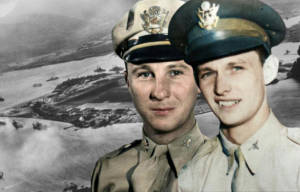
As time stretches on, the rough details of wartime recollection often blur, making the surviving firsthand stories all the more valuable. Accounts of heavy combat and punishing training tend to dominate, but it’s the smaller moments—the late-night talks, the brief bonds formed between service members—that often reveal just as much about resilience and character.
This truth stood out vividly on the night before disaster. On December 6, 1941, two young U.S. Army Air Corps pilots spent the evening drinking and talking long past midnight, leaving them poorly rested. The next morning, Japanese forces unleashed their attack on Pearl Harbor, and the pair awoke to confusion and devastation—hungover, stunned, and thrust into chaos.
There was no time to stay grounded. Disregarding orders, they sprinted to their Curtiss P-40B Tomahawks, launched into the air, and engaged the attackers.
Their courageous stand quickly became the stuff of legend. Hollywood later dramatized the event in Pearl Harbor (2001), though the 1970 film Tora! Tora! Tora! offers a portrayal closer to the historical reality.
Fatigued, heavily outnumbered, and flying headlong into danger, the two pilots met the moment with extraordinary resolve—proving that courage can rise even from imperfect beginnings.
Night before the ‘Day of Infamy’

The attack on December 7, 1941, took place on a Sunday, which means that, for many on Ford Island (particularly those stationed there), a typical Saturday night was all that separated them from the day that would come to live in infamy.
Returning to the barracks, 2nd Lt. George Welch and Ken Taylor of the 15th Pursuit Group had just returned from an epic night of partying and poker. To be musing about the night’s activities one minute and watching the attack the next must have been quite a sobering sight.
The Japanese attacked in two waves, with over 350 fighters, bombers and torpedo aircraft from six different aircraft carriers. The target was the US Pacific Fleet, most of which was anchored at Pearl Harbor at the time. When it was over, eight battleships were sunk or heavily damaged, along with three light cruisers, a minelayer, an anti-aircraft training ship and three destroyers.
Some 188 American aircraft were also destroyed, mostly sitting wing to wing on the ground, but that doesn’t mean a few brave fighters didn’t take to the sky to give the Japanese a little taste of what was to come.
Responding to the attack on Pearl Harbor

As Wheeler Field became a primary target for the Japanese, George Welch called out to Haleiwa Field to have two P-40s fueled and ready because two pilots were coming in hot… Potentially a little drunk and hungover, but coming in hot all the same.
The pair sped to the airfield in their Buick and quickly mounted the aircraft without orders, to simply do what they could. The P-40s were initially only armed with .30-cal. ammunition for the wing guns, but to these two men, that was enough to get started.
After they took off, they headed toward Barbers Point, at the southwest tip of Oahu, and initially saw an unarmed group of Boeing B-17 Flying Fortresses flying from the mainland. They arrived at Ewa Mooring Mast Field to find it being strafed by 12 Aichi D3A “Val” dive bombers (some say Nakajima B5N2 “Kate” dive bombers) from the second Japanese wave, after they’d expended their bomb ordnance at Pearl Harbor.
While Welch and Ken Taylor were outnumbered six-to-one, they immediately began firing on the dive bombers. Taylor shot down two enemy dive bombers and was able to damage another. They continued to circle the skies, fighting whatever targets presented themselves until they needed to return to base for more ammunition and fuel.
Returning to Wheeler under the threat of friendly anti-aircraft fire, they sought to refuel and load up with the more potent .50-cal. ammunition for their nose-mount synchronized machine guns. When they returned, however, the ammunition was in a burning hanger. Despite this, two brave mechanics ran into the inferno to save what they could.
Returning to the skies over Hawaii

After rapidly refitting their P-40s with fresh ammunition, George Welch and Ken Taylor lifted off once more, racing to confront the second wave sweeping in over Pearl Harbor. As Taylor dove toward an incoming formation, danger exploded out of nowhere—Mitsubishi A6M Zeros burst through the cloud cover and sprang a lethal trap.
A bullet detonated inside Taylor’s cockpit, missing his head by mere inches. Metal fragments ripped through his left arm and embedded themselves in his leg. Seeing his friend struck, Welch immediately rolled into position, lined up the attacker, and sent the Zero spiraling down in flames. Despite the blood loss and searing pain, Taylor steadied his fighter, took aim, and crippled another enemy aircraft as it tried to flee.
The two regrouped in the air and hurled themselves back into the fray. Their sudden, aggressive counterattack shattered the ambush. Realizing they had lost the initiative, the Japanese pilots broke away and raced back toward their carriers.
Even with his ammunition running low and his wounds worsening, Taylor refused to break off. He fired until every gun ran dry, chasing the retreating fighters until the sky finally cleared.
Though they launched without authorization—and flatly ignored orders to remain grounded—neither pilot hesitated. Their valor led to Medal of Honor nominations, and both men were awarded the Distinguished Service Cross, an enduring tribute to their fearless stand against overwhelming odds.
Fighting in World War II

After Pearl Harbor, George Welch was initially tasked with giving war bond speeches to support the war effort, while Ken Taylor was assigned to the 44th Fighter Squadron, with whom he’d go on to score additional air-to-air kills. He’d later be wounded in an air raid at Guadalcanal and was sent home to train American pilots.
Following the Second World War, Taylor remained in the service and became an officer in the newly formed US Air Force. He retired at the rank of colonel, before joining the Alaska Air National Guard, from which he retired a brigadier general in 1971.
Welch’s story was a little more tragic. In 1944, he resigned his commission to become a test pilot for some of the country’s newly evolving jet aircraft. While instructing and training American pilots on these new aircraft in the Korean War, it was reported that Welch scored several MiG kills – in direct disobedience to orders – while “supervising” his students.
In 1954, while test piloting a North American F-100 Super Sabre, the aircraft broke up mid-air, ultimately resulting in his death. Welch would go on to be buried at Arlington National Cemetery.
More from us: The US Military Once Built a Japanese Warship in the Middle of the California Desert
While the fate of these two men would take separate courses, what they accomplished in the sky over Pearl Harbor inspired a nation. They proved from early on that America was ready for a fight and that the iconic words of Japanese Adm. Isoroku Yamamoto to be true. When he said, “I fear all we have done is to awaken a sleeping giant and fill him with a terrible resolve,” it would be because men like Welch and Taylor were determined to make it so.