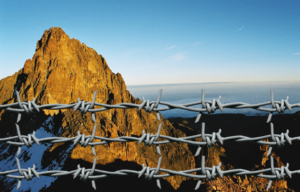
For most prisoners of war, the fear of being captured during an escape—and the harsh punishment that would likely follow—makes the idea of fleeing seem incredibly risky. The notion of breaking free from captivity only to willingly return later is even harder to imagine. Yet in 1943, three Italian POWs did precisely that after successfully climbing to the summit of Mount Kenya, the second-highest mountain in Africa.
An escape (and return) plan is hatched

Felice Benuzzi was born in Vienna, Austria, on November 16, 1910, but spent much of his childhood in Trieste, where he developed a passion for exploring the rugged terrain of the Julian Alps and the Dolomites. After completing a law degree at Sapienza University of Rome in 1938, he joined the Italian Colonial Service and took up a post in Ethiopia as a colonial administrator. During the British campaign in East Africa in 1941, he was taken prisoner and interned at POW Camp 354.
Despite being a skilled and seasoned mountaineer, Benuzzi had never tackled a peak on the scale of Mount Kenya, whose summit reaches over 17,000 feet.
He later wrote about how he remained “spell-bound” for hours after seeing it, adding, “I had definitely fallen in love.”
Supplies are gathered
Slowly but surely, Benuzzi came up with a plan of action. Because he was in a POW camp, he had minimal resources for his climb. He wrote to his family in Italy, asking them to send his boots and warm, woollen clothing. He stopped smoking and was able to barter with his extra cigarettes to get his hands on other necessary items.
Benuzzi also scoured camp trash for usable items and hoarded crackers, chocolate and dried fruit from packages he received. He also used hammers stolen from the camp workshop to create ice picks, and made his crampons from bits salvaged from trash heaps. For maps, Benuzzi only had the drawings he had made of the mountain and a label from a food can.

Benuzzi knew that he would need to persuade other prisoners to take part in his plan. The first person he recruited was his bunkmate, Giovanni “Giuàn” Balletto, a doctor who was also an experienced mountaineer. Next came Vincenzo “Enzo” Barsotti, a man with no previous mountain-climbing experience. Despite this, Barsotti was considered suitable for the venture because he was believed to be “mad as a hatter,” and the plan called for men who were just a little “mad.”
With his companions chosen and the necessary supplies gathered, Benuzzi still had to solve the problem of getting out of the camp. Balletto had been allocated a small section of the camp garden, which he used to grow tomatoes and other vegetables. He had also constructed a small tool shed on his plot, and the three men began quietly transferring their equipment and provisions there over time.
Prisoners could enter the garden only through a locked gate by showing a valid garden pass. Balletto was the only member of the group who had one, and their escape plan required them to pass through the gate after dark. To make that possible, they needed to obtain the key to the garden gate.

They tried to get a hold of the key several times. One fateful day, Benuzzi stumbled upon it carelessly left on the compound officer’s desk. He was able to make several impressions of it in a piece of tar and had a prisoner mechanic cut the key from them. The team tried to unlock the gate with their new key, but, much to their dismay, it didn’t work. Finally, after making many adjustments and oiling the key, the team successfully unlocked the gate.
Their breakout was scheduled for January 24, 1943.
A great escape, followed by a return to camp
On the night they slipped away, the three prisoners managed to cross the garden and exit the camp unnoticed. But reaching Mount Kenya was still a long journey ahead. For several days, they moved under the cover of darkness—and eventually in daylight as well—trekking through dense tropical forests at the mountain’s base until they finally arrived at its northwestern ridge.

Against all odds, the trio began their ascent of Mount Kenya, establishing a makeshift base camp at 14,000 feet. Benuzzi and Balletto set their sights on Batian Peak, the mountain’s highest summit, but a sudden snowstorm forced them back to camp, exhausted and freezing. After a day of rest, they refused to give up and instead turned to Point Lenana, the third-highest peak, rising to 16,355 feet.
Amazingly, the two men reached the summit. There, with numb fingers, they planted a homemade Italian flag and sealed a handwritten note inside a bottle—proof of their impossible feat. Victorious, they descended to rejoin Barsotti at base camp, before all three began the long trek back down the mountain.

The three Italian POWs returned to Camp 354 eighteen days after their escape. After returning, they were sentenced to 28 days in solitary confinement. However, their sentence was reduced to only seven days, as the camp commandant was impressed by their “sporting effort.”
More from us: Here’s The Way German Commandos Rescued An Imprisoned Benito Mussolini
In 1946, Benuzzi returned to Italy. He later published a book about the 1943 climb, titled No Picnic on Mount Kenya. He passed away in Rome in July 1988.