Continuity of Operations

In the turbulent decades following World War II, as the nuclear arms race escalated, the U.S. government developed an extensive continuity-of-government (COG) strategy to ensure national leadership could survive and operate during a nuclear attack. This system relied on three core elements: fortified land-based command centers, airborne command posts, and sea-based command ships—each designed to keep the government functioning even under the most extreme conditions.
A highly secure communications network linked four key hubs: the National Military Command Center (NMCC), the Alternate National Military Command Center (ANMCC), the National Emergency Airborne Command Post (NEACP), and the National Emergency Command Post Afloat (NECPA).
The NMCC, housed within the Pentagon, and the ANMCC, located in a hardened bunker near Blue Ridge Summit, Pennsylvania, served as the fixed, ground-based nerve centers. Above them, the NEACP operated from specially modified U.S. Air Force aircraft capable of remaining airborne for long periods. At sea, NECPA relied on Navy command ships built to act as fully functional floating versions of the White House.
Although these vessels never needed to assume their emergency wartime roles, they were far from idle. Presidents John F. Kennedy and Lyndon B. Johnson both used the command ships for continuity drills, overnight stays, and even as mobile headquarters during foreign trips—quiet reminders of the ever-present nuclear threat that shaped Cold War planning.
USS Northampton (CLC-1/CC-1)

The USS Northampton (CLC‑1/CC‑1) was launched on January 27, 1951, as an Oregon City-class heavy cruiser, though she differed significantly from her sister ships. With a displacement of 13,700 long tons—heavier than the standard 13,260 long tons of her class—Northampton also boasted a slightly higher top speed of 38 MPH compared to 37.3 MPH for the others.
USS Wright (CVL-49/AVT-7/CC-2)

USS Wright (CVL-49/AVT-7/CC-2), a Saipan-class light aircraft carrier, entered service with the U.S. Navy on February 9, 1947. In her early years, the ship primarily served as a training carrier, giving naval aviators opportunities to sharpen their flying skills and qualify for carrier landings. Wright completed 40 short cruises dedicated specifically to flight-training operations.
Wright departed Norfolk, Virginia, on January 11, 1951, for her first major deployment, heading to the Mediterranean to serve with the U.S. 6th Fleet. Her arrival at Gibraltar on January 21 marked the start of her first overseas assignment. After receiving repairs and maintenance the following year, she was designated flagship of Carrier Division 14. While serving in that capacity, Wright participated in NATO exercises, including operations with Britain’s Royal Navy.
Following additional maintenance at the Philadelphia Naval Shipyard in 1953, Wright was reassigned to the U.S. 7th Fleet in the Pacific. Her journey took her through the Panama Canal, with stops at San Diego and Pearl Harbor, before she reached Yokosuka, Japan. Carrying Marine Attack Squadron 211, Wright conducted operations in waters around the Korean Peninsula and Okinawa.
On October 15, 1954, Wright concluded her Pacific deployment and set out for the West Coast of the United States. Soon after returning, the carrier began the process of being taken out of active service. She was later decommissioned and placed with the Pacific Reserve Fleet.
Serving with the National Emergency Command Post Afloat (NECPA)

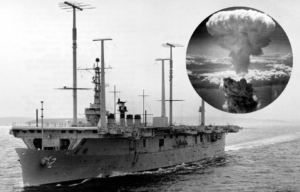
On March 15, 1962, USS Wright (CC-2) received the command ship designation CC-2 and began an extensive conversion for its new mission. Although the classification remained in use for only about a year, the refit significantly transformed the vessel’s interior. Former aircraft hangar spaces were converted into advanced command-and-control centers featuring operations rooms and secure living quarters designed for senior military officers and government officials. The flight deck was fitted with large antenna structures to support long-range global communications, while the aft portion of the ship retained its helicopter operating capability.
The ship returned to service on May 11, 1963, first operating off the U.S. West Coast before eventually transferring to Norfolk. During the Cold War, it became part of the National Emergency Command Post Afloat program, earning the nickname “Zenith” and developing a reputation as one of the most technologically advanced communications ships ever put to sea.
In practice, the ship’s most notable operations involved supporting high-level communications rather than carrying out nuclear emergency missions. From April 11 to 14, 1967, it provided communications support for President Lyndon B. Johnson during the Punta del Este summit. The following year, on May 8, 1968, Wright assisted the disabled USS Guadalcanal (LPH-7), towing the ship for roughly 84 miles after mechanical failures left it without propulsion.
When the Pueblo Crisis arose in February 1969, USS Wright was placed on an elevated state of readiness while based in Norfolk, but it was not sent to participate in the operation. The ship’s service came to an end when it was decommissioned on May 27, 1971.
National Emergency Airborne Command Post (NEACP)

In the 1960s, U.S. defense planners considered adding a third vessel to the National Emergency Command Post Afloat program. Ideas ranged from converting the USS Triton (SSRN‑586) to retrofitting a Saipan-class aircraft carrier. Ultimately, the proposal was abandoned, as the existing cruisers—the USS Northampton and USS Wright—were deemed sufficient. These two ships continued to serve as the Navy’s floating command centers until their decommissioning in the 1970s.
More from us: Messerschmitt Me 410 Hornisse: The German Bomber Destroyer That Was No Match for Allied Fighters
The U.S. Air Force continues to depend on the E‑4B “Nightwatch” as a critical component of its airborne command and control system. Decades into service, the aircraft remains fully operational and ready to support national security missions at a moment’s notice. Plans to replace it through the Survivable Airborne Operations Center (SAOC) program gained momentum around 2021–2022, yet the E‑4B remains an active and reliable asset.
Supporting the E‑4B are the two Boeing VC‑25 aircraft, widely recognized as Air Force One when carrying the President. While their primary role is executive transport, these planes are equipped with reinforced communications and defensive systems, enabling them to function as backup airborne command centers if necessary. Together, the E‑4B and VC‑25 fleet form a robust airborne network, ensuring continuity of leadership and command during national emergencies.