Photo Credit: U.S. Navy / Naval History and Heritage Command / Wikimedia Commons / Public Domain (Colorized by Palette.fm)
On May 28, 1958, the USS Stickleback (SS-415) sank during a peacetime training exercise off the coast of Hawaii.
Although the submarine never took part in combat, its service history was connected to several important events of World War II and the early Cold War. Its first deployment took place around the time of the Atomic bombings of Hiroshima and Nagasaki in August 1945. After being decommissioned following World War II, the submarine was later returned to active duty during the Korean War, where it was used to help train a new generation of submariners.
The submarine was eventually lost during a training exercise after surfacing near the USS Silverstein (DE-534). A sudden mechanical failure left Stickleback unable to maneuver, and it was struck soon afterward. The crew was safely evacuated, but the submarine sank shortly after the collision.
Though the accident happened during peacetime rather than combat, the loss of Stickleback served as a reminder of the constant dangers involved in submarine operations.
USS Stickleback (SS-415) following World War II
USS Stickleback (SS-415), 1945. (Photo Credit: US Navy / Wikimedia Commons / Public Domain)
On June 26, 1946, following the Second World War, the USS Stickleback was decommissioned. However, the submarine was recommissioned on September 6, 1946, serving as a training ship out of San Diego. In November 1952, the vessel was sent to Mare Island Naval Shipyard to be converted into a GUPPY IIA-type submarine.
After her conversion, Stickleback joined Submarine Squadron 7 out of Pearl Harbor. Between February-July 1954, she saw service supporting the United Nations (UN) forces in Korea. Following the conflict, the vessel participated in a number of exercises and training missions.
Not-so-routine anti-submarine warfare exercise
USS Stickleback (SS-415), 1950s. (Photo Credit: U.S. Navy / Wikimedia Commons / Public Domain)
During an anti-submarine warfare exercise near Oahu, the USS Stickleback (SS-415) was operating with the USS Silverstein (DE-534) and a torpedo recovery vessel. What began as a standard training mission quickly turned into a serious emergency.
As part of the exercise, Stickleback was simulating a torpedo attack against Silverstein when it suddenly lost power during the maneuver. Without propulsion or full control of buoyancy, the submarine dropped rapidly into the Pacific, reportedly descending to a depth of 800 feet—deeper than its tested operating limits. The unexpected dive placed both the submarine and its crew in immediate danger and triggered urgent emergency response efforts.
Crisis averted… for now
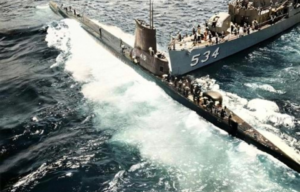
USS Silverstein (DE-534) off the coast of Pearl Harbor, Hawaii, 1955. (Photo Credit: BMC Albert Curry, U.S. Navy / NavSource / Wikimedia Commons / Public Domain)
The USS Stickleback narrowly avoided a fatal fall thanks to the crew’s rapid response. When the submarine unexpectedly entered an uncontrolled dive during the exercise, the sailors immediately carried out emergency procedures, blowing the ballast tanks to halt the plunge and force the vessel back toward the surface. Their decisive actions avoided catastrophe.
But reaching the surface created a new danger.
As Stickleback emerged from the water, she crossed directly into the path of the destroyer escort USS Silverstein, which was also taking part in the training exercise. Silverstein‘s crew had only moments to react, reversing the engines and attempting a hard turn, but they were unable to avoid a collision. The destroyer struck Stickleback on the port side, tearing open the pressure hull. Seawater poured into vital compartments, leaving the submarine beyond saving despite every attempt to preserve her.
Disaster strikes the USS Stickleback (SS-415)
Collision between the USS Stickleback (SS-415) and Silverstein (DE-534), 1958. (Photo Credit: U.S. Navy / Naval History and Heritage Command / Wikimedia Commons / Public Domain)
The USS Stickleback began taking on water. With little they could do, the 82 crewmen aboard were transferred to the torpedo retrieval ship involved in the exercise. Attempts to save the vessel involved the USS Silverstein, along with the USS Sturtevant (DE-239), Sabalo (SS-302) and Greenlet (ASR-10), securing lines around her.
Despite their efforts, the submarine continued to flood. At 6:57 PM on May 29, it was reported that Stickleback “sank in 1,800 fathoms of water.” Just a month later, she was removed from the Naval Register.
Discovering a wreck at the bottom of the ocean
Lt. Cmdr. Roy Robison, skipper of the USS Stickleback (SS-415), and other crew members, 1952. (Photo Credit: Los Angeles Examiner / USC Libraries / CORBIS / Getty Images)
In 2020, the Lost 52 Project, a private company dedicated to locating all American submarines lost during World War II and the four that sunk during the Cold War, began a search for the USS Stickleback. This marked the company’s sixth discovery, achieved through the use of sonar-based imagery and robotics technology.
Bob Neyland, head of the Naval History and Heritage Command’s Underwater Archaeology Branch, stated Stickleback‘s discovery provided “an opportunity to remember and honor the service of our sailors and marines.”