Getting permission from Denmark

In 1951, the United States and Denmark entered into the Defense of Greenland agreement, which permitted NATO members to investigate the construction of military facilities on the island as part of the broader defense of Greenland and allied territories. Although the agreement allowed the establishment of American bases, it did not grant permission for the deployment of nuclear missiles.
H.C. Hansen was wary of introducing nuclear weapons to Greenland, concerned that such a move could heighten international tensions. When questioned by U.S. Ambassador Val Petersen about the Army’s intentions, Hansen avoided issuing a clear rejection, leaving enough ambiguity for the project to continue moving forward.
To the public, the United States Department of Defense described the undertaking as a program focused on Arctic engineering, testing portable nuclear reactors, and conducting scientific studies of the ice sheet. The project’s actual purpose—the potential deployment of nuclear missiles beneath Greenland’s ice—was omitted from official explanations.
Camp Century

The Army named the project “Camp Century,” using it as a public disguise for the true nature of the operation.
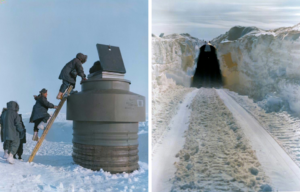
Construction began in June 1959 and was completed just over a year later, in October 1960. The process was challenging. A three-mile-long access road was built to transport equipment and supplies to the location. Trenches were dug into the ice, reinforced with steel arches to create a roof, and then covered with snow for additional protection and concealment.
Within these trenches, wooden buildings were put up, with gaps left between the walls and the ice to minimize melting caused by internal heat. The base was insulated, sourced fresh water from the ice, and was powered by the world’s first portable nuclear reactor (the PM-2A), which was installed in 1960.
Camp Century was capable of housing over 200 soldiers and included various amenities, such as a kitchen, cafeteria, laundry, communications center, hospital, chapel, and even a barbershop. It featured 26 tunnels and acted as a testing ground for assessing the viability of operations beneath the ice.
Project Iceworm

Although Camp Century appeared to be a scientific and military research base, it also served as a cover for the Army’s highly classified Project Iceworm. Using Camp Century as a model, the plan envisioned an underground tunnel network spanning more than 52,000 square miles—roughly three times the size of Denmark.
The proposed plan would have contained 600 modified “Iceman” ballistic missiles, positioned about four miles from one another, with 60 Launch Control Centers overseeing the entire network. By hiding these weapons beneath Greenland’s ice sheet, the United States hoped to create a hidden launch capability, primarily intended to deter or strike the Soviet Union during the Cold War.
The Iceman missile itself was based on the Minuteman Intercontinental Ballistic Missile (ICBM) and had an estimated range of 3,300 miles. Operating such an enormous installation would have required a permanent force of approximately 11,000 Army personnel.
Problems with Project Iceworm


Project Iceworm remained a secret until the Danish Institute of International Affairs began investigating the former military base. Documents about the Army’s true intentions were declassified in 1996, and the secret about Camp Century was finally revealed to the public.
Years after the base was shuttered, its tunnels collapsed, and now a thick layer of ice covers the once-operational facility, making it virtually unreachable. However, the operation wasn’t for nothing, as Camp Century actually provided valuable information via the collection of some of the world’s first ice core samples.
The environmental effects of Project Iceworm may be awaiting society in the future. While Camp Century was in operation, its nuclear reactor produced over 47,000 gallons of radioactive waste that’s still buried under Greenland’s ice cap.
More from us: How Many Times Did the World Nearly End During the Cold War? Answer: A Lot
Scientists believe that, if climate change continues at the rate it currently is, the ice cap could melt enough to expose the nuclear waste by 2100, which could negatively impact the ecosystems within the surrounding area.