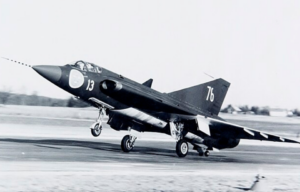
In the years following World War II, many countries competed to build faster and more advanced jet fighters, and Sweden joined that effort. In the 1960s, Saab introduced the Saab 35 Draken, an unusual design featuring a tailless body and a distinctive double-delta wing that broke from conventional aircraft layouts.
Saab engineers worked through significant technical challenges using repeated testing and refinement, ultimately producing a highly maneuverable, high-speed interceptor capable of performing multiple mission types. The success of the Draken reinforced Saab’s reputation for innovative aerospace design and established it as one of the more forward-thinking fighter aircraft of its era.
Development of the Saab J35 Draken

Amid the Cold War, the Swedish Air Force was determined not to fall behind in the race for cutting-edge jet fighter technology. They envisioned a supersonic interceptor capable of intercepting bombers at high altitudes, prompting the Defence Materiel Administration to lay out stringent requirements for a next-generation aircraft.
Unlike the U.S. Air Force’s Lockheed F-104 Starfighter, the Swedish fighter had to fulfill a unique role—it was designed to operate from reinforced public roads, a strategy born out of Sweden’s need to protect itself against potential nuclear threats during the Cold War. Additionally, it needed to be effective in all weather conditions.
Thus, the Saab J35 Draken, also known as the “Nordic Dragon,” was conceived to meet these high demands.
The Draken’s standout feature was its double-delta wing design, a daring choice that had never been tested in operational aircraft. Though the design posed potential risks, it promised solutions to many of the challenges faced by the Swedish Air Force. The robust delta wing structure provided ample space for fuel storage, which was crucial for long-range missions, although it did create additional drag.
Without the aid of modern tools like computer simulations, Saab’s engineers embarked on a painstaking process of trial and error. Through extensive wind tunnel testing and initial flight trials, they developed a smaller, flyable prototype known as the Saab 210, or “Little Dragon.” The Little Dragon made a successful first flight over Stockholm in January 1952, proving the concept and breathing life into the full-scale J35 Draken project.
Saab J35 Draken specs

Powered by a turbojet engine with afterburners, the Draken could exceed Mach 2, more than twice the speed of sound. Its cockpit offered pilots generous space and excellent visibility, complemented by advanced radar and fire-control systems that kept the aircraft at the cutting edge of fighter technology. The fuselage was organized into front and rear sections, each carefully arranged to house essential avionics and mechanical systems.
In terms of armament, the Draken primarily carried up to four AIM-9 Sidewinder missiles on its wings, with additional capability to launch rockets or bombs from internal storage. Depending on the mission, it could also be fitted with twin 30 mm cannons or external fuel tanks to extend its range.
A rather bouncy start

The introduction of the Saab 35 Draken into operational service was not without difficulties.
Although its innovative double-delta wing design offered impressive performance, it also made the aircraft demanding to handle. Pilots had to carefully control stability during landing, turning each descent into a precise and high-pressure task. However, this challenging handling characteristic also produced an unexpected benefit: while learning to master the aircraft, pilots developed a maneuver that had not previously been recorded or used by any other air force.
Cobra Maneuver

As Swedish test pilots worked to understand the challenging J35 Draken, they developed a key flying technique that would later be known as the Cobra Maneuver. They found that when the aircraft entered a stall at very high angles of attack and became difficult to handle, rapidly reducing the angle of attack allowed the jet to recover from the stall and return to controlled flight.
The maneuver effectively transformed the Draken into a massive airbrake, allowing it to drop off speed in just a few seconds. Combined with the aircraft’s high speed, long range, and advanced capabilities, the J35 helped redefine what was possible during a “super stall.” The Cobra Maneuver became a dramatic demonstration of controlled flight at the edge of a stall, showcasing the Draken’s exceptional maneuverability and its ability to decelerate rapidly when required.
Saab J35 Draken’s legacy

The J35 Draken wasn’t just a high-altitude interceptor—it also demonstrated remarkable agility as a dogfighter. Its sharp maneuverability and blistering speed gave it an edge over many of its contemporaries, making it nearly twice as capable as other single-engine fighters of the same era.
As Saab continued to refine the design, the upgraded J35B variant brought even greater advancements. Equipped with a more powerful engine, an enlarged afterburner, and a reengineered rear fuselage, the aircraft delivered improved performance across the board. Most notably, it was integrated into Sweden’s sophisticated STRIL 60 air defense network, allowing the Draken to operate seamlessly within a cutting-edge, radar-guided command system—ahead of its time in both concept and execution.
More from us: Why Did a Test Pilot Wear a Gorilla Mask In Flight?
While the Cobra Maneuver is often linked with modern Russian jets such as the Sukhoi Su-27 and Mikoyan MiG-29, its origins trace back to an unexpected source. The pioneering Saab J35 Draken was the first aircraft to unintentionally perform the maneuver—long before it became a deliberate display of aerodynamic mastery.
During flight testing, pilots discovered that the Draken’s unique double-delta wing configuration allowed it to momentarily pitch its nose to an extreme angle of attack without stalling—a phenomenon that would later be refined into the now-famous Cobra Maneuver. This accidental breakthrough cemented the Draken’s place in aviation history as not only a formidable fighter but also a trailblazer in aerodynamic innovation.