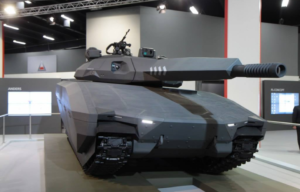
Photo Credit: Ministerstwo Obrony Narodowej / Polish Ministry of National Defence / Wikimedia Commons / Attribution
Nations continually seek to modernize their armed forces with cutting-edge weaponry and armored vehicles. In 2013, Poland unveiled the PL-01, a concept tank intended to provide direct fire support on the battlefield. Early projections anticipated widespread production and operational deployment by the late 2010s, yet these plans never came to fruition, leaving the future of the project uncertain.
Development and unveiling
PL-01 concept tank. (Photo Credit: U.S. Army Maneuver Center of Excellence / Wikimedia Commons / Public Domain)
The PL-01 was created by Polish company OBRUM in collaboration with the United Kingdom’s BAE Systems. Its design was derived from the CV90120-T, an export-model variant of Sweden’s Combat Vehicle 90. Intended as a direct-fire support vehicle, the PL-01 featured a configuration comparable to that of contemporary main battle tanks. In addition to combat duties, it was also designed to function in roles such as mine clearing, armored vehicle recovery and repair, and battlefield command.
The vehicle made its public debut at the International Defense Industry Exhibition held in Kielce, Poland, in 2013. Although speculation suggested it might enter military service by 2018, no PL-01 units have ever progressed beyond the factory stage. Reports later claimed that deliveries of the so-called stealth tank could begin in 2022, but those predictions ultimately did not happen.
PL-01 specs
The PL-01 concept tank is based on the Swedish CV90120-T. (Photo Credit: Łukasz Golowanow / Konflikty.pl / Wikimedia Commons / Attribution)
The PL‑01 followed the standard layout of a modern main battle tank. The driver occupied the front of the hull, with the commander and gunner nearby, while the rear compartment could carry up to four infantry soldiers on shock‑absorbing seats designed to reduce injuries from mines or improvised explosive devices.
Built on the proven CV90 chassis, the tank featured a suspension system with seven roadwheels per side. Its rear-mounted, unmanned turret included an integrated active protection suite and was equipped with two banks of smoke grenade launchers, four on each side. Both hull and turret incorporated layered defensive systems, including automated fire suppression and comprehensive safeguards against nuclear, biological, and chemical threats.
A 940-horsepower diesel powerplant working through a torque converter was designed to drive the tank to an estimated 43 mph on paved roads and approximately 31 mph across off-road terrain. Depending on operating conditions and mission requirements, its expected range was between about 160 and 310 miles.
Protecting the crew was a key priority in the vehicle’s design. Both the hull and turret used modular ceramic-aramid composite armor, reinforced with additional panels reportedly capable of resisting explosions comparable to 10 kilograms of TNT. The design also supported the installation of reactive armor for improved defense against shaped-charge munitions, including HEAT rounds.
The PL-01 was equipped with advanced communications equipment, GPS navigation, and digital battlefield management systems to improve combat performance. It also featured adaptive camouflage, using thermally regulated panels and infrared sensors to alter its heat signature, making it more difficult to detect with thermal imaging and complicating tracking by radar and other sensors.
NATO-standard cannon and machine guns
PL-01. (Photo Credit: Ministerstwo Obrony Narodowej / Polish Ministry of National Defence / Wikimedia Commons / Attribution)
The PL-01’s main armament is a 105 mm or 120 mm gun mounted in a rear-positioned turret. Fitted with an autoloading system, it can put about six rounds downrange per minute and is capable of firing both standard and guided anti-tank munitions. Ammunition capacity totals 45 rounds, with 16 of those rounds kept in ready storage inside the turret.
The vehicle is armed with a 7.62 mm UKM-2000C as standard, and can be fitted with either an extra 7.62 mm weapon (with up to 8,000 rounds) or a heavier 12.7 mm machine gun (with about 400 rounds). Alternatively, the turret can accept a 40 mm automatic grenade launcher, supplied with 96 rounds, in place of the machine‑gun options.