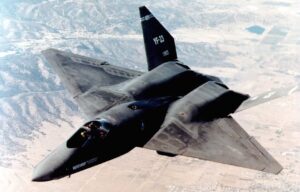
Northrop, later merged into Northrop Grumman, built a strong reputation as one of North America’s leading military aircraft manufacturers, known for advanced and unconventional designs. This made the company a natural competitor when the U.S. Air Force sought a successor to the McDonnell Douglas F-15 Eagle.
Northrop’s entry, the YF-23—dubbed the “Black Widow II”—competed directly against Lockheed’s prototype in a highly publicized evaluation program. Although the YF-23 ultimately lost the contract, it is still regarded as an impressive engineering achievement and an important milestone in the evolution of next-generation fighter aircraft design.
Replacing the McDonnell Douglas F-15 Eagle

The Northrop YF-23 was developed as part of the US Air Force’s Advanced Tactical Fighter (ATF) program, which required a replacement for the aging F-15 Eagle. In service since the mid-1970s, the F-15 was beginning to struggle against newer Soviet fighters, like the Mikoyan MiG-29 and Sukhoi Su-27.
The ATF program listed several requirements. The new aircraft needed to excel in both air superiority and ground attack roles, ensuring its effectiveness in a wide range of combat scenarios. It also had to incorporate cutting-edge advancements in stealth, power and flight-control systems.
Developing the Northrop YF-23


As aforementioned, the Northrop YF-23’s diamond-wing design reduced its radar cross-section, making it more stealthy than its predecessors. It could also reach a top speed of March 2.2, thanks to two turbofan engines, with a unique standout feature being the aircraft’s ability to “supercruise” – maintaining supersonic speeds without the use of afterburners. This not only contributed to its stealth capabilities, but also helped conserve fuel.
Keeping in line with the US Air Force’s requirement for the use of state-of-the-art flight equipment, the YF-23 featured a fly-by-wire control system and an advanced radar system, the latter of which allowed for long-range target detection and tracking. For those not familiar with aerial combat, this meant the fighter could be effective in both air-to-air and air-to-ground missions.
The YF-23 was designed to carry an M61 Vulcan as its primary weaponry, with an internal bay that was large enough to carry four AIM-120 AMRAAM or AIM-7 Sparrow medium-range missiles, along with two AIM-9 short-range missiles.
Losing out to Lockheed’s design

Unfortunately, the Northrop YF-23 wasn’t the design the US Air Force chose to enter production. While it hit much of what the service wanted, there’s was one issue that couldn’t be overlooked: its lack of maneuverability. As aforementioned, Lockheed’s design focused on agility, with thrust-vectoring capabilities, and this was deemed more important than the upgrades Northrop brought with its own design.
Outside of its lack of agility, Lockheed just simply had the upper hand. Its design, which later became the F-22 Raptor, was seen as more adaptable, should it be changed in the future, and the company was thought to have a better, more effective approach to program management.
With the YF-23 out of the running, the two prototypes were sent to NASA‘s Dryden Flight Research Center in California, where they continued undergoing tests, but never saw active service. They have since been put on display at the Western Museum of Flight and the National Museum of the United States Air Force.
An attempt to revive the Northrop YF-23

In the early 2000s, there was an attempt to revive the YF-23, with Northrop Grumman proposing a regional bomber variant, the FB-23. This aimed to leverage the original aircraft’s stealth and speed for long-range strike missions. While initially promising, it wasn’t meant to be, with the US Air Force opting to go with other programs emphasizing greater range and payload capacity.
More from us: Is the Shenyang FC-31 China’s Answer to the US Air Force’s F-35 Lightning II?
Surprisingly, Japan also played a role in the YF-23’s potential revival. Around the same time Northrop Grumman was looking at developing the FB-23 variant, the Asian nation was looking for a fighter aircraft to replace its aging military fleet. There was speculation that an updated version of the YF-23 would be offered up as a contender, but Japan ultimately decided to develop its own, leading to the creation of the Mitsubishi X-2 Shinshin.