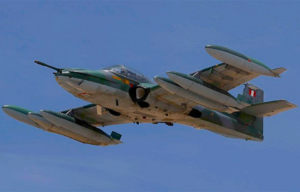
The Cessna A-37 Dragonfly was an important aircraft during the Vietnam War, and is still being used by Air Forces around the world today

Photo Credit: Galeria del Ministerio de Defensa del Perú / Wikimedia Commons CC BY 2.0

The Cessna A-37 Dragonfly was a small but highly capable attack aircraft developed from the Cessna T-37 Tweet, which led to its nickname, “Super Tweet.” Built mainly for close air support and counterinsurgency missions, the Dragonfly became an important aircraft for the United States Air Force during the Vietnam War.

After the war, the A-37 remained in service with several allied air forces, where it flew thousands of combat and patrol missions. Even decades after its original 1960s design, the Dragonfly continues to operate in six South American air forces, a reflection of its lasting versatility, dependability, and combat effectiveness.

Development of the Cessna A-37 Dragonfly

Cessna A-37B Dragonfly in flight
South Vietnamese-flown Cessna A-37B Dragonfly with the 516th Fighter Squadron on its way to attack Viet Cong positions in Ba-To, near Da Nang. (Photo Credit: United States Air Force / Wikimedia Commons / Public Domain)

In the early 1960s, as the US became more involved in Vietnam, the need arose for a counter-insurgency (COIN) aircraft. COIN operations included forward air control (FAC), reconnaissance, air escort and ground support missions.

In 1962, the Air Force’s Special Air Warfare Center looked at the T-37C as the aircraft to fill this role. Seen as a promising fit with the necessary modifications, the service contracted Cessna for two prototypes. The YAT-37D was produced with shorter wings (three pylons on each), larger wingtip fuel tanks, a General Electric minigun, improved avionics and a more robust landing gear. The first prototype flew in October 1964. 

Despite positive results, the program was stopped as interest faded. The decision seemed definite, with one of the prototypes being sent to the National Museum of the United States Air Force at Wright-Patterson Air Force Base, Ohio for public display (which it would do after being retired for a second and final time in 1970).

Continued escalation in Vietnam saw the increased loss of Douglas A-1 Skyraiders, renewing the need for a COIN aircraft. The Air Force, again, contracted Cessna for 39 AT-37Ds, which were later re-designated as A-37As, for testing. In 1967, to fast track the aircraft’s development, the A-37 was sent to Vietnam for combat evaluations.

Cessna A-37 Dragonfly specs

Minigun compartment in the right nose of a Cessna D-37B Dragonfly
Cessna A-37B Dragonfly minigun compartment. (Photo Credit: U.S. Air Force / Wikimedia Commons / Public Domain)

The A-37 Dragonfly carried a surprisingly powerful weapons load for an aircraft of its size. A single 7.62 mm General Electric GAU-2B/A minigun was installed on the right side of the nose, while its armament options also included bombs, napalm, SUU-11/A minigun pods, and rocket packs. Equipped with eight hardpoints—three beneath each wing and two under the fuselage—the aircraft was capable of carrying as much as 3,000 pounds of bombs, rockets and missiles.

Fuel tanks were fitted to the wingtips, and propulsion came from a pair of General Electric J85-GE-17A turbojet engines. Producing 2,400 pounds of thrust each, these engines allowed the A-37 to reach speeds between 485 and 507 mph.

Baptism by fire

Cessna T-37 Tweet in flight
Cessna T-37 Tweet with the 85th Flying Training Squadron. (Photo Credit: Staff Sgt. Andy Dunaway / United States Air Force / Wikimedia Commons / Public Domain)

The first A-37A Dragonflies were sent to Vietnam in August 1967 as part of the Combat Dragon evaluation program, during which they flew close air support, FAC, helicopter escort and night interdiction missions.

This baptism by fire was unusual. As Lon Holtz, who piloted A-37s, McDonnell Douglas F-4 Phantom IIs and General Dynamics F-16 Fighting Falcons, stated in an interview with Smithsonian Magazine, “No other aircraft had ever gone into combat that hadn’t been tested previously. Other fighters were proven here in the States […] That’s not the case with the A-37. This aircraft went over to prove itself in combat.”

At the conclusion of Combat Dragon in December 1967, the A-37A had flown 3,000 missions and not a single aircraft had been downed by enemy fire. The only two lost were due to landing accidents. The A-37 Dragonfly had proven itself.

That being said, some issues were realized, mainly around the A-37’s lack of range and endurance. These and other problems were taken into consideration, leading Cessna to develop the A-37B. Purpose built, unlike the “A” variant, it featured larger fuel tanks, a refueling probe on the nose, a heavier fuselage and a stronger engine. 

Service during the Vietnam War

Two Cessna A-37B Dragonflies in flight
South Vietnamese-flown Cessna A-37B Dragonflies with the 74th Tactical Wing. (Photo Credit: USAF / Wikimedia Commons / Public Domain)

In combat, the A-37 Dragonfly enjoyed pinpoint accuracy that others did not. Unlike swept wing aircraft that flew at high speeds, it was able to slow attack runs to only 100 MPH. This resulted in an average hitting range within a 45 foot radius of a target. As one forward air controller remarked, “Thank God, now I have somebody who can actually hit the d**n target.”

During the Vietnam War, A-37s were used by the Republic of Vietnam Air Force, as well as the US Air Force. In total, the aircraft flew 68,471 missions between 1967-74 (some sources say more than 160,000 combat sorties), focused on regions in South Vietnam. Despite valiantly taking part in the air war, the A-37 has been largely overlooked in favor of Vietnam’s “Heavy Metal,” including the F-4 Phantom II, the North American F-100 Super Sabre and the Republic F-105 Thunderchief. 

After the conflict, the A-37 continued to serve with the Air National Guard and Air Force Reserve, before being replaced by the Fairchild Republic A-10 Thunderbolt II.

Cessna A-37 Dragonfly in Central and South America

Cessna A-37 Dragonfly in flight
Honduran Air Force Cessna A-37 Dragonfly during the “Ahuas Tara” combined US/Honduran training exercise. (Photo Credit: TSGT KEN HAMMOND / Wikimedia Commons / Public Domain)

Beyond its service during the Vietnam War, the Cessna A-37 Dragonfly earned a strong and lasting reputation throughout Central and South America. Exported widely in the 1970s, the aircraft became popular with regional air forces because of its durable design and relatively simple maintenance needs. Its small size, long operating range, and ability to fly from short or rough runways made the Dragonfly especially effective in counterinsurgency missions and anti-narcotics operations.

More from us: The Vought F-8 Crusader was Nicknamed the ‘Last of the Gunfighters’

In 1983, El Salvador purchased 21 Cessna A-37B Dragonfly aircraft along with nine Cessna OA-37B Dragonfly models to replace its aging Dassault Ouragan fleet. The aircraft were quickly put into service during the Salvadoran Civil War. By the end of the conflict, only nine of the original Dragonflys were still airworthy, reflecting the heavy operational strain placed on the fleet.

Today, the A-37 remains in service with the air forces of six countries: Colombia, El Salvador, Guatemala, Honduras, Peru, and Uruguay. It continues to be valued for its dependability, flexibility, and effectiveness in reconnaissance and counterinsurgency operations.

Ryan McLachlan

Ryan McLachlan is a historian and content writer for Hive Media. He received his Bachelor of Arts in History and Classical Studies and his Master of Arts in History from the University of Western Ontario. Ryan’s research focused on military history, and he is particularly interested in the conflicts fought by the United Kingdom from the Napoleonic Wars to the Falklands War.

Ryan’s other historical interests include naval and maritime history, the history of aviation, the British Empire, and the British Monarchy. He is also interested in the lives of Sir Winston Churchill and Admiral Lord Nelson. Ryan enjoys teaching, reading, writing, and sharing history with anyone who will listen.

In his spare time, he enjoys watching period dramas such as Murdoch Mysteries and Ripper Street and also enjoys reading classical literature and Shakespeare. He also plays football and is an afternoon tea connoisseur.