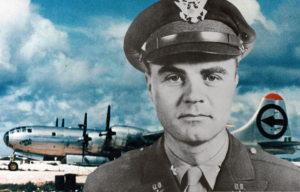
The American pilot who dropped the first atomic bomb on Hiroshima chose not to have a funeral or gravestone

Photo Credit: 1. Universal History Archive / Universal Images Group / Getty Images 2. Bettmann / Getty Images

In 2007, Brig. Gen. Paul Tibbets—the pilot who led the Enola Gay mission during the atomic bombing of Hiroshima—made a striking decision about how he wished to be remembered. Before his death, he requested that there be no funeral ceremony, no public memorial service, and no grave marker placed at his burial site.

Because of his connection to one of World War II’s most consequential events, the choice has continued to spark discussion and interpretation. Many have viewed his request as reflecting the immense burden associated with his wartime role, along with the decades of controversy, criticism, and public attention that followed him throughout his postwar life.

Paul Tibbets enlists with the US Army Air Corps

Paul Tibbets standing in front of the Enola Gay
Paul Tibbets next to the Boeing B-29 Superfortress Enola Gay that he piloted during the atomic bombing mission over Hiroshima, Japan, 1945. (Photo Credit: Bettmann / Getty Images)

Paul Tibbets was an abdominal surgeon before joining the U.S. Army Air Corps (USAAC). He originally signed up for a three-year commitment and earned his pilot wings in 1938. When World War II started, he decided to stay on active duty. While he’s best known for his role in the Pacific Theater, Tibbets actually flew bombing missions over North Africa and France first. He also served as General George Patton’s personal pilot from 1940 to 1941.

Paul Tibbets was a test pilot for the Boeing B-29 Superfortress

Boeing B-29 Superfortress in flight
Boeing B-29 Superfortress. (Photo Credit: wallycacsabre / Wikimedia Commons CC BY 2.0)

In the autumn of 1943, Paul Tibbets was called back to be a test pilot during the development of the Boeing B-29 Superfortress. He discovered that, by removing armor plating and armaments, the bomber became 7,000 pounds lighter and performed better. After a year, he was assigned to retrain other pilots in the 17th Bombardment Operational Training Wing (Very Heavy).

In 1944, Tibbets was appointed to lead the 509th Composite Group, which was tasked with the training and deployment of atomic bombs from B-29s.

Bombing of Hiroshima

Crew of the Enola Gay standing together
Crew of the Enola Gay before takeoff. (Photo Credit: John van Hasselt / Sygma / Getty Images)

In May 1945, Paul Tibbets and his crew relocated to Tinian, conducting routine bombing missions over Japanese-occupied islands while also training with atomic bomb prototypes.

When the 509th group received authorization to target Japan, Tibbets took command of the bomber chosen to deliver Little Boy, the atomic bomb dropped on Hiroshima. He named the aircraft Enola Gay, in honor of his mother.

Dropping Little Boy

Ground crewmen sitting beneath the Boeing B-29 Superfortress 'Enola Gay'
Little Boy being loaded into the Boeing B-29 Superfortress Enola Gay, 1945. (Photo Credit: US War Department / Office of the Chief of Engineers / Manhattan Engineer District / National Archives and Records Administration / Wikimedia Commons / Public Domain)

On August 6, 1945, Paul Tibbets flew the mission that dropped the Little Boy atomic bomb on Hiroshima, accompanied by his crew and two observation planes. Tibbets later described seeing a massive mushroom cloud quickly form and rise over the city after the detonation.

Tibbets did not take part in the second mission over Nagasaki, although several members of his crew did. He is historically regarded as the first person to deploy an atomic bomb against an enemy city.

Paul Tibbets returns home as a war hero

Crew of the Enola Gay riding in an open-top Jeep
The crew of the Enola Gay parading around the streets of New York, April 15, 1946. (Photo Credit: Keystone-France / Gamma-Keystone / Getty Images)

Paul Tibbets, a key figure during World War II, was awarded the Distinguished Service Cross for his crucial contributions to the war effort, and he was personally recognized by President Harry Truman during a White House ceremony.

However, Tibbets became a lightning rod for controversy in 1976 when he participated in a re-enactment of the Hiroshima bombing at an airshow in Harlingen, Texas. The event sparked outrage in Japan, prompting a formal apology from the U.S. government. Tibbets explained that his participation wasn’t meant to insult anyone.

Throughout his life, Tibbets firmly defended the atomic bombings, arguing they were essential for ending the war, even though he wasn’t proud and openly acknowledged the tragic loss of life they caused. His complex feelings about the destruction and ethical implications of nuclear warfare likely played a role in his wish to avoid a funeral or headstone, preferring not to become a symbol or focus of further debate.

Paul Tibbets’ final resting place

Paul Tibbets and Tom Ferebee sitting in the cockpit of the Enola Gay
Brig. Gen. Paul Tibbets and bombardier Tom Ferebee in the cockpit of the Enola Gay, 1981. (Photo Credit: Ben Martin / Getty Images)

In the final years of his life, Paul Tibbets was determined that his death should not revive controversy surrounding his involvement in the atomic bombing of Hiroshima. Concerned that a gravesite or public memorial might attract protests from anti-nuclear activists and others opposed to the mission, he decided against a conventional funeral and asked that no permanent monument bearing his name be created.

Tibbets instead requested cremation and instructed that his ashes be scattered over the English Channel, an area closely connected to his wartime service as an aviator. Following his death on November 1, 2007, at age 92, his family carried out his wishes in a private ceremony, giving him a quiet farewell over waters associated with a mission that permanently shaped the course of world history.

Rosemary Giles

Rosemary Giles is a history content writer with Hive Media. She received both her bachelor of arts degree in history, and her master of arts degree in history from Western University. Her research focused on military, environmental, and Canadian history with a specific focus on the Second World War. As a student, she worked in a variety of research positions, including as an archivist. She also worked as a teaching assistant in the History Department.

Since completing her degrees, she has decided to take a step back from academia to focus her career on writing and sharing history in a more accessible way. With a passion for historical learning and historical education, her writing interests include social history, and war history, especially researching obscure facts about the Second World War. In her spare time, Rosemary enjoys spending time with her partner, her cats, and her horse, or sitting down to read a good book.

linkedin.com/in/rosemary-giles