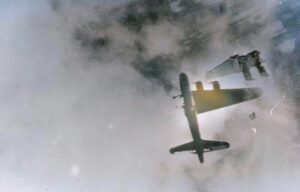
As the Second World War neared its end, Allied bombers continued launching intense strikes aimed at crippling what remained of Germany’s military and industrial capacity. One such mission involved Wee Willie, a B-17 Flying Fortress assigned to the 322nd Bomb Squadron. On April 8, 1945, while returning from a bombing run, the aircraft came under heavy German anti-aircraft fire.
A direct hit tore through Wee Willie’s fuselage, igniting a fierce blaze and sending the bomber spiraling out of control. Nearby crews could only watch in disbelief as the aircraft broke apart midair, descending in flames and smoke. In a somber turn, another airman managed to photograph the bomber’s final moments—images that would later stand among the most haunting visual records of the air war over Europe.
Today, those photographs remain a powerful testament to the bravery of bomber crews, who repeatedly flew into extreme danger knowing that any mission could be their last.
Boeing B-17G Flying Fortress Wee Willie

Wee Willie, a B-17G-15-B0 with the serial number 42-31333, was the 302nd B-17G Flying Fortress produced at Boeing Airplane Company’s Plant 2 in Seattle, Washington. Delivered to the US Army Air Forces in Cheyenne, Wyoming, in October 1943, the heavy bomber was later transported to RAF Bassingbourn in Cambridgeshire, United Kingdom.
Once in the UK, Wee Willie was assigned to the 322nd Bombardment Squadron (Heavy), part of the 91st Bombardment Group (Heavy), 1st Air Division, 8th Air Force.
At the time of its loss, the aircraft held the distinction of being the longest-serving aircraft within the 91st and was among the final planes to be lost to enemy action before the German surrender.
Preparing to bomb German railroad facilities


During the mission, German anti-aircraft fire caused minor damage to 13 Allied bombers and severely damaged four others. Out of the 73 aircraft participating, only two were completely lost, including the B-17G Wee Willie. Wee Willie was hit directly by an 88 mm flak shell between its #2 engine and bomb bay, sending it into a steep, vertical dive.
An eyewitness described the scene: “The fuselage was on fire and when it had dropped approximately 5,000 feet [1,524 meters] the left wing fell off. It continued down and when the fuselage was about 3,000 feet [914.4 meters] from the ground it exploded and then exploded again when it hit the ground.”
Wee Willie had a crew of nine, with Lt. Fuller as the sole survivor. Reports suggest he was ejected from the cockpit by the initial explosion, successfully deployed his parachute, and landed safely. However, he was captured by German forces shortly after landing, and his fate following the incident remains unknown.
The entire event was documented on film by an automatic strike camera mounted on another B-17, capturing footage from the release of the first bombs until the film ran out.
Loss of the Boeing B-17G Flying Fortress Times A-Wastin’

Lt. Mike Fodroci, a navigator on another B-17, witnessed the moment Times A-Wastin’ was destroyed. He later recalled that German anti-aircraft fire hit the bomber in its bomb bay, likely killing Lt. Pastras instantly.
“The ship pulled up and veered to the right, climbing directly over our ship,” he recalled. “Captain Shelby put our ship into a dive so steep that I was thrown up against the astro hatch of the ceiling of the nose – seems I hung there for a brief second or two. I also observed that a bad fire was burning on the aircraft’s forward bomb bay area and that the co-pilot was trying to climb out of the small window with his back pack on. Somehow, we saw three chutes emerge from #504 as she spun toward the earth.”
Out of the crew aboard Times A-Wastin’, only two survived. Radio operator Bob A. Smith and flight engineer/top turret gunner Lyle Jones were captured by the Germans and, like Lt. Fuller, became prisoners of war.
Despite the loss of two bombers, the mission was deemed a success

More from us: What Is the Real Story Behind WWII’s Famous Crying Child-Soldier Photograph?