USS Pueblo (AGER-2) prior to becoming a spy ship

Constructed in 1944 as the Banner-class cargo ship FP-344/FS-344 for the U.S. Army, the vessel spent her early years away from active combat. In April 1945, responsibility for the ship transferred to the U.S. Coast Guard, which used her to train civilians preparing to enter Army service during the closing months of World War II. She continued in this relatively quiet training capacity until she was decommissioned in 1954, after which she largely disappeared from public view.
More than ten years later, the ship was brought back into active service and extensively modernized. After being recommissioned as USS Pueblo (AKL-44), she initially served as a light cargo vessel before receiving a new classification as AGER-2 and the official designation of an “environmental research vessel.”
Despite that seemingly routine title, the ship’s true purpose was far more secretive. Her conversion transformed USS Pueblo into a signals intelligence platform fitted with communications interception and surveillance equipment. While outwardly conducting research, she was assigned to gather electronic intelligence on behalf of the Office of Naval Intelligence and the National Security Agency, supporting covert Cold War operations during a time of escalating tensions involving North Korea and the wider Soviet bloc.
USS Pueblo (AGER-2) is deployed to North Korea

By 1967, the USS Pueblo had completed shakedown training and was prepared for its first espionage mission. On January 5, 1968, the ship set sail with the goal of gathering intelligence on both North Korea and the Soviet Navy. Eleven days later, the Pueblo reached the 42nd parallel, ready to patrol the North Korean coastline while staying at least 13 nautical miles away from shore.
On January 23, 1968, North Korea launched an attack on the Pueblo. The spy ship was spotted by a submarine chaser, which issued an ultimatum: surrender or face fire. Although the Pueblo tried to flee, its slower speed made it impossible to evade the threat.
The submarine chaser was soon joined by four torpedo boats, another chaser, and two Mikoyan-Gurevich MiG-21 aircraft. Armed with only a few handguns and two M2 Browning machine guns, the Pueblo and her crew were severely outgunned. Despite this, they put up resistance for as long as possible to prevent the North Koreans from boarding.
North Korea captures the USS Pueblo (AGER-2)

As the USS Pueblo neared the North Korean port of Wonsan, the crew rushed to destroy classified documents and intelligence records. The process forced the ship to slow down, making it an easier target for the approaching enemy.
North Korean patrol boats soon attacked with machine-gun fire and a 57 mm cannon. During the assault, crewman Duane Hodges was killed, while two others, including U.S. Marine Sgt. Bob Chicca, were wounded. North Korean forces then boarded and captured the ship, blindfolding the crew and tying their hands.
After being taken ashore, the crew members were subjected to harsh treatment and repeated physical abuse while in North Korean captivity.
American sailors were held captive for months

Signing the three A’s document

At the time of the USS Pueblo’s capture, the United States was deeply involved in the Vietnam War. Concerned that tensions with North Korea could escalate, American officials pursued a diplomatic approach to address the crisis. After nearly a year, both nations reached an agreement that allowed for the safe return of the Pueblo’s crew.
On December 23, 1968, US Army Maj. Gilbert Woodward signed a document known as the “three A’s agreement,” drafted by North Korean authorities. This agreement required the United States to acknowledge wrongdoing, apologize, and pledge to prevent similar incidents in the future.
Following this, the crew members were released and returned to the United States, while the Pueblo remained in North Korean possession. Initially displayed in Wonsan and Hŭngnam, the vessel was eventually moved to the Victorious Fatherland Liberation War Museum in Pyongyang.
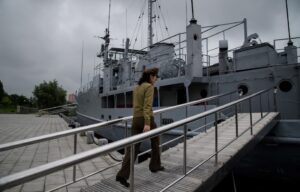
USS Pueblo (AGER-2) is still held captive

When North Korean forces took control of the USS Pueblo, they also captured 10 encryption devices and thousands of highly classified documents—marking one of the most damaging intelligence losses of the Cold War. The trove of secret material offered North Korea and its allies, including the Soviet Union, a rare window into U.S. surveillance techniques and communication codes.
Remarkably, the Pueblo is still listed as an active commissioned vessel by the U.S. Navy, despite being held in enemy territory since 1968. Now docked in Pyongyang, the ship has been transformed into a museum exhibit and a powerful symbol of North Korean propaganda. It undergoes regular maintenance and has even received commemorative paint jobs to coincide with national observances like the anniversary of the Korean War.
In response to North Korea’s ongoing defiance and a renewed U.S. designation as a state sponsor of terrorism in 2017, surviving crew members and the families of deceased sailors filed a lawsuit under the Foreign Sovereign Immunities Act. In 2021, a U.S. court awarded them $2.3 billion in damages. Still, collecting on that judgment remains a long shot, as there are no straightforward financial links between the United States and North Korea.