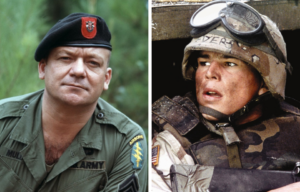
Army Ranger vs Green Beret

The U.S. Army Rangers and Green Berets represent the pinnacle of American military capability, yet each is structured for a distinct mission profile. Rangers operate as agile light infantry, trained to strike swiftly in high-intensity engagements such as raids, airfield seizures, reconnaissance missions, and combat rescues. Their motto, “Rangers Lead the Way,” reflects their role as frontline shock troops, designed to seize initiative and dominate in direct combat.
In contrast, Green Berets typically operate in small, cohesive teams, often behind enemy lines or within politically sensitive regions. Their focus lies in unconventional warfare, including training and advising allied forces, counterterrorism, foreign internal defense, and supporting insurgencies when strategically necessary. The motto “De Oppresso Liber,” or “To Free the Oppressed,” underscores their mission of empowering local partners and achieving influence through indirect, adaptive operations.
Although both units fall under U.S. Special Operations Command and share overlapping capabilities, their strengths complement one another: Rangers provide rapid, overwhelming force, while Green Berets offer strategic reach and cultural expertise. Together, they give U.S. forces versatile tools to address challenges across the full spectrum of military conflict.
Army Ranger training requirements

A major distinction between U.S. Army Rangers and Green Berets lies in how personnel qualify for their respective roles. Army soldiers who are 18 years old or older and satisfy the necessary eligibility, fitness, and medical requirements may attend Ranger School. Civilians who want to pursue service with the Rangers can instead enlist under an Option 40 contract, giving them the chance to enter the 75th Ranger Regiment’s selection pipeline once they have completed the required initial training.
Completing Ranger School, a rigorous leadership course, earns a soldier the Ranger Tab but does not by itself grant membership in the 75th Ranger Regiment. To serve in the regiment, candidates must also complete the separate Ranger Assessment and Selection Program (RASP).
Green Beret training requirements

Becoming a Green Beret involves a significantly more difficult path. Soldiers already serving in the Army must complete a minimum of three years of service and hold the rank of E-3, or private first class, before they can apply for the Special Forces. Those with no prior military experience can instead enlist under an 18X contract, allowing them to pursue the Green Berets after completing Basic Training and the Basic Airborne Course (BAC).
Applicants accepted into the selection process first attend the two-week Special Operations Preparation Course (SOPC), a physical conditioning program designed to prepare them for the challenges of the Special Forces Qualification Course (SFQC), commonly known as the “Q” Course.
Candidates must then complete the Special Forces Preparation Course (SFPC), which evaluates their physical abilities and land navigation skills. The course is intentionally demanding to eliminate those who are not yet ready for the Q Course. Successful participants continue to the Special Forces Assessment and Selection (SFAS), a three-week evaluation that measures intelligence, physical fitness, motivation, trainability, judgment, and influence.
Only after completing each of these stages are soldiers eligible to move on to the Q Course.
Ranger Assessment and Selection Process (RASP)

Special Forces Qualification Course (SFQC)

For a soldier to become a Green Beret, they must endure the Q Course, a one-to-two-year process that’s split into six phases to churn out skilled Special Forces members.
The first phase is course orientation and history. Lasting seven weeks, it teaches candidates the core mission and tasks of the US Army Special Forces and the various military occupational specialties (MOS). The second focuses on language and culture, with soldiers expected to become experts in the language and culture they’re assigned, through 18-24 weeks of training and education.
The third is small-unit tactics and lasts for 13 weeks. Throughout, soldiers become skilled marksmen, and are trained in urban warfare operations, sensitive exploitation procedures, and complete Survival, Evasive, Resistance, and Escape (SERE) training.
The fourth phase – MOS training – assigns candidates into their respective fields: detachment commander, engineer sergeant, medical sergeant, weapons sergeant or communications sergeant. The fifth consists of the Unconventional Warfare Culmination Exercise – Robin Sage, which takes four weeks. The soldiers are dropped into a fictional environment of political instability, and told to plan and apply their skills to overcome the challenges of overthrowing a faux-guerrilla regime.
More from us: There’s a Big Difference Between the FBI and CIA
The sixth and final phase of the Q Course is what all candidates hope to reach: graduation. Here, those who’ve completed their training are awarded their green beret, officially making them members of the Army’s Special Forces.