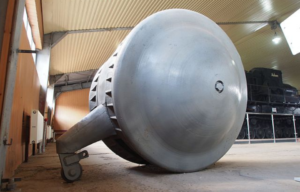
The Kugelpanzer was a seemingly useless vehicle
Historians are still puzzled by the Kugelpanzer because no surviving records clearly explain why it was built or what it was meant to do. Nearly everything known about the vehicle is based on informed speculation rather than confirmed documentation. The most widely accepted theory is that it was built by Krupp, the well-known German company that produced many of the weapons and armored vehicles used by Germany during World War II.

It was probably only operated by one person
The vehicle’s compact dimensions indicate that it was designed to carry a single person. Its engine sat behind the operator, while the steering wheel was positioned at the rear. This arrangement helped maintain balance and stability as the large wheels rotated.

However, other aspects of the design remain uncertain. Russian Popular Mechanics reports estimates suggesting that the Kugelpanzer was probably quite slow, with a top speed of roughly 5 miles per hour. The narrow opening at the front likely served as a viewing slit and may also have accommodated a machine gun, possibly a 7.92mm MG-34 or MG-42.
Only a single Kugelpanzer survived World War II
Most knowledge of the Kugelpanzer comes from a single vehicle captured by the Red Army in 1945 after it was recovered from Japan’s Kwantung Army in Manchuria. Believed to be the only surviving example, it is now housed at the Kubinka Tank Museum. After its capture, the vehicle was repainted, and its internal propulsion system was removed. Museum staff restored its original paintwork in 2000, providing a rare glimpse of its intended appearance.

The exact makeup of the Kugelpanzer‘s armor is still unknown because officials have not permitted samples to be removed for analysis. There is also no verified evidence that the vehicle, or any comparable design, ever saw combat service, especially on the European front.
In appearance, the Kugelpanzer bears some resemblance to other unconventional armored vehicle concepts, such as the First World War Treffas-Wagen, Russia’s Tsar Tank, A.J. Richardson’s Tumbleweed Tank, and the one-wheeled War Tank. Despite these similarities, none of those machines match the Kugelpanzer‘s unusual and distinctive design.
Japan’s kamikaze strategy
Speculation about the Kugelpanzer’s intended role spans several possibilities. The most widely accepted theory suggests it served as a light reconnaissance vehicle. However, others argue it may have been designed for infantry support or for laying communication cables along the front lines. The most provocative idea, however, is that it was developed for the Imperial Japanese Army and possibly intended for use in kamikaze-style missions during the Pacific campaign of World War II.

By 1944, Japanese pilots had begun intentionally diving their aircraft into enemy targets to cause maximum destruction, fully aware that such missions would cost them their lives. As the year progressed and Japan’s situation grew increasingly dire, the Imperial Japanese Army formally incorporated these suicide attacks into its military strategy—prompting the development of specialized vehicles and equipment to support this grim new approach.
The Kugelpanzer shared features with kamikaze attack aircraft

In addition to improvising existing devices, the Japanese developed an array of new military vehicles. This included the Yokosuka MXY-7 Ohka, a kamikaze attack aircraft; manned underwater crafts like the Kaiten and Kairyū; and Shin’yō boats
More from us: How Sling Weaponry Revolutionized Warfare In The Ancient World
Given the purpose behind their designs would more than likely lead to the death of their occupants, these vehicles were often small and lightly armored. They also had little to no offensive weaponry onboard. The Kugelpanzer shared these features, leading some to theorize it was used to ram into enemy tanks.