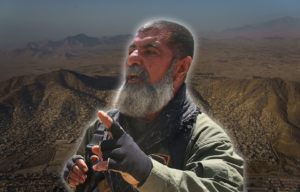
Photo Credits: 1. MARCUS YAM / Los Angeles Times / Getty Images. 2. HAIDAR MOHAMMED ALI / AFP / Getty Images (background removed, brightness, highlights, and saturation increased in Canva).
Abu Tahsin al-Salhi, famously dubbed the “Sheikh of Snipers,” earned legendary status during Iraq’s fierce campaign against ISIS. A battle-hardened veteran whose military career began in the 1973 Yom Kippur War, he brought more than forty years of combat experience, discipline, and unmatched marksmanship to the fight.
When ISIS captured large swathes of Iraqi territory in 2014, al-Salhi joined the Popular Mobilization Forces, a government-backed coalition of Shiite militias. His calm under pressure and extraordinary shooting skills quickly set him apart on the front lines.
With 384 confirmed kills—many executed at extraordinary ranges—he became both a dreaded opponent for ISIS fighters and a potent source of morale for Iraqi forces. By the time Mosul was liberated, al-Salhi had transcended the role of a lone sniper, becoming a symbol of resilience and national defiance, representing Iraq’s unwavering determination to vanquish extremist threats.
Abu Tahsin al-Salhi fought in several conflicts
Abu Tahsin al-Salhi during the fight for the city of Mosul, 2017. (Photo Credit: HAIDAR MOHAMMED ALI / AFP / Getty Images)
Abu Tahsin al-Salhi, a veteran fighter in his sixties, had taken part in several wars before joining the Iraqi Civil War, which is also referred to as the 2013–17 War in Iraq. His military service began during the 1973 Yom Kippur War, when he served with the 5th Mountainous Brigade on the Golan Heights front.
Becoming a seasoned soldier over the decades
Abu Tahsin al-Salhi during the fight for the city of Mosul, 2017. (Photo Credit: HAIDAR MOHAMMED ALI / AFP / Getty Images)
Following this, Abu Tahsin al-Salhi fought in the 1974-75 Second Kurdish-Iraqi War, the 1980-88 Iran-Iraq War, the Gulf War and the Iraq War. By the time ISIS militants pushed across the Iraq border, he was a well-seasoned soldier. Despite his age, he took up arms to defend his country against the invading enemy.
Abu Tahsin al-Salhi fought with the Popular Mobilization Units
Abu Tahsin al-Salhi, 2017. (Photo Credit: HAIDAR MOHAMMED ALI / AFP / Getty Images)
In 2015, Abu Tahsin al-Salhi joined the Popular Mobilization Units (PMU), a government-approved coalition that works alongside the Iraqi Army but operates on its own. The PMU has strong connections with Iraq’s military and security forces.
The coalition comprises around 40 militias, with around 100,000 fighters in total. While most members are Shia, the PMU also includes Sunni, Christian, and Yazidi fighters.
An exceptionally-skilled sniper
Mourners hold a portrait of Abu Tahsin al-Salhi during his funeral in the city of Basra, 2017. (Photo Credit: HAIDAR MOHAMMED ALI / AFP / Getty Images)
Abu Tahsin al-Salhi became a member of the Popular Mobilization Units (PMU), quickly gaining recognition for his extraordinary marksmanship. Credited with killing more than 300 enemy combatants, he earned a reputation for exceptional accuracy and was known by the nicknames “Hawk Eye” and the widely recognized “Sheikh of Snipers.” His skill with a rifle, combined with his unwavering dedication, led to the creation of a tribute video celebrating both his accomplishments and his commitment to the cause.
Abu Tahsin al-Salhi was dedicated to defending his country
Iraqi fighters from the Shiite Muslim Al-Abbas Popular Mobilization Units (PMU) keep position in the area surrounding the village of Dujail, in Salaheddin province, north of Baghdad, 2015. (Photo Credit: MOHAMMED SAWAF / AFP / Getty Images)
In the video, Abu Tahsin al-Salhi recalled how he was granted a month-long break from fighting. However, after just two weeks, his deep commitment to defending his country drove him to return to the battlefield.
He explained, “I’m relaxed, my mind is relaxed. Last time they gave me a month off, and after 12 days, I came back.”
Abu Tahsin al-Salhi lost his life in northwest Iraq
Iraqi mourners carry the coffin of Abu Tahsin al-Salhi during his funeral in the southern city of Basra, 2017. (Photo Credit: HAIDAR MOHAMMED ALI / AFP / Getty Images)
Abu Tahsin al-Salhi conducted many of his best-known sniper operations from Jurf al-Sakhar, later renamed Jurf al-Nasr, southwest of Baghdad, although his reputation spread across several Iraqi battlefields. His last deployment brought him to the outskirts of Hawija in northwestern Iraq, then one of ISIS’s remaining major strongholds. In September 2017, al-Salhi was killed while advancing with the militia during the campaign to retake the area, ending his long military career.
Al-Salhi was 64 when he died in combat, leaving behind a reputation that went beyond his skill as a sniper. He was highly regarded within Iraqi military circles for his accuracy, bravery, leadership, and commitment. His combat record made him a prominent symbol of resistance, while those who fought alongside him continued to remember his service and the example he established.