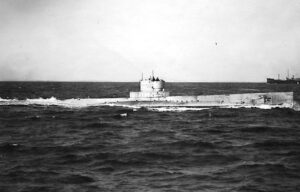
The USS R-14 (SS-91) belonged to the R-class, a series of 27 submarines constructed for the U.S. Navy between 1918 and 1919. While the design was completed near the end of World War I, nearly all of the boats entered service after the fighting had ended and never saw wartime action. Replacing the earlier O-class submarines, the R-class introduced several important upgrades, most notably the use of 21-inch (533 mm) torpedo tubes, a standard that continues to be used on modern submarines.
Every R-class submarine was equipped with a 76 mm deck gun, allowing it to engage smaller surface vessels or provide limited defense against aircraft while operating on the surface. Measuring about 186 feet long and displacing roughly 640 tons, these submarines relied on a diesel-electric propulsion system that paired two 600-horsepower diesel engines for surface operations with two 467-horsepower electric motors for submerged travel.
On the surface, the R-class was capable of speeds of approximately 12.5 knots, while underwater it could make about 10.5 knots. Although they arrived too late to participate in World War I, the innovations introduced with the class influenced future U.S. submarine designs and played a role in the continuing advancement of American undersea warfare capabilities.
USS R-14

The construction of the USS R-14 began in 1918, and she was commissioned by the end of 1919. Although she did not see active combat during WWI, the submarine played an essential role in the Pacific Fleet during peacetime, contributing to the development and refinement of submarine and anti-submarine warfare tactics. Additionally, she was involved in several search and rescue missions.
The USS R-14 remained in service throughout WWII, primarily functioning as a training vessel, and was overhauled in 1941. She was officially removed from the Naval Vessel Register in May 1945 and was dismantled in 1946.
The return to wind power

In 1921, the USS R-14 was participating in a search and rescue mission for the USS Conestoga, a US Navy ocean-going tug. Conestoga had disappeared while on her way to the South Pacific Ocean, which prompted a major search for the vessel.
In May of 1921, while surfaced and searching for the Conestoga, R-14 ran out of fuel and lost radio communications. The crew was about 100 nautical miles away from Pearl Harbor when the vessel ran out of fuel, a distance too far for her to reach on battery power alone. On top of this, the USS R-14 only carried enough food to last the crew 5 days.
The submarine was dead in the water, without any power and no way of calling for help.
Fortunately, the submarine’s engineering officer Roy Trent Gallemore came up with an unusual but smart plan. Gallemore suggested going back to the basics, and sailing R-14 to Pearl Harbor under wind power.
To do this, the crew tied together several bunk bed frames and attached them to the torpedo-loading crane in front of the conning tower. They then tied a foresail made out of eight hammocks to the bed frame assembly.
With just this one sail, R-14 began to move at a speed of 1.2 mph and gained rudder control. Gallemore’s plan was clearly working, so the crew added another sail made from six blankets to the radio mast, which increased the submarine’s speed by a further 0.58 mph. A third sail comprised of eight blankets added another 0.58 mph to the R-14‘s speed.
The submarine was eventually able to start charging its batteries. R-14 and all of its crew arrived at Hawaii 64 hours later, after a long and slow journey.
R-14‘s captain, Lieutenant Alexander Dean Douglas received a commendation for his crew’s clever problem-solving from Chester W. Nimitz, his Submarine Division Commander.
The USS Conestoga would never be found in the search, or for another 95 years. The tugboat was discovered in 2009 just off the coast of California, and its identity was confirmed in 2015.